Whether a Labradoodle Sheds Less Than a Goldendoodle
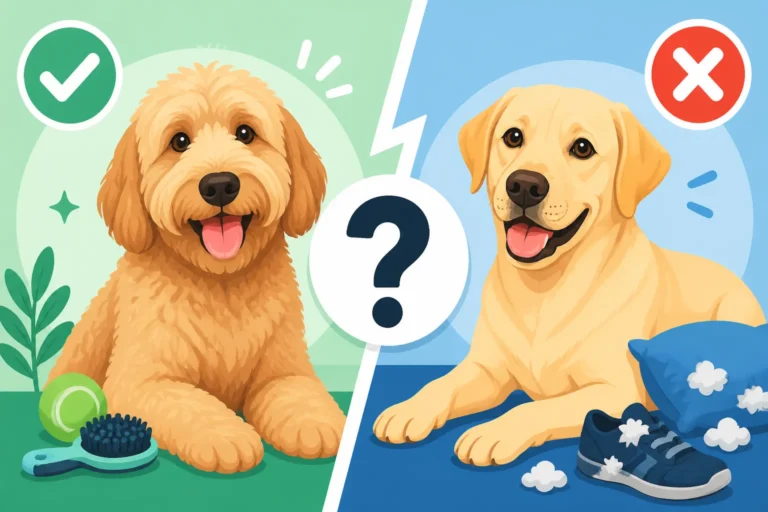
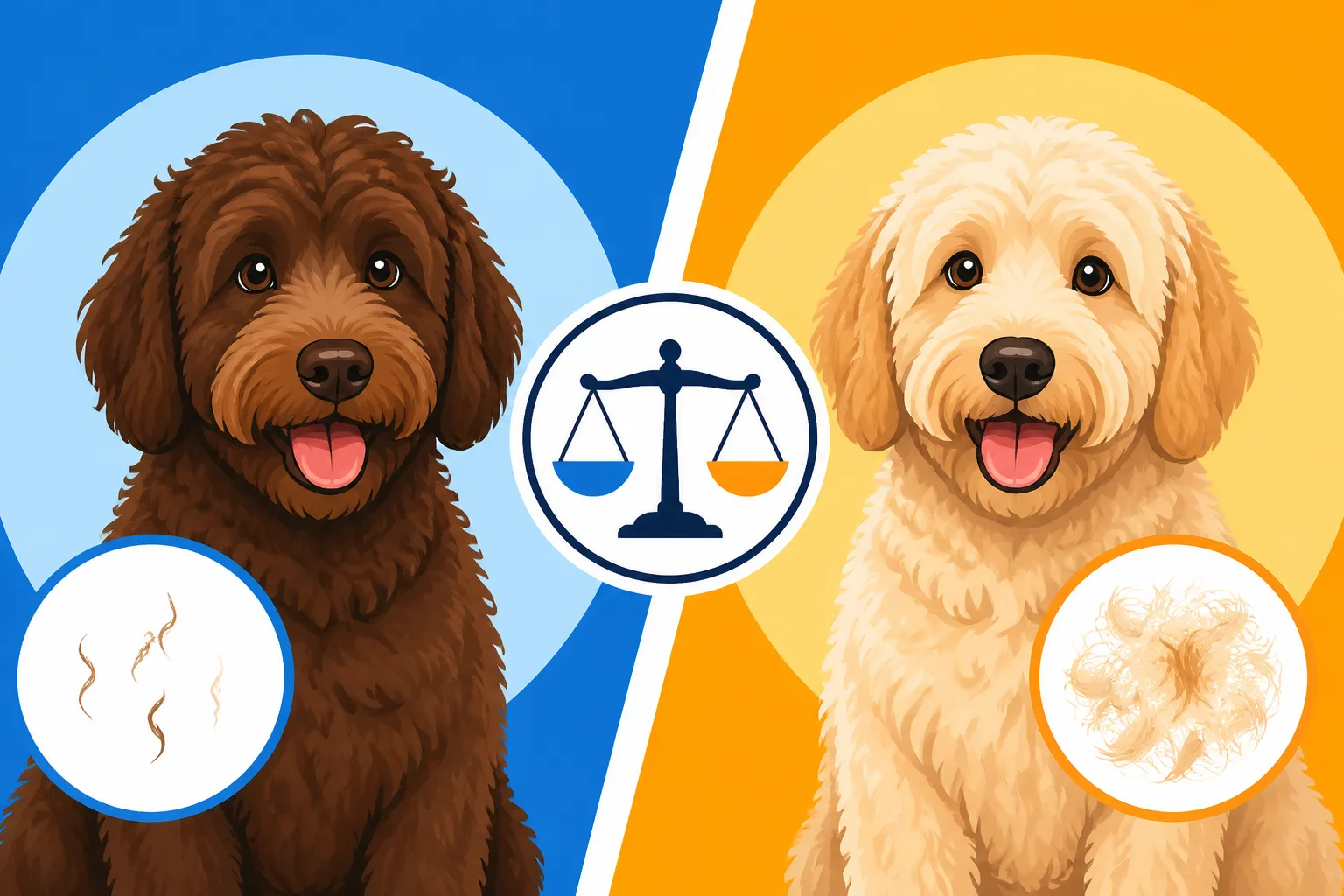
A Labradoodle does not reliably shed less than a Goldendoodle. Both are crosses with a Poodle, and both can inherit anything from a shedding coat to a low-shedding one. If you are choosing between them because of hair on the sofa—or allergies—the individual dog’s coat, parentage, and grooming needs matter more than the breed name.
Do Labradoodles shed less than Goldendoodles
There is no dependable rule that Labradoodles shed less. A Labradoodle is a Labrador Retriever–Poodle cross, while a Goldendoodle is a Golden Retriever–Poodle cross. Both can inherit coat traits from either parent, and even puppies in one litter may grow up with noticeably different coats.
A Labradoodle with a coat that takes after its Labrador parent may shed quite a bit. A Goldendoodle with a straighter, Golden Retriever-like coat may do the same. Conversely, either dog may have a curlier or fleece-like coat that releases less loose hair around the home but needs regular brushing to prevent tangles and mats.
| What you notice | Labradoodle | Goldendoodle |
|---|---|---|
| Possible coat types | Straight, wavy, or curly | Straight, wavy, or curly |
| Shedding range | Can be low, moderate, or heavy | Can be low, moderate, or heavy |
| Likely higher-shedding influence | Labrador-like coat traits | Golden Retriever-like coat traits |
| Grooming concern | Mats, especially in dense or curly coats | Mats, especially in dense or curly coats |
| Best predictor | The individual dog’s coat and family history | The individual dog’s coat and family history |
Why the breed label does not predict shedding
The word “Labradoodle” describes a cross, not one standardized coat. A first-generation Labradoodle may inherit more obvious traits from one parent, while later-generation breeding can produce different combinations. A puppy’s coat may also change as it matures, so the soft coat you see early on is not always a reliable forecast of adult shedding or grooming needs.
The same variability applies to Goldendoodles. One may have a loose, straighter coat that sheds more noticeably; another may have a curlier coat that holds loose hair within the curls. That can make a low-shedding dog look as though it barely loses hair, even though loose strands may still be caught in the coat until brushing or grooming removes them.
If a breeder describes every puppy as “non-shedding,” treat that as a promise to investigate, not a guarantee. Ask what the parent dogs’ coats are like, what shedding the breeder has observed in related litters, and whether the breeder can explain the limits of predicting coat outcomes. For more on coat inheritance, see Whether an F1 Labradoodle's Coat Is a Gamble and Whether a Labradoodle's Coat Type Can Be DNA Tested.
Which dog may leave more hair around the house
A Labradoodle might shed more than a particular Goldendoodle, but a different Labradoodle could shed less than that same Goldendoodle. The Labrador and Golden Retriever sides both have coats that can shed, while Poodle-like coat traits may reduce visible loose hair for some dogs. The balance differs from dog to dog.
Shedding can also be easy to underestimate in a curly coat. A straight-haired dog may leave fur on a dark sweater or across a hardwood floor, making the shedding obvious. A curlier dog may retain loose hairs until they are brushed out, while mats form if the coat is neglected. Less hair on the floor does not necessarily mean less maintenance.
For owners comparing the two breeds, it helps to focus on the real household question: are you prepared to brush and groom this particular coat consistently? If you are hoping for a dog that requires little cleaning and little grooming, a low-shedding coat can still surprise you with regular brushing, professional grooming, and cleanup around favorite sleeping spots.
What coat type and generation can tell you
Coat texture can offer clues, but it is not a perfect shedding forecast. Straight, wavy, and curly coats each bring different trade-offs. A straighter coat may release more visible hair, while a curlier coat may tangle more easily and require careful brushing down to the skin.
Straight, wavy, and curly coats
A straighter Labradoodle or Goldendoodle coat may be easier to comb through than a dense curl, but it can leave more loose hair on furniture, clothing, and floors. Whether that happens often or only seasonally varies by individual dog. The coat may also have an undercoat or thickness that affects how much hair is released.
Wavy coats can fall somewhere between straight and curly in appearance, but “in between” does not automatically mean low-maintenance. Wavy hair can still form mats, especially where friction occurs: behind the ears, under a collar or harness, in the armpits, and around the legs. These are common trouble spots in either cross.
Curly coats may make shedding less visible because loose hairs can get caught among the curls. That can be helpful for reducing hair scattered around the home, but the coat needs frequent, thorough brushing. A quick pass over the top is not enough if the hair underneath has started to knot. The care involved is explored in The Three Labradoodle Coats: Hair, Fleece and Wool and Brushing a Labradoodle to the Skin, Not the Surface.
Why generation is only one piece of the puzzle
People often assume that a Labradoodle or Goldendoodle with more Poodle ancestry will definitely shed less. More Poodle influence may make a curlier or lower-shedding coat more likely in some breeding programs, but it cannot guarantee an individual puppy’s adult coat or how much hair it will lose.
Generation labels also do not tell the whole story about coat quality. Two dogs with the same label can have different parents, family histories, and coat traits. If low shedding is important, ask about the actual adult coats in the puppy’s close relatives rather than relying only on terms like F1, F1b, or multigenerational.
A coat DNA panel may help identify certain inherited coat characteristics, but it is not a simple promise that a dog will never shed or trigger allergies. Ask what a test does and does not show, and consider it alongside the dog’s family history and the breeder’s observations. See Whether Later Generations Shed Less Than an F1 Labradoodle and What Makes a Labradoodle Australian for related context on coat predictability and breeding programs.
How shedding connects to grooming and allergies
It is tempting to judge a dog by the amount of fur you find in the house. But shedding is only one part of living with a Labradoodle or Goldendoodle. Coat care, cleaning routines, and allergy concerns all deserve separate consideration.
Low shedding does not mean low grooming
A curly or fleece-like coat may leave less loose hair around your home, yet need more brushing and professional coat care than a straighter coat. If brushing stops for a few weeks, small tangles can tighten into mats. Those mats may be painful, particularly when they pull at the skin or form in sensitive areas such as behind the ears and under the legs.
A practical routine usually includes checking the coat systematically rather than brushing only the obvious outer layer. Work in small sections, use a suitable brush, and follow with a comb to check whether you can reach through the coat. If the comb catches near the skin, there may be a tangle that the brush did not fully remove. Your groomer can show you the technique on your dog’s specific coat.
Keep basic tools in one place so a short brushing session is easier to fit into the week. Chewy is one place owners may look for everyday grooming supplies such as slicker brushes, combs, and detangling products; choose tools that suit your dog’s coat and ask a groomer for guidance if you are unsure. For coat-change concerns, The Coat Change That Hits a Labradoodle at Nine Months explains why a young dog’s grooming routine may need extra attention as its adult coat develops.
Shedding and allergies are not the same thing
A lower-shedding dog is not automatically allergy-safe. People can react to proteins associated with a dog’s skin flakes, saliva, and urine, not just loose hair. Hair may carry allergens around the home, but choosing a dog based only on how much fur it leaves behind does not reliably prevent allergy symptoms.
If someone in your household has allergies, spend time around the specific dog or its close relatives before committing, if possible. Pay attention to symptoms over more than a brief visit, and talk with an allergy professional about your situation. No coat type can guarantee that a person will be symptom-free.
Regular cleaning may help reduce the amount of hair and dander that accumulates, though it cannot remove the underlying risk. Wash dog bedding as appropriate, vacuum areas where the dog rests, and keep grooming supplies handy. Chewy may be a convenient place to browse tools such as lint rollers or pet-hair cleanup items, but these are household aids—not a way to make a dog hypoallergenic. For a closer look at the distinction, read Whether a Labradoodle Is Truly Hypoallergenic and Whether Dander or Hair Sets Off Allergies Around a Labradoodle.
How to choose between a Labradoodle and a Goldendoodle
If shedding is your main concern, choosing by breed name alone is a gamble. Compare individual coats and family history, then decide whether the likely grooming routine fits your home, schedule, and budget. The dog that leaves less visible hair may not be the dog that takes less work.
Questions to ask before choosing a puppy
Ask the breeder what the adult coats of the puppy’s parents are like and whether they shed noticeably. Find out how coats from previous litters developed as the dogs matured. A useful answer will acknowledge that puppies can differ and that coat changes may affect both shedding and grooming.
Also ask what brushing routine the breeder recommends, when puppies are introduced to grooming handling, and what professional grooming may be needed as the coat grows. If the answer is simply that the dogs are “hypoallergenic” or “don’t shed,” ask for clarification. Those phrases can gloss over meaningful differences between individual dogs.
If you are adopting an adult dog, you have a practical advantage: you can assess the coat that is already there. Spend time brushing the dog if possible, ask the foster or previous owner what they have noticed around the home, and check for mats or skin irritation. Consider reading Where to See Labradoodles Before You Commit before making a decision based on photos or a short meeting.
A realistic way to compare the two
Try to compare the dogs you are actually considering, not an idealized version of either cross. Notice whether loose hair is visible after petting or brushing, but remember that a single session cannot tell you exactly what to expect year-round. Ask how often the dog is brushed, how quickly its coat tangles, and what grooming has been necessary so far.
Then think about your tolerance for the whole routine. If you strongly dislike loose hair, a dog with a curlier coat may appeal—but only if you can keep up with brushing and coat care. If you prefer a simpler coat routine, you may be more comfortable with a coat that sheds more visibly but is easier to comb. Neither choice is automatically easier; the trade-off is between loose hair and coat maintenance.
For either dog, plan for regular brushing, occasional cleanup, and professional guidance when needed. Chewy can be one option for finding routine pet-care supplies, but your dog’s groomer can help identify the right brush and comb for its actual coat. The best choice is not necessarily the Labradoodle or Goldendoodle that sheds least in theory. It is the individual dog whose coat and care needs your household can realistically manage.
Disclaimer
This article is for general informational purposes only and does not constitute professional advice. Laws, prices and regulations vary by location and change over time. Consult a qualified professional for guidance on your specific situation.