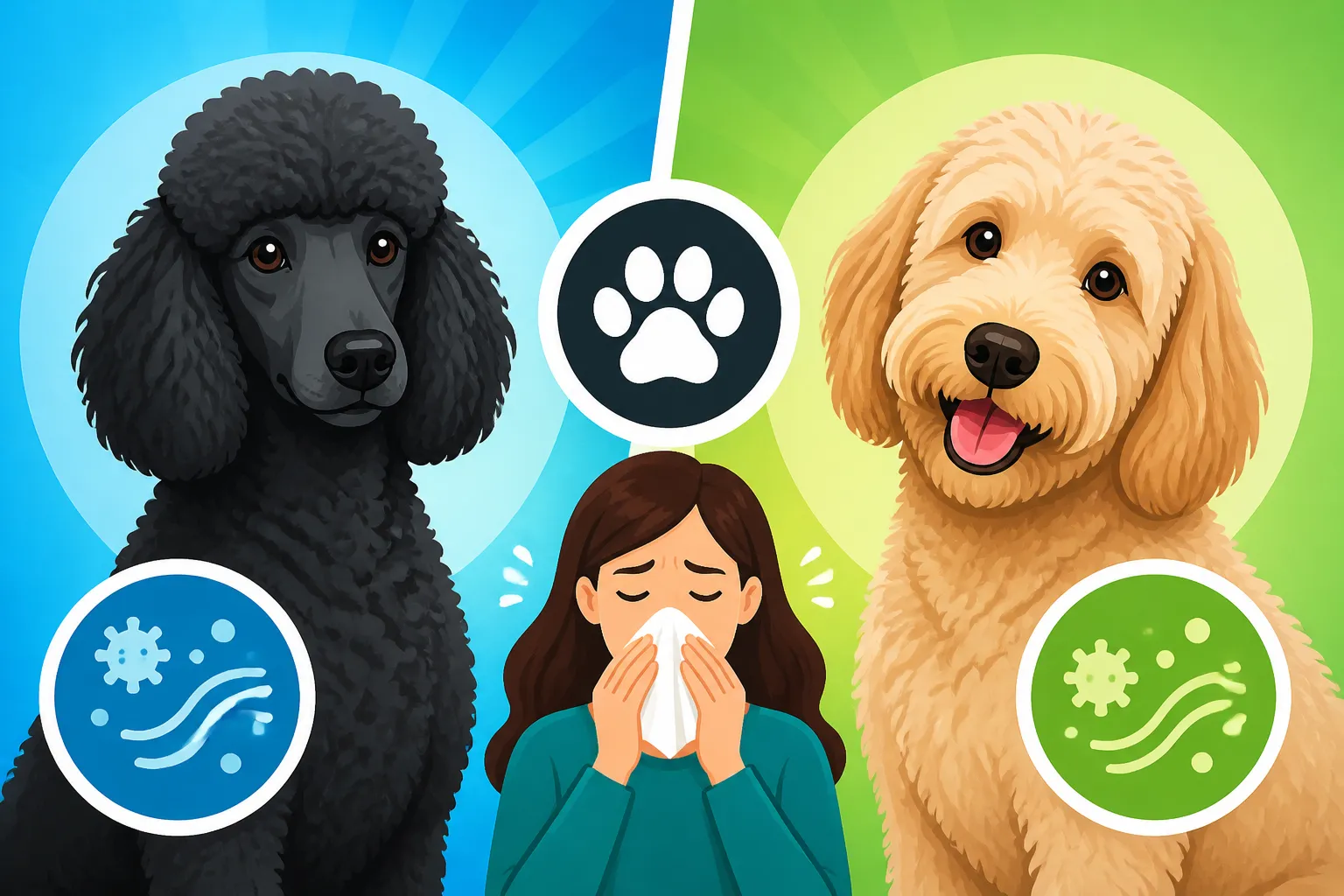
Whether a Standard Poodle Beats a Labradoodle for Allergies
Choosing between a Standard Poodle and a Labradoodle for allergies can feel like a gamble, especially when people promise one coat is “hypoallergenic.” Neither dog is guaranteed not to trigger symptoms. This guide explains what actually causes dog allergies, why a Standard Poodle may be a more predictable choice than a Labradoodle, and how to test your reaction before bringing either dog home.
Why no dog is guaranteed to be allergy friendly
The allergen is not the hair
Dog allergies are usually reactions to proteins found in a dog’s skin flakes, saliva, and urine. Hair can carry these allergens around the home, but it is not usually the allergen itself. That distinction matters: a dog that sheds very little may leave less loose hair behind, but it can still produce allergenic proteins.
People also vary in what sets off their symptoms. One person might react most when brushing a dog, while another has trouble after the dog licks their hands or sleeps on their bedding. A low-shedding coat may help reduce some loose hair and dander in a room, but it cannot remove the proteins from the dog’s body or guarantee that symptoms will be mild.
That is why “hypoallergenic” is best treated as a loose description, not a promise. If allergies are a deciding factor, it helps to learn Whether a Labradoodle Is Truly Hypoallergenic and Whether Dander or Hair Sets Off Allergies Around a Labradoodle before choosing based on coat appearance alone.
Shedding and allergens are related but not the same thing
Less shedding can mean less hair drifting onto furniture, clothing, and floors. It may also make a home easier to keep tidy. But the amount of shedding does not neatly predict whether a particular person will react to a particular dog. A low-shedding dog can still trigger symptoms, and two people with dog allergies may react differently to the same animal.
There is no simple coat test that can tell you how your body will respond. Coat texture, curl, and shedding are useful when planning grooming and cleaning, but they are not a substitute for spending time with the actual dog. For a family weighing two breeds, it’s useful to separate two questions: “How much loose hair will this dog leave around?” and “Will I personally react to this dog?”
If symptoms are significant, talk with an allergist before making a commitment. They can help you understand your triggers and discuss whether allergy testing or other medical guidance is appropriate. A breeder’s assurance, a dog’s coat description, or a short visit should not replace that advice.
Standard Poodle versus Labradoodle for allergies
Why a Standard Poodle may be more predictable
Standard Poodles generally have a dense, curly coat that grows continuously and is usually clipped rather than shed in the same way as a typical Labrador coat. Loose hairs can become caught in the curls instead of falling freely around the home. Many owners appreciate the reduced hair on clothing and floors, though the trade-off is regular brushing and professional or careful home grooming.
That coat pattern makes the Standard Poodle a more predictable bet if your main concern is loose shedding. “More predictable” does not mean “allergy safe.” Poodles still produce dander and saliva, and people can still react to them. A poodle’s coat also needs consistent maintenance; when brushing is skipped, tangles and mats can build up close to the skin.
The practical advantage is that the breed’s coat tends to be more consistent than the range you can see in Labradoodles. If you want a fuller explanation of how different Labradoodle coats affect shedding and care, see The Three Labradoodle Coats: Hair, Fleece and Wool.
Why a Labradoodle’s coat can be harder to predict
A Labradoodle is a cross between a Labrador Retriever and a Poodle, and its coat can vary. Depending on the dog’s ancestry and inherited traits, a Labradoodle may have a coat that sheds more, a wavy fleece coat, or a curlier coat that needs frequent brushing and clipping. Even puppies in the same litter can differ.
Generation labels can offer background about a dog’s parentage, but they do not guarantee a particular coat or an allergy outcome. A later-generation Labradoodle may have a coat that looks more Poodle-like, but looks alone do not establish how much the dog sheds or how a person will react. If you’re comparing generations, Which Labradoodle Generation Suits an Allergic Home and Whether Later Generations Shed Less Than an F1 Labradoodle can help explain what generation can—and cannot—tell you.
A breeder may describe a puppy as low-shedding, but that description is not a clinical allergy guarantee. Coat can change as a puppy matures, and adult grooming needs may be different from what you see in puppy photos. It’s reasonable to ask about the adult coats of close relatives, while remembering that family history still cannot predict your own symptoms with certainty.
| Consideration | Standard Poodle | Labradoodle |
|---|---|---|
| Coat predictability | Often more consistent within the breed | Can vary considerably by ancestry and individual dog |
| Loose hair around the home | Often relatively low, though individuals vary | Ranges from more noticeable shedding to low-shedding coats |
| Allergy guarantee | None | None |
| Grooming needs | Regular brushing and clipping | Depends on coat; brushing and grooming can be substantial |
| Best way to assess your reaction | Spend repeated time with the individual dog | Spend repeated time with the individual dog |
Which one is the better starting point?
If your priority is a coat that is generally less prone to shedding, a Standard Poodle may be the more straightforward starting point. Its coat is typically more consistent than a Labradoodle’s, so you may have fewer unknowns about loose hair and grooming. But if a specific Labradoodle is already part of your life or your family has found one whose coat and temperament suit you, don’t assume the cross is automatically a poor choice.
The most useful comparison is between the actual dogs you may live with, not just breed descriptions. A Standard Poodle that triggers your symptoms is not a better choice for you than a Labradoodle you tolerate well. Likewise, a low-shedding Labradoodle may still cause a reaction. Personal response should carry more weight than a label.
How to test your reaction before choosing
Spend time with the individual dog
Try to meet the dog you are considering more than once, ideally in a setting where you can spend meaningful time together. A brief outdoor greeting may not reflect what happens after a dog has been inside your home, brushed, or cuddled on the couch. If possible, arrange visits that resemble everyday contact: sitting in the same room, handling the coat, and interacting at a normal pace.
Pay attention to symptoms during the visit and afterward. Sneezing, itchy eyes, congestion, coughing, skin irritation, or breathing symptoms can appear on different timelines. Keep notes about where you were, how long you spent with the dog, and what contact you had. That record can help you discuss the situation with an allergist rather than relying on a vague memory of “I seemed fine.”
Meeting the parent dogs can provide helpful context about adult coat type, but it does not prove how the puppy will develop or how you will react to that puppy. If you are considering a Labradoodle, you can also ask how the breeder describes the coat and what grooming the adult dogs in the line need. For more guidance, read Whether an Allergic Family Should Meet a Labradoodle First and Whether a Labradoodle's Coat Type Can Be DNA Tested.
Do not make a decision from a single short visit
A quick visit can be misleading. The dog may have recently been bathed, the interaction may be too brief to bring on symptoms, or the setting may differ from the home where you’ll live together. A dog that seems comfortable during one meeting may still trigger symptoms with regular close contact.
If your allergy symptoms have been serious, do not deliberately expose yourself to a dog as a test without getting medical guidance. Breathing difficulty or severe symptoms deserve particular care. An allergist can help you decide what kinds of exposure are appropriate and how to interpret symptoms. This is especially important if someone in the household has asthma or a history of severe allergic reactions.
Also consider the household as a whole. One person may have mild symptoms while another is strongly affected. Before bringing a dog home, make sure the decision works for everyone who will share the space—not just the person who is most excited about the breed.
Reducing allergens at home if you bring a dog home
Build a practical cleaning routine
Even when a dog is a relatively low shedder, routine cleaning can reduce the amount of hair and dander that settles around the home. Wash dog bedding regularly, clean the areas where the dog rests, and consider keeping the dog out of bedrooms—particularly the bedroom of the person with allergies. A vacuum with effective filtration and washable furniture covers may make daily life easier, though no cleaning routine can eliminate all allergens.
A few simple habits are often easier to maintain than an ambitious plan that falls apart after two weeks. For example, you might wash the dog’s blanket on a regular schedule, wipe surfaces where the dog spends time, and brush the dog in a place that is easy to clean. If brushing triggers symptoms, ask another household member or a groomer to handle it.
Chewy can be one place to look for practical supplies such as washable pet bedding or grooming tools. Before buying anything, check whether the item suits your dog’s coat and whether it is easy to clean; a tool that stays unused in a cupboard will not improve your routine.
Keep grooming consistent and comfortable
Regular grooming can help prevent mats and remove loose hair, but it does not make a dog allergen-free. The right schedule depends on the coat. A curly or woolly coat may need more frequent brushing and clipping than a shorter, looser coat. A qualified groomer can help you understand what the individual dog needs and how to maintain the coat between appointments.
If you plan to brush at home, use a routine you can keep up with rather than waiting until the coat is tangled. A quick, gentle session in a ventilated area may be easier than a long grooming session indoors. Some people with allergies find it helpful to avoid brushing themselves and to wash their hands after handling the dog.
Chewy may also carry basic grooming supplies, but choose tools based on coat needs rather than marketing claims about allergy relief. Neither a brush nor a special shampoo can remove the allergens a dog naturally produces. For more on coat care, see The Line Brushing a Labradoodle Coat Needs and Whether Bathing Reduces Allergens on a Labradoodle.
Make a decision based on fit, not promises
For allergies, a Standard Poodle is often the more predictable choice for low shedding, while a Labradoodle can be less predictable because coat type varies. Neither breed is guaranteed to suit an allergic household. The dog’s individual coat, your own sensitivity, and the amount of close contact you have all matter.
Before deciding, compare adult coat care, meet the specific dog repeatedly when medically appropriate, and involve an allergist if symptoms are more than mild. Think through daily cleaning and grooming too: the most allergy-friendly plan is only useful if it fits your home and routine. Chewy can be a convenient source for washable covers and cleaning or grooming essentials, but supplies should support a realistic routine—not stand in for testing whether you can live comfortably with the dog.
Disclaimer
This article is for general informational purposes only and does not constitute professional advice. Laws, prices and regulations vary by location and change over time. Consult a qualified professional for guidance on your specific situation.