Whether a Labradoodle Is Easier Than a Labrador
A Labradoodle may seem easier than a Labrador because people often expect less shedding and a softer, more adaptable temperament. But the trade-off can be a coat that needs regular brushing and professional grooming, while exercise and training needs remain substantial. This guide compares the everyday work involved so you can judge which dog fits your home and routine.
The everyday care that makes one dog easier
Grooming is the biggest practical difference
A Labrador’s short coat is relatively straightforward: it sheds, sometimes heavily, but usually does not need professional clipping or daily detangling. You will still need to brush out loose hair, clean ears when needed, trim nails, and keep up with bathing. The fur can show up on furniture and clothing, but the routine is generally simple.
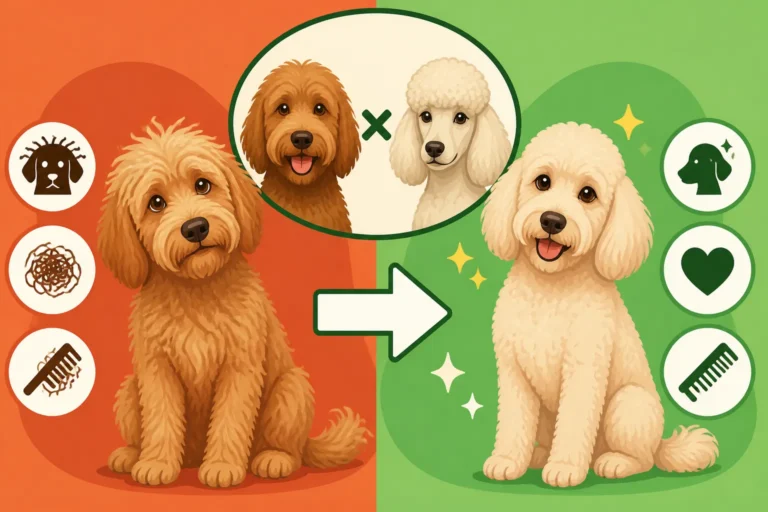
A Labradoodle’s coat can be less noticeable around the house, but “less shedding” does not mean “less work.” Hair that stays caught in a curly or wavy coat can tangle close to the skin. Without consistent brushing, small knots can tighten into painful mats, especially behind the ears, under a collar or harness, in the armpits, and around the legs. The three broad coat types—hair, fleece, and wool—can have different care needs. The Three Labradoodle Coats: Hair, Fleece and Wool
This is where a Labradoodle can be harder than a Labrador in a very ordinary, weekly way. You may need to section the coat and brush from the skin outward, rather than simply run a brush over the top. A quick surface brush can make a coat look tidy while leaving dense tangles underneath. The guide to Brushing a Labradoodle to the Skin, Not the Surface explains why that distinction matters.
| Everyday task | Labrador | Labradoodle |
|---|---|---|
| Loose hair around the home | Often noticeable, especially during shedding periods | Varies by coat; some shed, while others retain loose hair in the coat |
| Brushing | Helpful for managing shedding and keeping the coat clean | Often essential to prevent tangles and mats |
| Professional grooming | Usually limited to bathing, nails, and occasional tidy-ups | Many coats need regular clipping and coat maintenance |
| Coat predictability | Fairly consistent short coat | Can vary in texture, curl, density, and shedding |
| Exercise and engagement | Usually needs daily activity and interaction | Usually needs daily activity and interaction |
| Training | Benefits from consistent, reward-based practice | Benefits from consistent, reward-based practice |
The table describes common patterns, not a guarantee for an individual dog. Labradoodles vary considerably, and a particular dog’s coat may not match what you expected from its parents or generation.
Grooming appointments are part of the routine
Many Labradoodle owners need to plan for recurring professional grooming, with the exact timing depending on the dog’s coat, length, lifestyle, and how well it is brushed at home. A longer coat may look appealing in photos but can take more effort to keep free of tangles. A shorter clip can make home care easier, though the coat still needs attention as it grows.
That work is easiest to manage when it is built into the dog’s routine early. A puppy who learns to accept brushing, paw handling, nail care, and the sound of clippers is more likely to cope calmly as an adult. If grooming starts only after mats appear, brushing may become uncomfortable and stressful for both dog and owner. For a deeper look at appointment frequency, see The Six to Eight Week Clock on a Labradoodle's Coat.
For example, picture a household that enjoys weekend hikes and lets its dog swim. A Labrador can come home muddy and still be relatively simple to rinse and towel dry. A Labradoodle may need a thorough rinse, careful drying, and a check for tangles once the coat is clean. If the coat stays damp or is left tangled, the owner may have more work later. If you’re stocking up on a suitable brush, comb, or dog shampoo, Chewy is one place owners may look for basic grooming supplies; the right tools still depend on the coat and the dog’s tolerance for handling.
Exercise, training, and energy
Neither dog is automatically low-maintenance
Both Labradors and Labradoodles commonly need regular exercise, company, and opportunities to use their brains. A daily walk alone may not be enough for a young, energetic dog, particularly if the rest of the day consists of long periods without activity. Fetch, scent games, training exercises, swimming where safe, and food puzzles can help provide variety.
A Labradoodle may inherit the Labrador’s interest in retrieving and the Poodle’s quickness to learn, but individual dogs differ. Some are lively and persistent; others are more moderate. A Labrador is not necessarily wild, and a Labradoodle is not necessarily calm. Breed labels can hint at tendencies, but they cannot tell you exactly how much exercise an individual dog will need.
When a dog is under-stimulated, the problem may show up as jumping, chewing, barking, persistent attention-seeking, or difficulty settling. Owners sometimes interpret these behaviors as stubbornness when the dog needs a better balance of movement, training, rest, and predictable routines. The Exercise a Labradoodle Needs Before It Behaves explores how activity and behavior can be connected.
Training depends more on consistency than the mix
Labradors and Labradoodles can both be enthusiastic learners, which is useful—but enthusiasm may also mean pulling toward people, jumping up, grabbing objects, or racing after interesting smells. Reward-based training, clear household rules, and short practice sessions are valuable for either dog. A large, excited adolescent can be difficult to manage even if it is friendly.
Labradoodles are sometimes promoted as easy to train, but intelligence does not make training automatic. A clever dog may learn quickly when the lesson is clear and rewarding; it may also find its own entertainment when left without guidance. Labradors can be similarly food-motivated and energetic. For either dog, practice walking calmly, greeting people politely, coming when called, and settling at home should start early and continue beyond puppyhood. For help with one common challenge, see Teaching a Sixty Pound Labradoodle Not to Pull.
It is also worth considering the dog’s size and strength, not just its temperament. A friendly dog that lunges toward another dog or pulls toward a visitor can still knock someone off balance. If a first-time owner is hoping that the word “doodle” means an easy, self-managing pet, it is worth reading Whether a Labradoodle Is Really an Easy First Dog before choosing.
Predictability, shedding, and household fit
A Labrador is usually more predictable
Labradors are an established breed with a relatively consistent coat and general size range, although individual dogs still vary in energy, health, and temperament. Their short coat sheds, and that can be a deal-breaker for someone who strongly dislikes hair on furniture. But the basic grooming expectations are easier to anticipate.
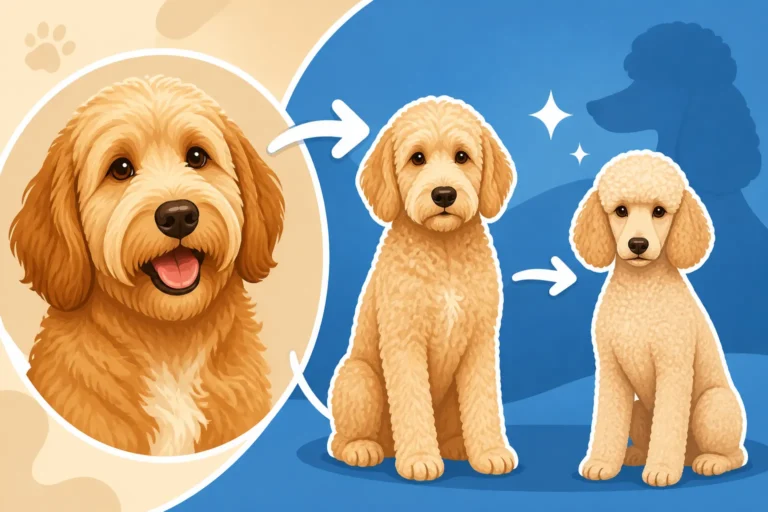
Labradoodles can vary more because their coat and other traits depend on their parents and breeding. One may have a wavy coat that needs frequent brushing; another may have a curlier coat that mats readily; another may shed more than its family expected. A puppy’s appearance is not a dependable promise of its adult coat or grooming needs. Generations and coat genetics can offer clues, but they do not turn every litter into a set of identical dogs.
Neither dog should be chosen on the assumption that it is guaranteed to be hypoallergenic. People react to allergens from dogs in different ways, and shedding less does not necessarily mean a dog will not trigger symptoms. If someone in the household has allergies, spend time around the specific dog or dogs being considered, and speak with a healthcare professional about the person’s situation.
Think about your actual week, not an ideal one
A Labradoodle may suit you better if you are willing to brush consistently, schedule grooming, and make coat care part of ordinary life. A Labrador may suit you better if you prefer a more predictable short-coat routine and do not mind managing shed hair. Neither is an effortless choice: both need exercise, companionship, training, and routine veterinary care.
Consider what happens on your busiest days. If work runs late, children have activities, or travel disrupts the schedule, who will walk the dog and keep up with coat care? A Labradoodle’s grooming needs do not disappear when the calendar gets crowded. A Labrador’s shedding may be easier to manage than a neglected, matted coat, but its need for attention and exercise remains. The right fit is the dog whose ordinary needs you can meet, rather than the one whose best-case traits sound appealing.
For a broader look at the kind of home that may work well, explore The Household a Labradoodle Actually Suits. And if the decision is really about whether a mixed breed is more work overall, Whether a Labradoodle Is More Work Than a Purebred offers another useful comparison.
How to decide between a Labradoodle and a Labrador
Use a realistic checklist
Before choosing, ask yourself these questions:
- How do I feel about shedding? A Labrador commonly leaves visible loose hair. A Labradoodle may shed less, but its coat may require more brushing and grooming.
- Will I brush a dog regularly? If the answer is no, a long, dense Labradoodle coat may be a poor match unless you keep it clipped short and can still maintain it.
- Can I make room for grooming appointments? Consider both the time and the ongoing expense of professional care. Check local groomers’ availability and ask what they can manage for the coat type you expect.
- Can I provide daily activity and training? Both dogs need more than a quick trip outside. Plan for walks, play, training, and time with the family.
- Am I relying on a promise that the dog will be calm or allergy-friendly? No label guarantees either outcome. Ask about the individual dog’s parents, temperament, coat, and care needs, and meet the dog when possible.
- Who will handle care when life gets busy? Agree on responsibilities before the dog arrives, especially brushing, exercise, and arranging veterinary or grooming visits.
If you are comparing breeders, ask specific questions about the parents’ coats, how adult relatives are groomed, and what care the breeder recommends for the puppy’s likely coat. Ask to see health-testing information too. A good conversation should leave you with realistic expectations, not only assurances that the puppy will be easy to manage.
Make the choice around the work you prefer
There is no universal winner. A Labrador can be easier if you want a low-complexity coat and can tolerate shedding. A Labradoodle can be easier for a household that strongly prefers to limit loose hair and is already prepared to brush and groom regularly. But a Labradoodle is not automatically easier to train, quieter, less energetic, or suitable for allergy sufferers.
If home grooming is part of your plan, gather supplies before the dog arrives and learn how to use them gently. Chewy may be convenient for finding routine items such as a comb or dog-safe shampoo, but a groomer or veterinarian can help you choose products and care methods for a particular coat or skin concern. Avoid using a product just because it is labeled for a certain coat type if your dog has sensitive skin or a diagnosed condition.
The most useful question is not “Which dog is easier?” but “Which kind of work can I reliably do?” If you would rather vacuum than brush and book grooming, a Labrador may be the more practical choice. If you would rather manage coat care than live with frequent loose hair, a Labradoodle may fit better—provided you genuinely have time for its coat and daily needs. Chewy and other pet-supply retailers can help owners find routine care items, but no product replaces consistent handling, exercise, training, and professional advice when a health concern appears.
Disclaimer
This article is for general informational purposes only and does not constitute professional advice. Laws, prices and regulations vary by location and change over time. Consult a qualified professional for guidance on your specific situation.