What Breeding a Labradoodle Back to a Poodle Fixes
Many prospective Labradoodle owners dream of a dog with that perfect low-shedding, allergy-friendly coat and a reliably sweet, intelligent temperament. However, the earliest generations of Labradoodles can be a bit of a genetic lottery, leading to frustration when expectations don't quite match reality. This guide dives deep into why some breeders choose to "backcross" a Labradoodle to a Poodle, and how this strategic breeding practice aims to stabilize desired traits, offering a more predictable and often more suitable companion for many families.
The Predictability Challenge of Early Labradoodle Generations
When you bring home a Labradoodle puppy, you’re often looking for a specific set of characteristics that blend the best of the Labrador Retriever and the Poodle. But in the first few generations, this blend can be quite unpredictable, leading to surprises in terms of appearance, coat type, and even temperament. It's a bit like rolling the genetic dice.
Understanding F1 and F2 Generations
An F1 Labradoodle, the very first cross, is typically a 50/50 mix of a purebred Labrador Retriever and a purebred Poodle. While this initial cross is often lauded for its "hybrid vigor," which suggests increased health due to diverse genetics, the physical traits can vary wildly. Some F1 puppies might lean heavily towards the Labrador side, with straighter hair and more shedding, while others might inherit a curlier, Poodle-like coat. You can learn more about What F1 Means on a Labradoodle.
The F2 generation, which is the result of breeding two F1 Labradoodles together, often introduces even more variability. It's like shuffling the deck again, but with two decks that are already a mix. You might see puppies in the same litter exhibiting a wide range of coat types, from sleek and shedding to tightly curled and non-shedding. This genetic randomness can be both fascinating and challenging for prospective owners who have a clear vision of their ideal Labradoodle.
Why Coat Types Vary Wildly
The coat is one of the biggest reasons people seek out Labradoodles, specifically hoping for a low-shedding or hypoallergenic option. However, in F1 and F2 generations, the genes for shedding and coat type can express themselves in countless ways. You might end up with a "hair" coat that sheds almost as much as a Labrador, a "fleece" coat that is soft and wavy with minimal shedding, or a dense, curly "wool" coat that is truly non-shedding.
This unpredictability can be particularly disheartening for families with allergies. They might have been promised a non-shedding dog, only to find their F1 Labradoodle constantly leaves hair on the furniture and triggers sniffles. The genetic lottery of these early crosses means that while some puppies in a litter might inherit the desired coat, others simply won't. This makes it difficult for breeders to consistently produce puppies with the characteristics that have made the Labradoodle so popular.
What Exactly is a Backcross (F1b) and Why Breeders Do It?
To address the inconsistencies found in the F1 and F2 generations, many reputable breeders turn to a breeding strategy called a "backcross." This isn't about diluting the Labradoodle, but rather refining it to achieve greater predictability.
The Mechanics of an F1b Cross
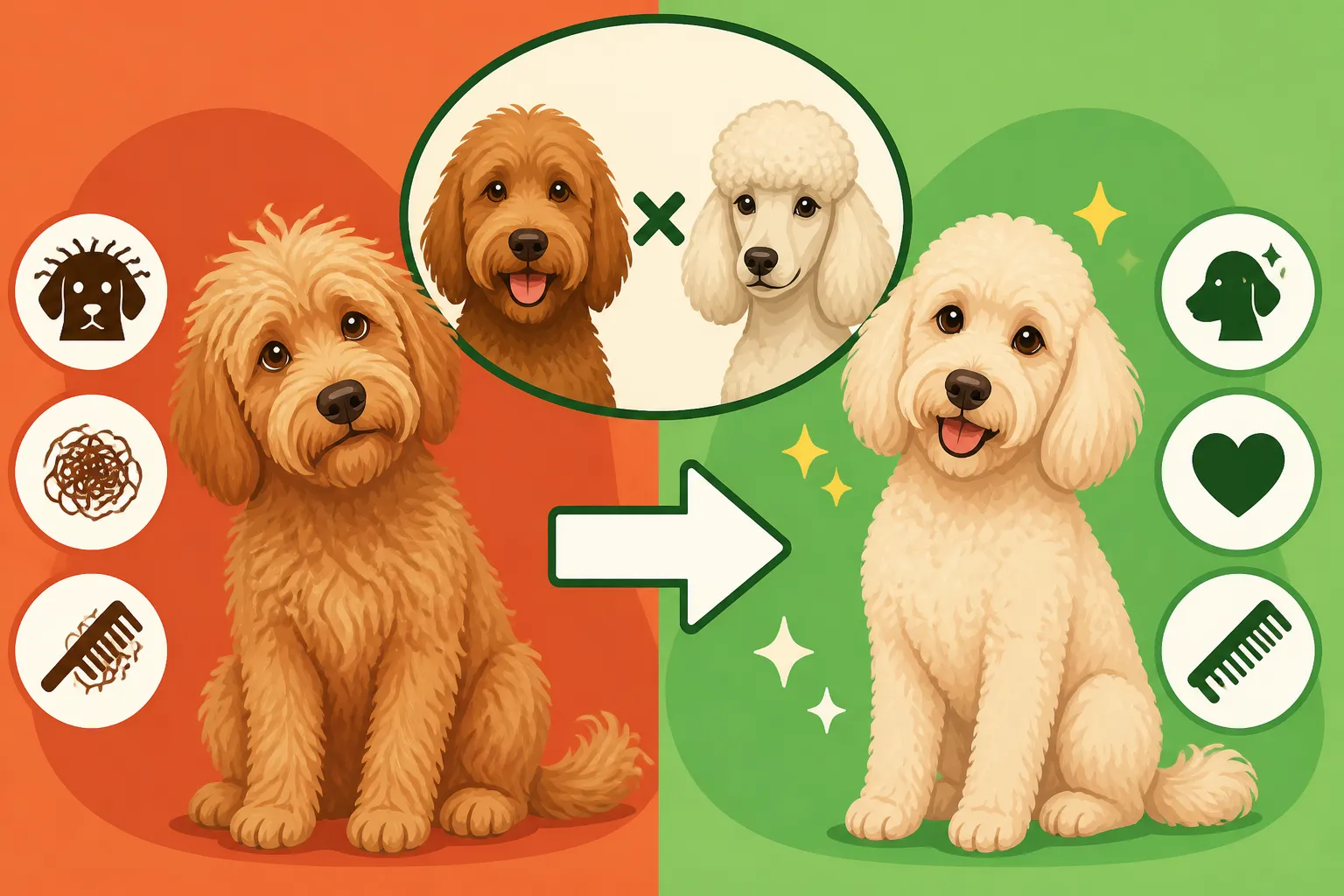
An F1b Labradoodle is produced by breeding an F1 Labradoodle (the initial Labrador-Poodle cross) back to a purebred Poodle. The "b" in F1b stands for "backcross." This results in a dog that is approximately 75% Poodle and 25% Labrador Retriever. This higher percentage of Poodle genetics is specifically chosen to reinforce desirable traits that are more consistently found in Poodles, such as the non-shedding coat and keen intelligence. If you're curious about the specifics, you can delve deeper into What F1b Means on a Labradoodle.
Breeders undertake this backcross for a very practical reason: to increase the likelihood of producing puppies that fit the typical Labradoodle mold that owners expect. While the F1 cross created the "Labradoodle" concept, the F1b often creates the consistent Labradoodle experience that many families are looking for, especially those concerned about allergies or specific coat qualities.
The Goal: Greater Consistency
The primary goal of a backcross to a Poodle is to achieve a greater degree of genetic consistency. By bringing in a higher proportion of Poodle genes, breeders can more reliably predict the offspring's coat type, which is often the main driving factor for this breeding decision. This consistency isn't just about appearance; it also extends to reducing shedding and, consequently, the allergic response in sensitive individuals.
This focused approach allows breeders to move away from the "hit-or-miss" nature of the F1 generation. Instead of hoping for the best, they are strategically stacking the genetic deck in favor of traits that are highly sought after in the Labradoodle. It’s a deliberate step towards establishing a more uniform "type" within the Labradoodle lineage, which is crucial for those who prioritize specific characteristics when choosing a family pet.
Harnessing Poodle Traits for a More Predictable Labradoodle
The Poodle half of the Labradoodle equation brings a wealth of desirable traits to the table, and backcrossing allows breeders to leverage these more consistently. This is particularly true for those characteristics that make the Labradoodle so appealing in the first place.
Achieving the Desired Low-Shedding Coat
One of the most significant benefits of breeding a Labradoodle back to a Poodle is the increased likelihood of achieving that coveted low-shedding, allergy-friendly coat. Poodles are renowned for their non-shedding, curly coats, and by doubling down on these genetics, F1b Labradoodles are far more likely to inherit a fleece or wool coat. This dramatically reduces the amount of hair shed around the home, a huge plus for cleanliness and comfort.
These coats, however, come with their own set of grooming requirements. A proper fleece or wool coat on a Labradoodle, while not shedding, is prone to matting and requires regular, thorough brushing to prevent knots and tangles from forming right down to the skin. It’s a trade-off: less shedding but more diligent grooming. You can read more about The Fleece Coat and Why Breeders Aim For It to understand why it's so popular. Products like detangling sprays and high-quality brushes from Chewy can become essential tools in your grooming kit to keep these beautiful coats in top condition.
Mitigating Allergy Concerns
For families where allergies are a significant concern, the F1b Labradoodle often becomes the preferred choice. While no dog is 100% hypoallergenic, the tighter, non-shedding coat of an F1b significantly reduces the amount of dander and loose hair released into the environment, which are the primary triggers for pet allergies. By minimizing these allergens, many individuals who would otherwise struggle with dog allergies can comfortably live with an F1b Labradoodle.
It's crucial to remember that individual reactions vary. Even with an F1b, it's always recommended for allergic family members to spend time with the specific puppy or its parents before committing. However, the increased Poodle genetic influence statistically makes them a much safer bet than their F1 counterparts. The goal is to provide a loving companion without compromising anyone's health or quality of life, which is why understanding Whether a Labradoodle Is Truly Hypoallergenic is so important.
Enhancing Trainability and Intelligence
Poodles are not just pretty faces; they are highly intelligent and often eager-to-please dogs, known for their trainability and quick minds. By reinforcing these Poodle traits through a backcross, F1b Labradoodles often exhibit an enhanced capacity for learning and a greater desire to work alongside their human companions. This can translate to an easier training experience, whether you're teaching basic manners or more complex commands.
Their intelligence means they thrive on mental stimulation, making them excellent candidates for dog sports, puzzle toys, and consistent training sessions. This eagerness to learn, combined with the Labrador's natural biddability, can result in a highly responsive and well-behaved family member. However, this also means they can get bored if not given enough to do, so owners should be prepared to provide plenty of engagement to keep their clever F1b Labradoodle happy and mentally stimulated.
Health and Temperament Benefits of Strategic Backcrossing
Beyond the coat, a strategic backcross can also influence the overall health and temperament of a Labradoodle. While it's not a magic solution to all genetic problems, it can help breeders steer the lineage towards more desirable characteristics.
Addressing Temperament Variances
The temperament of an F1 Labradoodle can be a bit of a mixed bag. Some might be laid-back like a classic Labrador, while others might inherit the more sensitive or energetic traits of a Poodle. By backcrossing to a Poodle, breeders often aim for a more consistent temperament profile, often leaning towards the Poodle's intelligent, biddable, and often slightly more reserved nature compared to the boisterousness of some Labradors. This can lead to a dog that is generally calmer indoors but still enjoys active play.
However, it's important to remember that early socialization and consistent training remain paramount regardless of generation. An F1b Labradoodle still needs to be exposed to a variety of sights, sounds, people, and other animals from a young age to develop into a well-adjusted adult. A good breeder will also screen their breeding stock for sound temperaments, as genetics play a huge role, but environment and early experiences are just as crucial in shaping a dog's personality.
Potential Health Advantages and Considerations
While hybrid vigor is often cited as a benefit of F1 crosses, backcrossing doesn't necessarily negate this. Instead, it allows breeders to focus on specific health clearances within the Poodle lines, aiming to reduce the incidence of certain genetic conditions. For instance, reputable breeders will rigorously screen both the F1 Labradoodle parent and the purebred Poodle parent for common health issues found in both breeds, such as hip and elbow dysplasia, various eye conditions like Progressive Retinal Atrophy (PRA), and certain heart conditions. You can read more about Whether Health Tested Parents Add Years to a Labradoodle.
It's not about making a dog "healthier" simply by being an F1b, but rather about the intentionality of the breeding program. A responsible breeder using a backcross is typically doing so to refine and improve the breed's consistency while still adhering to strict health testing protocols for both parents. Owners should always ask to see health certificates for both parents, demonstrating clearance for common conditions relevant to Poodles and Labradors.
Here's a quick comparison of F1 vs. F1b characteristics:
| Characteristic | F1 Labradoodle (F1) | F1b Labradoodle (F1 x Poodle) |
|---|---|---|
| Genetic Makeup | 50% Labrador, 50% Poodle | ~25% Labrador, ~75% Poodle |
| Coat Predictability | Highly variable (hair, fleece, wool) | More consistent (typically fleece or wool) |
| Shedding Level | Varies widely, some can shed significantly | Low to no shedding, much better for allergies |
| Grooming Needs | Variable; hair coats less, wool coats more | Generally higher; prone to matting, requires regular brushing |
| Allergy Friendliness | Inconsistent; can be problematic for allergy sufferers | Significantly improved; generally better for allergy sufferers |
| Temperament Consistency | Variable mix of Labrador and Poodle traits | Leans more towards Poodle traits (intelligent, biddable) |
| Appearance | Can look more Labrador or more Poodle | Often appears more Poodle-like, curlier coat |
What to Consider When Choosing an F1b Labradoodle
While F1b Labradoodles offer increased predictability and often fit the ideal image many people have, there are still important factors to weigh before bringing one home.
The Poodle Influence in Appearance and Grooming
Given their 75% Poodle genetic makeup, F1b Labradoodles will almost certainly look more like a Poodle than an F1 Labradoodle might. Expect a curlier, denser coat and often a more refined facial structure. While still retaining some of the endearing qualities of the Labrador, the Poodle's influence will be pronounced. This means embracing the "doodle" look fully.
This also directly impacts grooming. The beautiful, low-shedding fleece or wool coat that is so appealing requires significant maintenance. These coats are prone to matting, especially behind the ears, in the armpits, and around friction points like harnesses. Regular brushing, at least several times a week, is absolutely non-negotiable, and professional grooming every 6-8 weeks is essential to keep their coat healthy and prevent painful matting. This grooming regimen is a commitment, both in time and cost. Many owners find that grooming supplies like those found at Chewy, from slicker brushes to detangling sprays, become staples in their home. You can also research Why a Wool Coated Labradoodle Costs More to Groom to get a clear picture.
Finding a Reputable Breeder
Regardless of whether you choose an F1, F1b, or What Multigen Means on a Labradoodle, finding a reputable breeder is the most critical step. A good breeder prioritizes the health and temperament of their dogs above all else. They will be transparent about their breeding practices, enthusiastically share health clearances for both parent dogs (including hips, elbows, eyes, and specific genetic tests), and provide references.
They should also be knowledgeable about the specific traits they are aiming for with their F1b crosses and be able to explain how the Poodle parent contributes to achieving those goals. Be wary of breeders who don't perform extensive health testing or who cannot clearly articulate the rationale behind their breeding choices. A responsible breeder will also welcome questions, allow you to meet the puppy's parents, and have a clear contract outlining health guarantees and return policies. Make sure to ask to see proof of health testing, as whether a breeder's DNA panel covers health too is a critical question for any potential puppy owner.
Understanding Potential Drawbacks
While F1b Labradoodles offer many advantages, they aren't without their considerations. The increased Poodle influence means they might inherit some Poodle characteristics that aren't everyone's cup of tea. For instance, some Poodles can be more prone to sensitive stomachs or skin issues, and these might carry over. Their energy levels can also be quite high, requiring ample exercise and mental stimulation to prevent boredom and destructive behaviors.
Furthermore, while shedding is greatly reduced, no dog is truly 100% non-shedding. Even F1bs can have a minimal amount of "blow out" during seasonal changes or when heavily brushed. For those with severe allergies, a visit to the breeder to interact with the F1b parents is crucial to gauge any potential reaction before committing to a puppy. Understanding these nuances helps set realistic expectations, ensuring a happy and harmonious life with your F1b Labradoodle.
Disclaimer
This article is for general informational purposes only and does not constitute professional advice. Laws, prices and regulations vary by location and change over time. Consult a qualified professional for guidance on your specific situation.