Telling an Australian Labradoodle From a Labradoodle
It’s a common scenario: you’re falling head over heels for the adorable, shaggy-haired “Labradoodle” you keep seeing online or at the dog park, picturing yourself enjoying endless cuddles and adventures with your new best friend. But then you stumble across the term “Australian Labradoodle,” and suddenly, everything feels a little murky. Are they the same thing? Is one better than the other? The confusion is real, and it can be frustrating when you’re just trying to figure out which furry companion will best fit your life. This guide is here to untangle the differences, helping you understand the unique stories, traits, and expectations for both the original Labradoodle and its Australian counterpart.
The Original Labradoodle: A Classic Cross
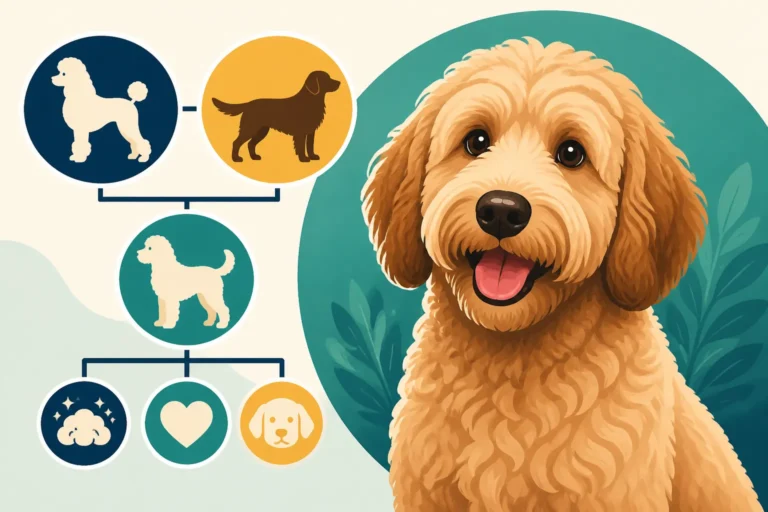
When most people first hear "Labradoodle," they're often picturing the original cross that captivated the world. This dog, born from the deliberate mating of a Labrador Retriever and a Standard Poodle, was initially conceived with a very specific, noble purpose in mind: to create a guide dog for a visually impaired woman whose husband suffered from dog allergies. It was a brilliant idea – combine the trainability and gentle nature of the Labrador with the low-shedding coat of the Poodle.
The Genesis of a Global Phenomenon
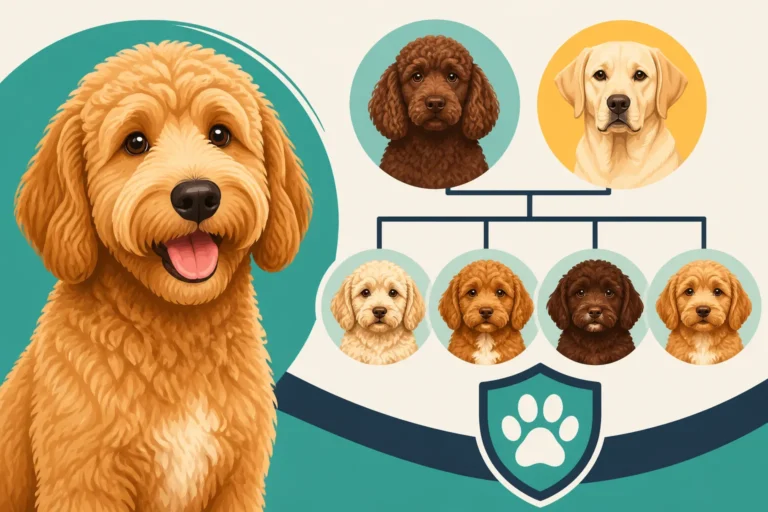
The story of the Labradoodle truly begins in Australia in 1989 with Wally Conron at the Royal Guide Dogs Association of Australia. He was the one tasked with finding a hypoallergenic guide dog. His solution, pairing a Labrador and a Standard Poodle, led to a litter of three puppies, one of whom, Sultan, became the pioneering allergy-friendly guide dog. This initial cross, often referred to as an F1 generation (first generation), was simply intended to merge the best qualities of both parent breeds. The goal was practical: service work for people with allergies.
However, as often happens with innovative ideas, the Labradoodle quickly captured public attention far beyond its original intent. People were drawn to their charming appearance, their often friendly demeanor, and the promise of a dog that might shed less than a typical retriever. Soon, what was once a careful, specific breeding program became a widespread phenomenon, leading to a huge demand for these "designer dogs." The 1989 Cross That Made the First Labradoodle delves deeper into this fascinating origin story.
Traits from its Parents
The original Labradoodle is a true hybrid, meaning its traits can vary quite a bit from one puppy to the next, even within the same litter. This is part of the joy and also the unpredictability of a first-generation crossbreed. On one hand, you might get a dog that leans heavily into the Labrador's eager-to-please, boisterous retrieving instincts, ready for a game of fetch any time, anywhere. These dogs often have a more classic "doggy" smell and may still shed, albeit possibly less than a pure Labrador.
On the other hand, a Labradoodle might inherit more of the Poodle's intelligent, sometimes reserved, and often elegant nature. Their coats tend to be curlier and denser, and their grooming needs are significantly higher. The beauty of this cross is often found in the blend – a dog with the Poodle's smarts and lower-shedding coat, combined with the Labrador's notorious friendliness and love for family. However, the exact mix of personality and physical traits, including the coat type, isn't guaranteed with an F1 or even an F1b (first generation backcross) Labradoodle. This variability is something many first-time owners aren't fully prepared for, as What F1 Means on a Labradoodle explains further.
Introducing the Australian Labradoodle: A Breed Apart
Now, let's talk about the Australian Labradoodle, which often causes the most confusion because of its similar name. Despite sharing the "Labradoodle" moniker, the Australian Labradoodle is a distinctly different entity with a much more complex genetic background and a different breeding philosophy behind it. It's not just a Labrador and a Poodle cross; it's a multi-generational, carefully cultivated development that eventually included several other breeds.
A Deliberate Path Towards a Purebred Standard
Unlike the original Labradoodle, which was an intentional crossbreed, the Australian Labradoodle was developed with the long-term goal of creating a consistent, recognized breed. This journey began shortly after the initial Labradoodle's surge in popularity, as breeders in Australia recognized the variability of the F1 crosses. They wanted more predictability in temperament, health, and coat type. To achieve this, they introduced other breeds into the mix over several generations.
The initial foundation breeds were, of course, the Labrador Retriever and the Poodle. But to stabilize traits and introduce desirable characteristics, the Irish Water Spaniel and the Cocker Spaniel (both English and American varieties) were carefully integrated. This multi-breed infusion was not a haphazard process; it was a highly selective breeding program, spanning many generations, aimed at developing a consistent "type" that would eventually breed true. This rigorous approach is what truly sets the Australian Labradoodle apart. Why an Australian Labradoodle Is Not a Labradoodle and The Four Breeds Inside an Australian Labradoodle dive deep into this fascinating evolution.
The Impact of Additional Breeds
The inclusion of the Irish Water Spaniel and Cocker Spaniel has had a significant impact on the Australian Labradoodle's characteristics. The Irish Water Spaniel, known for its dense, curly, water-repellent coat and strong retrieving instincts, contributed to the desired fleece and wool coat textures and enhanced the athletic capabilities. The Cocker Spaniel, with its merry disposition and smaller size, was often incorporated to help reduce overall size and refine temperament, adding to the gentle and companionable nature that is a hallmark of the Australian Labradoodle.
This multi-generational breeding, often referred to as "multigen," allowed breeders to selectively choose dogs that consistently displayed the desired coat types (fleece and wool, with minimal shedding), specific temperaments (friendly, intelligent, calm, intuitive), and robust health. The aim was to move beyond the hybrid vigor lottery of an F1 cross and establish a stable lineage. The Multigen Program That Made the Australian Labradoodle illustrates this process in more detail. The result is a dog that is generally more consistent in appearance, temperament, and coat qualities, making it a more predictable choice for families, especially those with allergy concerns.
Key Distinctions in Appearance, Coat, and Temperament
Now that we understand their origins, let's lay out the practical differences you'll notice when comparing an original Labradoodle to an Australian Labradoodle. These distinctions are crucial for anyone trying to decide which type is the right fit for their home and lifestyle.
Appearance and Physical Traits
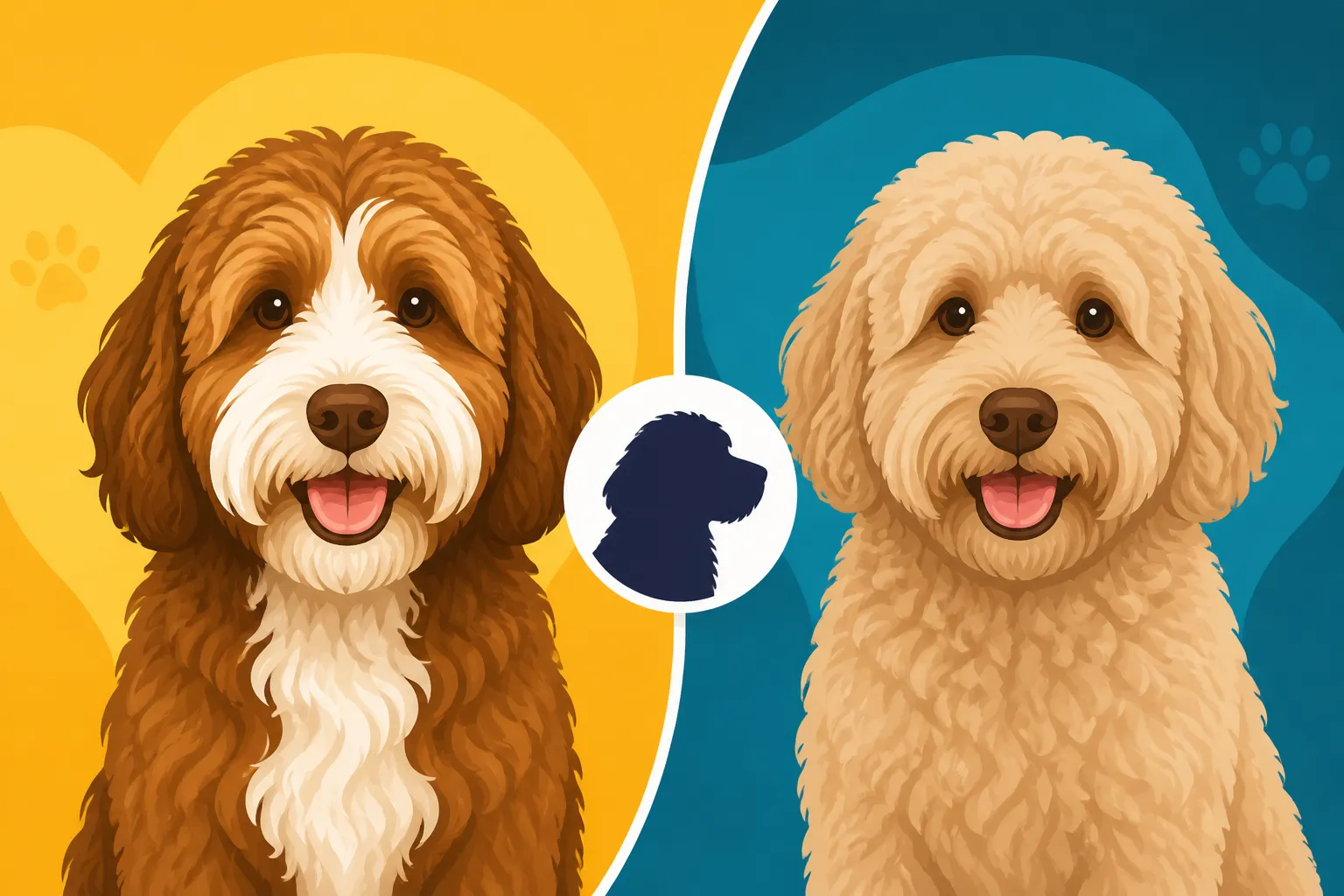
At first glance, both dogs are undeniably charming, often with that characteristic "doodle" look that's so endearing. However, there are subtle yet significant differences. The original Labradoodle, being a first-generation or early-generation cross, tends to show a wider range of physical traits. Some might look very much like a Poodle, with a slender build and tightly curled coat, while others might appear more Labrador-like, with a broader head and a shaggier, possibly wavy coat. Their body structure can vary, sometimes appearing more square or more rectangular depending on the dominant parent breed's genes.
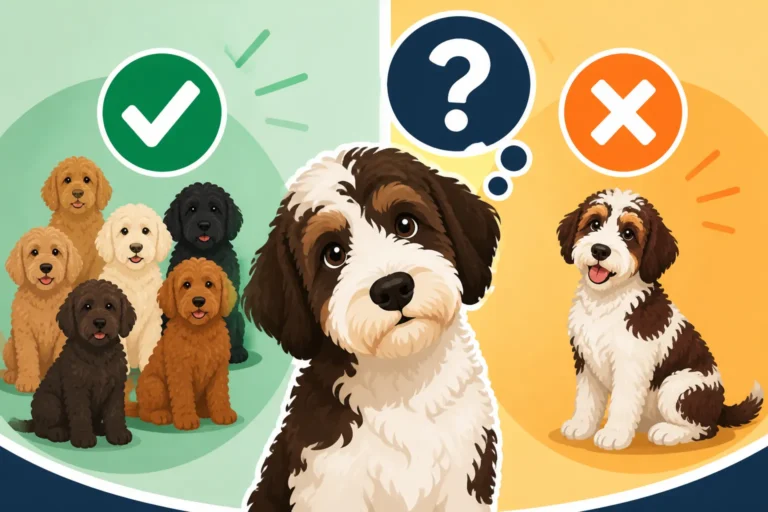
Australian Labradoodles, by contrast, have been bred over many generations to a specific type, resulting in a more uniform appearance. They generally have a more compact, athletic build, often described as balanced and graceful. Their heads are typically well-proportioned to their bodies, and their expressions are often soft and intelligent. They tend to have a distinct "Labradoodle look" that is immediately recognizable once you know what to look for – a consistent breed-type rather than a blend of two distinct breeds. This consistency is a direct result of the careful multi-generational breeding efforts.
Coat Types and Grooming Needs
This is perhaps one of the biggest differentiating factors, especially for families with allergies or those concerned about shedding and grooming.
| Feature | Original Labradoodle (F1, F1b) | Australian Labradoodle (Multigen) |
|---|---|---|
| Coat Types | Highly variable: Hair (sheds), Fleece (wavy/shaggy), Wool (curly/dense). Often a gamble. | Consistent: Primarily Fleece (soft, wavy/curly) or Wool (dense, curly). Bred for minimal shedding. |
| Shedding | Ranges from moderate to heavy (hair coat) to low (wool coat). Less predictable. | Generally very low to non-shedding. Highly sought after for allergy sufferers. |
| Allergenicity | Variable; not all are truly "hypoallergenic." Hair coats can trigger allergies. | More reliably "allergy-friendly" due to consistent fleece/wool coats. |
| Grooming Needs | Can range from moderate (hair coat) to high (fleece/wool coats that mat). | High. Requires regular brushing to prevent mats, professional grooming every 6-8 weeks. |
| "Improper Coat" | Common in early generations, resulting in shedding, flat coat. | Rare, as breeders select against the IC gene over generations. What an Improper Coat Means on a Labradoodle explains this. |
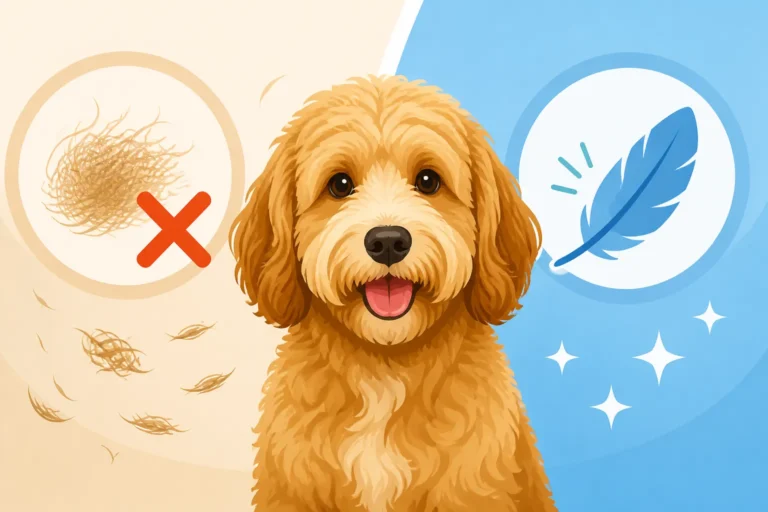
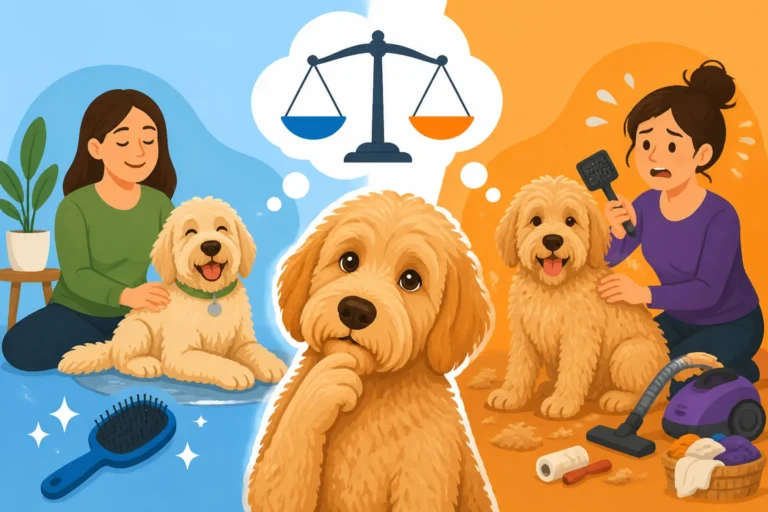
The original Labradoodle can produce three main coat types: hair, fleece, and wool. The hair coat is similar to a Labrador's, sheds, and isn't allergy-friendly. The fleece coat is soft and wavy or shaggy, while the wool coat is dense and curly, similar to a Poodle's. The problem is, you can't always predict which coat an F1 puppy will have until it grows. This unpredictability means that some "Labradoodles" shed quite a bit, making them unsuitable for allergy sufferers.
Australian Labradoodles, on the other hand, have been meticulously bred to consistently produce fleece or wool coats. These coats are typically very low-shedding, often non-shedding, which is why they are so highly prized by those with allergies. The Fleece Coat and Why Breeders Aim For It further details why this coat type is so desirable. This consistency also means that while their grooming needs are high (regular brushing and professional trims are essential to prevent matting), you generally know what you're getting. You won't be surprised by a shedding hair coat if you've chosen an Australian Labradoodle from a reputable breeder. You can find all sorts of grooming tools and specialty shampoos on sites like Chewy to keep these coats in tip-top shape.
Temperament and Personality
While both types are generally known for being intelligent and good-natured, the multi-generational breeding of the Australian Labradoodle has led to a more consistent and predictable temperament. They are often described as exceptionally friendly, outgoing, intuitive, and highly intelligent, making them excellent family pets and even successful service dogs. They tend to be very devoted to their families, often described as "Velcro dogs" due to their desire to be close to their people. This consistency in temperament is a significant advantage for those seeking a dog with a specific behavioral profile.
Original Labradoodles, being a first cross, can exhibit a wider spectrum of personalities. Some might be laid-back and calm, taking after a mellow Labrador, while others might be more high-strung and energetic, inheriting more of the Poodle's drive. While generally friendly, their precise personality can be more of a lottery. This doesn't mean they aren't wonderful dogs, but it does mean a prospective owner should spend more time observing the puppy and its parents to gauge the likely temperament. For both types, early socialization and consistent training are paramount to ensure a well-adjusted companion, and you'll find a wide selection of training treats and chew toys on Chewy to aid in that process.
Breeding, Generations, and Predictability
Understanding the different breeding strategies and generational classifications is key to grasping why these two types of "Labradoodles" are so distinct. It impacts everything from genetic health to coat characteristics and behavioral predictability.
The Role of Generations (F1, F1b, Multigen)
The terms "F1," "F1b," and "Multigen" are critical when discussing Labradoodles.
- F1 Labradoodle: This is the first-generation cross between a purebred Labrador Retriever and a purebred Poodle. As discussed, these dogs are the most genetically diverse, meaning their traits are the least predictable. You might get a curly coat, a wavy coat, or a shaggy shedding coat; a calm demeanor or a very energetic one. It’s a roll of the dice in many respects.
- F1b Labradoodle: This refers to a first-generation Labradoodle (F1) bred back to a Poodle (or sometimes a Labrador, but Poodle backcrosses are more common for allergy reasons). The goal here is to increase the likelihood of a low-shedding coat. An F1b is typically 75% Poodle and 25% Labrador, which usually results in a curlier, less shedding coat.
- Multigenerational (Multigen) Labradoodle: This is where the Australian Labradoodle fits in. A multigen Labradoodle is the result of breeding two Labradoodles (of F3 generation or higher) together, or breeding an F3 or higher Labradoodle to another approved breed within the Australian Labradoodle's lineage (like a Cocker Spaniel or Irish Water Spaniel, though these are less common in established lines now). The goal of multigen breeding is to stabilize the desired traits over many generations, leading to much greater predictability in appearance, coat, and temperament.
This multi-generational breeding program is central to why Australian Labradoodles are considered a step closer to being a distinct breed, whereas original Labradoodles (especially F1s and F1bs) remain essentially crossbreeds. The dedication to this process has allowed breeders to refine the specific characteristics they want to see in every puppy. Whether an Australian Labradoodle Breeds True is a fascinating read on this topic.
Predictability in Health and Temperament
One of the motivations behind creating the Australian Labradoodle was to achieve greater predictability in health. While both parent breeds (Labrador and Poodle) are generally robust, they are prone to certain hereditary conditions, such as hip and elbow dysplasia, progressive retinal atrophy (PRA), and certain heart conditions. In an F1 cross, while hybrid vigor can sometimes reduce the incidence of some issues, it doesn't eliminate them, and the genetic outcomes can still be quite varied.
With Australian Labradoodles, responsible breeders have spent decades meticulously health testing their breeding stock and carefully selecting individuals with strong health clearances. The aim is to reduce the incidence of inherited diseases through multiple generations of selective breeding. This focus on long-term health is a cornerstone of the Australian Labradoodle breeding philosophy. While no dog is guaranteed to be free from health issues, the extensive history and transparent health testing within reputable Australian Labradoodle lines often offer a greater degree of confidence in predicting potential health outcomes.
Similarly, the predictability in temperament is a huge draw. When you acquire an Australian Labradoodle from a well-established line, you generally have a very good idea of the personality traits it will exhibit: friendly, intelligent, adaptable, and usually excellent with children and other pets. This consistency comes from the careful selection of breeding dogs over many generations, reinforcing the desired behavioral characteristics. This level of predictability is often harder to achieve with first-generation Labradoodles, where the genetic lottery can result in a wider range of temperaments.
Making Your Choice: Which Labradoodle is Right for You?
Deciding between an original Labradoodle and an Australian Labradoodle isn't about one being inherently "better" than the other, but rather about which type aligns best with your family's needs, expectations, and lifestyle. Both can make wonderful companions, but their differences are important to consider.
Considerations for Families with Allergies
If you or a family member suffer from dog allergies, this is likely your top consideration. The Australian Labradoodle, with its consistently bred fleece or wool coat, offers a much higher likelihood of being allergy-friendly. Their multi-generational breeding has specifically focused on producing non-shedding or very low-shedding coats, which are crucial for allergy sufferers. Many reputable Australian Labradoodle breeders will have extensive experience with families managing allergies and can provide guidance.
For an original Labradoodle, especially an F1 (first generation), it's a much bigger gamble. Some F1s might inherit a Poodle-like coat and be fine for allergy sufferers, but many others will have a hair coat or a fleece coat that still sheds enough to trigger reactions. An F1b (backcross to a Poodle) is a safer bet than an F1, but still may not be as consistently non-shedding as a multi-generational Australian Labradoodle. If allergies are a concern, always spend time with the puppy and its parents before committing, and consider the Australian Labradoodle for a more predictable outcome.
Expectations for Appearance and Consistency
Do you have a very specific image in mind when you think of a Labradoodle? If you're looking for that consistent "teddy bear" or shaggy, elegant appearance that is typical of many doodles, an Australian Labradoodle is more likely to meet those visual expectations. Their breeding has refined their look over time, leading to a more uniform aesthetic. You'll find a broader range of colors and coat textures, but within a defined "type" that is unique to the Australian Labradoodle.
The original Labradoodle, on the other hand, offers more variety in appearance. You might get a dog that looks almost exactly like a Poodle, or one that heavily favors the Labrador. This can be a delightful surprise for some owners, but for others, the inconsistency might be a drawback. If you embrace the idea of a truly unique mixed-breed look, an F1 or F1b Labradoodle might be appealing.
The Importance of Predictable Temperament
For families seeking a dog with a well-established and predictable temperament, especially for first-time dog owners or those with young children, the Australian Labradoodle often provides greater peace of mind. Their long history of selective breeding for specific personality traits means you can generally expect a friendly, intelligent, and adaptable companion. This consistency can be invaluable when integrating a new dog into a busy household. Whether an Australian Labradoodle Is More Predictable dives into this further.
With original Labradoodles, while many are wonderful dogs, the temperament can lean more heavily towards one parent breed or the other, or be a unique blend that requires more adaptability from the owner. This isn't necessarily a negative, but it means you need to be prepared for a wider range of potential personalities. Engaging with a responsible breeder who performs temperament testing on their puppies and allows you to meet the parent dogs is especially crucial when considering an F1 or F1b Labradoodle.
Ultimately, both the original Labradoodle and the Australian Labradoodle are beloved companions capable of bringing immense joy to their families. Your decision will hinge on how much importance you place on predictability in coat type (for allergies), appearance, and temperament, versus embracing the inherent variability of a crossbreed. Do your research, talk to reputable breeders, and consider what kind of furry family member will truly thrive in your home. You can find everything from premium dog food to training tools for either type of Labradoodle on Chewy, making sure your new companion gets the best start.
Disclaimer
This article is for general informational purposes only and does not constitute professional advice. Laws, prices and regulations vary by location and change over time. Consult a qualified professional for guidance on your specific situation.