Whether a Straight Coated Labradoodle Is a Fault
Many Labradoodle hopefuls dream of that iconic wavy, low-shedding fleece coat, a hallmark of the breed's appeal. So it can be a real jolt when your adorable fluffball starts to grow up, and instead of waves and curls, you see straight, often coarser hair emerging. This can lead to questions and even worry: is this "straight coat" a sign of something wrong, or a "fault" in your beloved companion? This guide will dive deep into the world of Labradoodle coats, explaining the genetics behind straight hair, what it means for your dog's care, and why it's far from a "fault."
Understanding the Labradoodle Coat Spectrum
When you embark on the journey of welcoming a Labradoodle into your life, you quickly learn that their coats aren't a one-size-fits-all affair. There's a whole spectrum, and while some are highly sought after, others are simply less common but no less legitimate. The perception of a "fault" often comes from a misunderstanding of this diversity.
The Ideal: Fleece and Wool Coats
Most people envision a Labradoodle with a soft, flowing coat, often described as fleece or wool. The fleece coat is typically wavy or spiraling, feeling silky and light, almost like cashmere. It tends to be the lowest shedding and is often the goal for breeders aiming for allergy-friendly qualities. Then there's the wool coat, which is denser and curlier, similar to a Poodle's coat, and also considered low-shedding and desirable for allergy sufferers. Both these types require significant grooming, but they represent the breed's intended aesthetic and functional characteristics. Breeders often talk about The Three Labradoodle Coats: Hair, Fleece and Wool as the gold standard.
The Reality: Hair Coats and Straightness
On the other end of the spectrum is the "hair coat," which more closely resembles that of a Labrador Retriever. This coat type is typically straight, coarser to the touch, and yes, it does shed. When a Labradoodle has a straight coat, it almost invariably means they have this hair coat. It's a natural genetic outcome, especially in earlier generations like an F1 (first-generation) Labradoodle, where you're mixing two distinct purebreds – a Labrador and a Poodle. The coat genetics aren't fully predictable in these early crosses, leading to a wider range of outcomes. For some owners, this comes as a surprise, especially if they were expecting the non-shedding qualities commonly associated with the "Doodle" name.
Is a Straight Coat a "Fault"?
From a pure aesthetic or breed standard perspective (if the Labradoodle had an official one recognized by major kennel clubs, which it doesn't), a straight hair coat is generally not the "ideal" that many breeders strive for. However, calling it a "fault" implies a flaw in health, temperament, or function, and this is simply not the case. A straight-coated Labradoodle is just as much a Labradoodle as its curly-coated siblings. The term "fault" is often used in the context of show dogs to describe deviations from a written standard, but since the Labradoodle is not a recognized breed with such a standard, this term is somewhat misapplied. The real "fault" would be a breeder misrepresenting the coat type or health of a puppy. It's more accurate to say it's a variation from the most desired coat type.
The Genetics Behind a Straight Labradoodle Coat
Understanding genetics can take a lot of the mystery out of why your Labradoodle might have a straight coat. It's not a random occurrence, but rather a direct result of inherited traits.
The Furnishings Gene and Its Impact
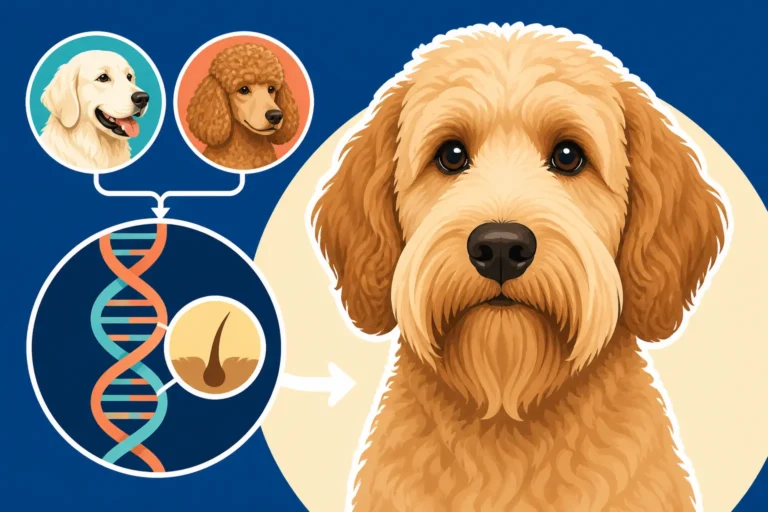
The biggest player in a Labradoodle's coat type is a gene called "Furnishings," often denoted as F. This gene is responsible for the longer hair on a dog's face – the mustache, beard, and eyebrows – which gives Poodles, and consequently most Doodles, their characteristic "doodle" look. Without at least one copy of the dominant Furnishings allele, a dog will have what's sometimes called an "improper coat" (IC), or more simply, a hair coat that lacks these furnishings. The Furnishings Gene Behind a Labradoodle's Beard is absolutely crucial for that classic Labradoodle appearance.
Here's a simple breakdown of the genetics:
- FF: Dog has two copies of the Furnishings gene. Will have furnishings and likely a fleece or wool coat (depending on other curl genes).
- Ff: Dog has one copy of the Furnishings gene and one copy of the "no furnishings" gene. Will have furnishings and likely a fleece or wool coat. This dog is a "carrier" for the hair coat gene.
- ff: Dog has two copies of the "no furnishings" gene. Will have a straight hair coat, lacking furnishings. This is your straight-coated Labradoodle.
When you breed a Poodle (always FF) with a Labrador (always ff), all of their F1 puppies will be Ff. This means they will all have furnishings and typically a wavy or curly coat. This is why Whether an F1 Labradoodle's Coat Is a Gamble can be a surprising read for new owners. However, if you then breed two F1 Labradoodles together (Ff x Ff), you introduce the possibility of ff puppies in the litter (approximately 25% of the time), resulting in straight hair coats.
Other Genes Affecting Coat Texture and Curl
While the Furnishings gene is key for that "doodle" look, other genes influence the actual texture and degree of curl. There are genes for curl (like the KRT71 gene) and genes for coat length. A dog could have furnishings (Ff or FF) but still have a fairly loose wave or even appear quite straight if they have genes for minimal curl. However, a truly straight coat, like a Labrador's, without any waves or curls, is almost always associated with the absence of the Furnishings gene (ff). This means a distinct lack of beard and eyebrows, giving them a much more "Labrador-like" facial appearance. Understanding What an Improper Coat Means on a Labradoodle is really about understanding this genetic lottery.
Predictability in Generations
Breeders who are specifically trying to produce the non-shedding, fleece or wool coats will often use genetic testing to ensure their breeding dogs carry the correct Furnishings genes. This helps them avoid producing puppies with hair coats. In later generations (F1b, F2b, Multigen), careful breeding practices can significantly increase the predictability of coat type. However, for those early generations or less experienced breeders, the outcome can be more varied.
Living With a Straight Coated Labradoodle
So, you have a straight-coated Labradoodle. What does this actually mean for daily life? Rest assured, it mostly boils down to different care routines, not fundamental flaws in your dog's nature.
Grooming Requirements
The grooming needs of a straight-coated Labradoodle are generally less intense than those with fleece or wool coats, but that doesn't mean they're maintenance-free.
Shedding and Brushing Needs
Unlike the low-shedding fleece or wool coats, a straight hair coat will shed. Expect it to shed much like a Labrador Retriever, especially seasonally. This means you'll find hair on your furniture, clothes, and floors. Regular brushing is still essential, not just to remove loose hair and minimize shedding around the house, but also to keep the coat healthy and free of tangles. While it might not mat like a curly coat, dead undercoat can still accumulate and cause skin issues if not brushed out. A good quality slicker brush and an undercoat rake are your best friends here. You might find great tools on Chewy or Amazon that are specifically designed for shedding breeds. For more on shedding, check out Whether a Hair Coat Labradoodle Sheds Like a Labrador.
Bathing and Drying
Bathing a straight-coated Labradoodle is typically easier than bathing a curly one, as the hair is less prone to matting when wet. You'll still want to use a good dog shampoo and conditioner, rinsing thoroughly. Drying time will depend on the density of the coat, but it generally won't require the meticulous line-drying and blow-drying needed to prevent mats in a fleece or wool coat. A towel dry followed by air drying or a quick run with a regular dog dryer should suffice.
| Coat Type | Appearance | Shedding Level | Grooming Frequency (Brushing) | Grooming Challenges |
|---|---|---|---|---|
| Straight Hair Coat | Smooth, short to medium length, like a Labrador | Moderate to High | 2-3 times a week (for shedding) | Shedding, less "doodle" look |
| Fleece Coat | Soft, wavy to loose curls, like cashmere | Low | Daily to every other day | Matting, tangling, regular trims |
| Wool Coat | Dense, tight curls, like a Poodle | Very Low | Daily (for density) | Severe matting, professional trims |
Potential for Allergies
One of the primary reasons people choose a Labradoodle is the hope of a hypoallergenic dog. This is where a straight hair coat can diverge significantly from expectations. Because these coats shed, they release more dander (dead skin cells) into the environment, which is the actual trigger for most dog allergies. Therefore, a straight-coated Labradoodle is highly unlikely to be allergy-friendly. If you or a family member has severe dog allergies, a straight-coated Labradoodle might not be the best fit. It’s always best for an allergic family to meet a Labradoodle first, regardless of coat type, but especially so if the coat is straight.
Temperament and Health
Crucially, the coat type has absolutely no bearing on your Labradoodle's temperament or overall health. A straight-coated Labradoodle can be just as intelligent, loving, playful, and loyal as one with a perfect fleece coat. Their disposition will still be a blend of the Poodle's smarts and the Labrador's friendly, eager-to-please nature. Likewise, their propensity for genetic health conditions, such as hip and elbow dysplasia, eye conditions, or Addison's disease, is completely unrelated to their coat. These are inherited through different genes. Remember to always ask a breeder about health testing for both parent breeds, regardless of the puppy's coat type. Whether Health Tested Parents Add Years to a Labradoodle is a far more important consideration than coat texture.
Redefining Expectations: Is a Straight Coat Truly a "Fault"?
The term "fault" often carries a negative connotation, implying something broken or undesirable. But when it comes to a straight-coated Labradoodle, it's really about aligning your expectations with reality and celebrating the unique dog you have.
Beyond the Coat: Focusing on What Matters
For many Labradoodle owners, the initial draw might have been the promise of a low-shedding, curly companion. If your dog turns out to have a straight coat, it's easy to feel a pang of disappointment, especially if you had specific grooming or allergy expectations. However, a dog is so much more than its coat. Their personality, their bond with you, their goofy antics, and their unwavering affection are what truly define them. A straight-coated Labradoodle will still bring joy, companionship, and all the wonderful qualities that make this cross so popular. It might just mean adjusting your grooming routine and perhaps investing in a good vacuum cleaner!
The Importance of Breeder Transparency
This entire discussion highlights the critical importance of choosing a reputable and transparent breeder. A good breeder will be upfront about the potential for coat variations, especially in F1 litters, and ideally, they will conduct genetic testing for the Furnishings gene to give buyers a clearer picture of what to expect. They should also be able to explain the different Labradoodle generations and how they impact coat types. If you're specifically seeking a low-shedding or hypoallergenic dog, it's vital to discuss coat genetics with your breeder and ideally meet the parents or older siblings to get a sense of their adult coats. Some breeders will even allow you to return a puppy if its coat changes in a way that truly impacts your family's health (e.g., severe allergies).
Embracing Individuality
Ultimately, your Labradoodle, straight coat or not, is a unique individual. While a straight coat might deviate from the stereotypical "doodle" look, it doesn't diminish their value as a pet. They are still a wonderful blend of two intelligent and affectionate breeds. You might find you spend less time battling mats and more time simply enjoying their companionship. Focus on their health, their training, and the strong bond you build, and you'll realize that a "fault" is truly just a matter of perspective. Providing your Labradoodle with high-quality nutrition, perhaps from brands like Ollie, can also contribute to a healthy, shiny coat, regardless of its texture, and support their overall well-being.
Disclaimer
This article is for general informational purposes only and does not constitute professional advice. Laws, prices and regulations vary by location and change over time. Consult a qualified professional for guidance on your specific situation.