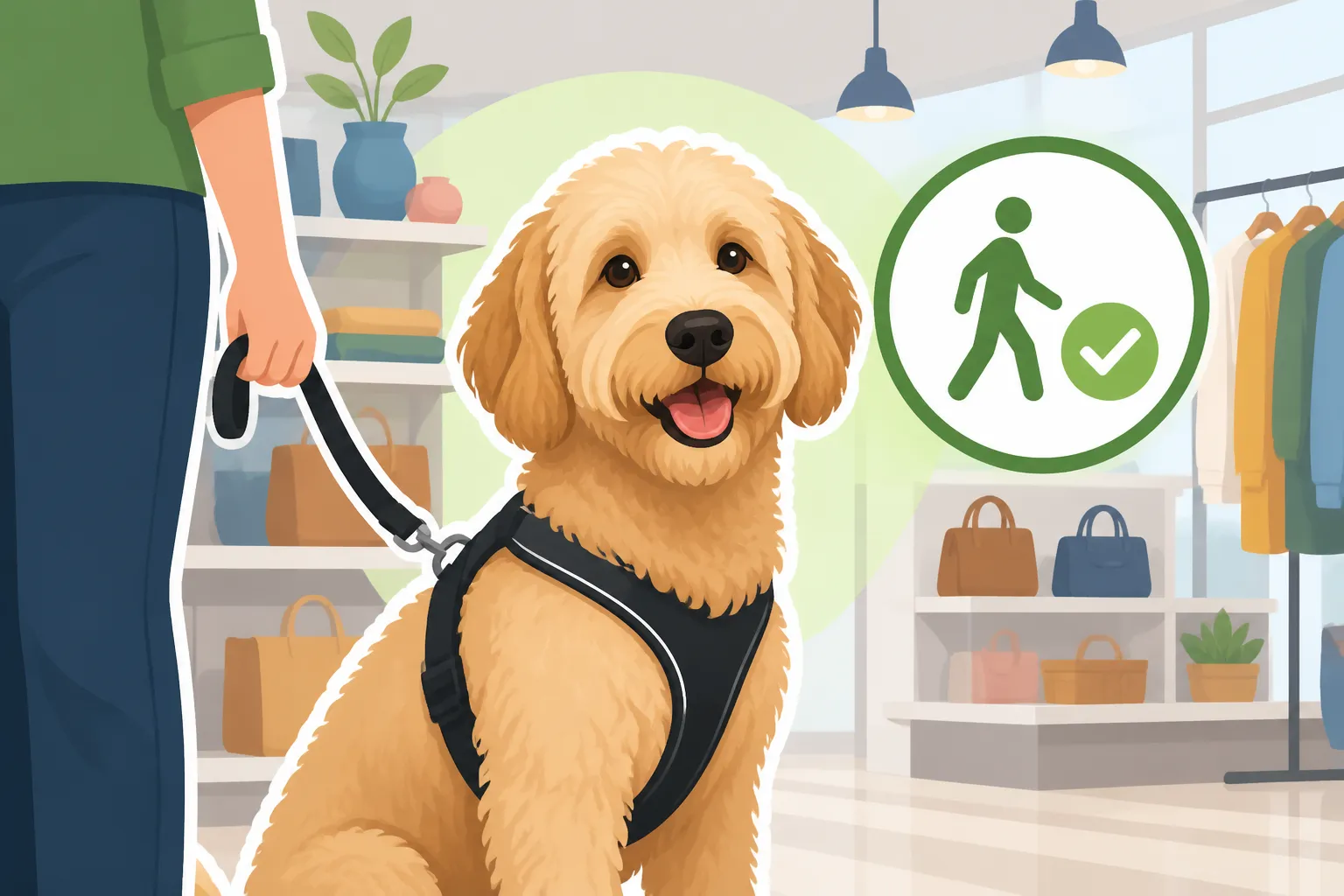
What Public Access Means for a Labradoodle in a Store
It’s a scenario many of us Labradoodle parents have faced: you’re heading to the local hardware store or a pet supply shop, and you wonder if your beloved furry companion can come along. The lines around what "public access" really means for our dogs, especially in places like grocery stores or boutiques, can be incredibly blurry and frankly, quite frustrating. This guide is here to clear up that confusion, explaining the legal landscape, practical considerations, and training steps needed to understand where your Labradoodle is truly welcome when you venture out together.
Understanding the Legal Landscape: Service Dogs vs. Pets
There's a widespread misconception that if a dog is well-behaved, it can go anywhere its owner goes. Unfortunately, that's just not the reality, and misunderstanding this can lead to awkward situations, disappointment, or even legal issues. The rules are quite specific, and they hinge entirely on whether your Labradoodle is a pet, an emotional support animal, or a legitimate service dog.
The Americans with Disabilities Act (ADA) and Service Animals
The cornerstone of public access for dogs in the United States is the Americans with Disabilities Act (ADA). This federal law provides specific protections for people with disabilities who use service animals. A service animal, under the ADA, is defined as a dog that has been individually trained to do work or perform tasks for an individual with a disability. This work or task must be directly related to the individual's disability. Think of tasks like guiding a visually impaired person, alerting a deaf person to sounds, pulling a wheelchair, alerting and protecting a person who is having a seizure, or reminding a person with mental illness to take prescribed medications.
It’s crucial to understand that the ADA grants service animals access to most public places, including stores, restaurants, hospitals, and transportation, even if pets are generally prohibited. This is not a blanket permission for all dogs. The key here is the trained task directly alleviating a disability. When challenged, businesses are legally allowed to ask only two questions: (1) Is the dog a service animal required because of a disability? and (2) What work or task has the dog been trained to perform? They cannot ask about the person's disability, demand to see certification, or ask the dog to demonstrate its task. Your Labradoodle, if it is a truly trained service animal, has these rights, but the responsibility to ensure it is always under control and house-trained rests squarely on your shoulders.
The Distinction Between Service Dogs and Emotional Support Animals
Here's where a lot of confusion, and frankly, some tension, arises. Emotional Support Animals (ESAs) are often vital companions, offering comfort and companionship that can be incredibly beneficial for mental health. However, ESAs are not considered service animals under the ADA. The law makes a clear distinction: ESAs provide comfort just by being present, while service animals are trained to perform specific tasks to mitigate a disability. This means that while an ESA might be allowed in housing where pets are otherwise restricted (under the Fair Housing Act), they do not have the same broad public access rights as service animals in places like grocery stores, retail shops, or restaurants.
Many owners mistakenly believe that because their Labradoodle provides emotional support, it automatically qualifies for public access. This isn't the case. Carrying an "Emotional Support Animal" vest or online registration doesn't grant your Labradoodle entry into non-pet-friendly establishments. Businesses are within their rights to deny access to ESAs if they have a "no pets" policy. Understanding this difference is vital to avoid uncomfortable confrontations and to respect the rights and regulations that protect legitimate service dog teams while also respecting the boundaries of businesses. You might be surprised to learn that even guide dog schools, the very programs that first popularized the Labradoodle, have moved away from them for various reasons, making the chances of a typical Labradoodle being a program-trained service animal less common today than you might assume. Why Assistance Programs Moved Away From the Labradoodle
The Expectations of a Public Access Labradoodle
If your Labradoodle is a legitimate service dog, or if you're taking your pet Labradoodle to a pet-friendly store, there are still significant expectations for their behavior. Public access isn't just about getting through the door; it's about being an unobtrusive, polite, and safe member of the public, which is a massive undertaking for any dog, let alone a bouncy, friendly Labradoodle.
Exemplary Behavior and Manners
A dog in a public place, whether a service dog or a pet in a pet-friendly store, needs to be practically invisible. This means no barking, no sniffing merchandise, no jumping on strangers (even friendly ones!), and absolutely no accidents on the floor. Imagine trying to shop for groceries with a dog constantly trying to lick everyone it sees or pulling on the leash every time it catches a new scent. It would be disruptive for other shoppers and create a negative impression of all dogs.
For a Labradoodle, known for their enthusiastic and often social nature, achieving this level of neutrality takes immense training and socialization. They need to be able to settle calmly, ignore distractions like dropped food, loud noises, children, and other animals. This isn't just about obedience; it's about developing a profound sense of self-control and a reliable "off-switch." Your dog needs to understand that a trip to the store isn't playtime, but rather an exercise in calm companionship. A helpful resource for developing these skills can be found in online training programs like BAXTER & Bella, which offer structured curricula to help build a well-behaved companion for various scenarios, including public outings.
Hygiene and Grooming Standards
Beyond behavior, hygiene is a critical, though often overlooked, aspect of public access. A dog entering any indoor public space, especially stores, must be clean and free of excessive shedding, odors, or parasites. No one wants to share an aisle with a dog that smells strongly of wet dog, leaves a trail of hair, or is scratching itself incessantly. This is particularly true for Labradoodles, whose coats, whether fleece or wool, can become matted and collect debris if not properly maintained.
Regular grooming is not just for aesthetics; it's a public health and courtesy issue. Before heading out, ensure your Labradoodle is brushed, its paws are clean, and its coat is free of any lingering dirt or outdoor smells. This often means consistent home grooming, getting comfortable with things like trimming the hair between a Labradoodle's pads, which can pick up a surprising amount of grime. If you struggle with keeping up, a professional groomer can be invaluable, but even then, daily quick brushes are a must. Teaching a Labradoodle to Lie Still for a Ninety Minute Groom
Preparing Your Labradoodle for Public Spaces
Taking your Labradoodle to public spaces, even pet-friendly ones, is not something you should jump into without preparation. It requires foundational training, careful socialization, and specific skill-building to ensure both your dog's success and your peace of mind.
Foundation Training and Socialization
Before your Labradoodle sets paw in a store, it needs a rock-solid foundation of basic obedience. Commands like "sit," "stay," "down," "come," and "leave it" are non-negotiable. More importantly, these commands need to be reliable not just in your quiet living room, but amidst distractions. You can practice these in gradually more stimulating environments, starting in your backyard, moving to a quiet park, and then to busier outdoor areas. Your Labradoodle should be able to walk politely on a leash without pulling, even when exciting things are happening around them. Teaching a Sixty Pound Labradoodle Not to Pull
Equally important is socialization. This isn't just about letting your Labradoodle meet every dog and person; it's about teaching them to be neutral and calm in the presence of various sights, sounds, smells, and people. Expose your Labradoodle to different types of people (kids, adults, people in uniforms, people with hats), different surfaces (tile, carpet, concrete), and different noises (shopping carts, loud conversations, music) in controlled, positive ways. The goal is for your Labradoodle to see these as normal background elements, rather than triggers for excitement or fear. A good online training program, such as those offered by BAXTER & Bella, can guide you through these critical early socialization and training steps, building confidence in both you and your Labradoodle.
Essential Gear and Practice Runs
When you do decide to take your Labradoodle into a store, having the right gear is crucial. A well-fitting, comfortable harness or collar that prevents pulling is essential, along with a sturdy leash. Avoid retractable leashes in public spaces, as they offer less control and can be a tripping hazard. Many owners find a short, fixed-length leash (4-6 feet) combined with a comfortable handle to be the most practical. You might also consider a compact mat or bed that your Labradoodle associates with settling down. This can be a game-changer for teaching them to relax at your feet while you browse. A good treat pouch, readily available on platforms like Amazon, is invaluable for easy access to high-value rewards to reinforce good behavior.
Start with short, low-stakes practice runs. Choose a quiet time of day at a pet-friendly store where you know your Labradoodle will have a positive experience. Don't plan to do your full shopping trip; just go in for a few minutes, practice a "sit-stay" near the entrance, walk a short aisle, reward calmness, and then leave. Gradually increase the duration and challenge as your Labradoodle gains confidence and demonstrates consistent good behavior. If your dog struggles with ignoring distractions, try practicing in quieter areas first, gradually building up to busier environments. Teaching a Labradoodle to Ignore Other Dogs in Public
Navigating Different Store Policies
Even with a perfectly trained Labradoodle, knowing where you can and cannot go is half the battle. Store policies vary wildly, and it's always best to err on the side of caution.
Identifying Pet-Friendly Establishments
The easiest way to avoid awkward encounters is to stick to clearly pet-friendly establishments. Many large retail chains, particularly those focused on home improvement or outdoor goods, openly welcome well-behaved, leashed dogs. Pet supply stores are, of course, a given. Some boutique shops, coffee houses with outdoor seating, or garden centers also extend a welcome mat to furry friends.
The best practice is always to check ahead. A quick call to the store or a glance at their website or front door signage can save you a lot of hassle. Look for "dogs welcome" signs, or search online for "pet-friendly stores near me." Remember that even in pet-friendly stores, the expectation for your Labradoodle's behavior remains high. Just because they're allowed doesn't mean they're exempt from good manners.
Respecting "No Pets" Policies
For stores that do not explicitly state they are pet-friendly, assume a "no pets" policy. This applies to most grocery stores, restaurants (unless service animals), clothing stores, and many other retail environments. These policies are in place for various reasons, including hygiene, safety, and the comfort of all customers, including those with allergies or fear of dogs. It’s important to respect these rules, even if you believe your Labradoodle is the best-behaved dog on the planet.
Trying to sneak your Labradoodle into a non-pet-friendly store can create problems for the business, its employees, and other customers. It can also reinforce negative stereotypes about dog owners and make it harder for legitimate service dog teams who already face scrutiny. If you're unsure, or if you simply can't leave your Labradoodle at home, consider leaving them in the car (if conditions are safe and legal, never in hot weather!) or opting for curbside pickup or delivery services. It’s about being a considerate member of the community and valuing the rules set by private businesses. After all, your Labradoodle is a beloved family member, and you want to ensure their experiences in public are positive and stress-free for everyone involved. The Household a Labradoodle Actually Suits
| Category | Service Animal (under ADA) | Emotional Support Animal (ESA) | Pet Labradoodle |
|---|---|---|---|
| Definition | Individually trained to perform tasks for a person with a disability. | Provides comfort and emotional support simply by its presence; not task-trained. | A companion animal not specifically trained for disability tasks or emotional support. |
| Public Access Rights (Federal) | Broad access to most public places (stores, restaurants, transportation), even if pets are generally excluded. | Limited public access. Generally no federal right to enter non-pet-friendly public establishments. | No federal public access rights. Entry is at the discretion of the business or property owner. |
| Housing Rights (Federal) | Protected under ADA and Fair Housing Act (FHA) for housing access. | Protected under Fair Housing Act (FHA) for housing access, with reasonable accommodation. | Subject to landlord's pet policies; no specific federal protection for housing access. |
| Air Travel Rights (Federal) | Permitted to fly in cabin with qualified individuals under Air Carrier Access Act (ACAA) for legitimate service animals. | Generally treated as pets; must meet airline pet policies (size, carrier, fees). Check individual airline policies. | Treated as pets; must meet airline pet policies (size, carrier, fees). |
| Documentation Requirements | No official "certification" or "registration" required or recognized by the ADA. Businesses can ask two questions only. | Often requires a letter from a licensed mental health professional. | No specific documentation for public access, beyond local licensing if applicable. |
| Required Behavior | Must be under handler's control (leash, voice, or other means) and housebroken. Can be removed if disruptive or not housebroken. | Expected to be well-behaved, but not held to the same high standard of task performance as service animals. | Expected to be well-behaved, leashed, and under control in pet-friendly areas. Can be asked to leave if disruptive. |
| Legal Basis | Americans with Disabilities Act (ADA) | Fair Housing Act (FHA), Air Carrier Access Act (ACAA) for specific purposes (though rules have tightened for ESAs on planes). | Local leash laws, business discretion. |
What to Do If Denied Entry
If you are a legitimate service dog handler with a Labradoodle trained for specific tasks and you are denied entry to a public place, it's important to understand your rights calmly and respectfully. Inform the establishment that your dog is a service animal under the ADA, and briefly explain the task it performs. Avoid getting into heated arguments. If the situation isn't resolved, you can ask for a manager or supervisor. Document the details of the encounter, including the date, time, location, and names of individuals involved. You can then file a complaint with the Department of Justice or your state's attorney general's office if you believe your rights have been violated.
For those with pet Labradoodles or ESAs, a denial of entry to a non-pet-friendly business is generally within the establishment's rights. In such cases, the best approach is to apologize for any misunderstanding, retrieve your Labradoodle, and leave without argument. It’s always a good idea to have a plan B, whether that’s another pet-friendly store, a quick stop at home, or having a companion wait outside with your dog. Our goal as Labradoodle owners is to foster positive perceptions of our wonderful dogs, and respectful adherence to rules, even when we wish they were different, goes a long way.
Disclaimer
This article is for general informational purposes only and does not constitute professional advice. Laws, prices and regulations vary by location and change over time. Consult a qualified professional for guidance on your specific situation.