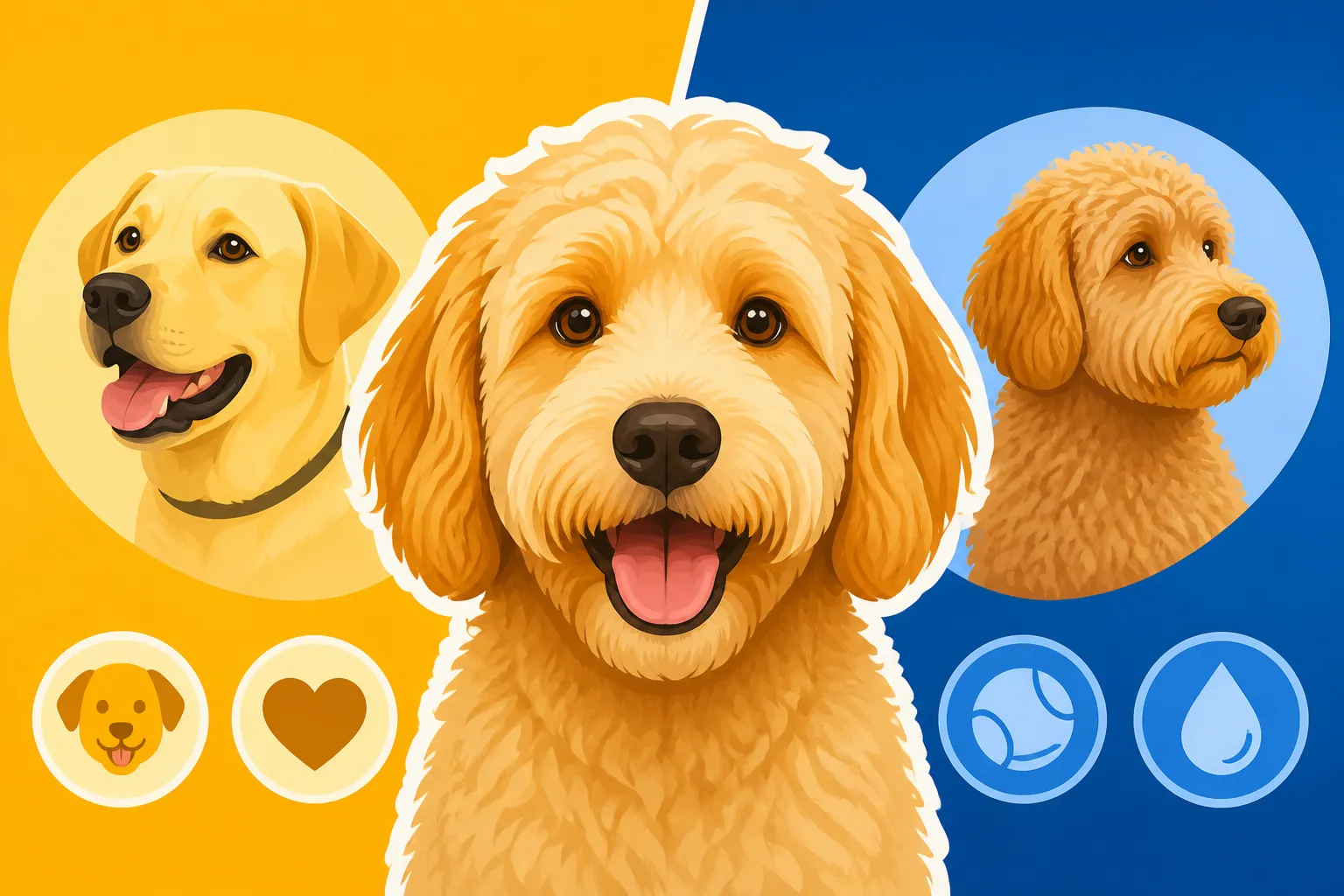
What a Labradoodle Owes to Its Labrador Side
A Labradoodle may carry the Labrador’s enthusiasm for people, food, games, and the great outdoors—but mixed-breed inheritance is never a neat half-and-half recipe. If you are wondering why your dog retrieves everything, begs at the kitchen counter, or seems to need a job, this guide explains which familiar traits may come from the Labrador side and how to live with them.
The Labrador traits you may notice first
A strong interest in retrieving
The Labrador was developed as a working gundog, and many Labradors enjoy carrying objects, chasing a thrown toy, and bringing things back. That retrieving instinct can show up in a Labradoodle as an obvious love of balls and fetch—or as an urge to pick up socks, shoes, leaves, and whatever else happens to be within reach.
Not every Labradoodle will retrieve naturally, and some will be far more interested in running after a toy than returning it. Others may carry things around without wanting to give them up. These differences are normal: a dog’s individual temperament, early experiences, training, and the traits inherited from its Poodle parent all shape how the instinct appears.
If your dog is keen on carrying things, give that interest a useful outlet. Teach a simple “take it” and “drop” routine with a toy, and reward your dog for bringing the toy back or releasing it. Keep the game short enough that your dog can still listen and settle afterward. The aim isn’t to turn every Labradoodle into a flawless retriever; it’s to make a natural interest easier to enjoy safely. For more on this particular tendency, see The Retrieving Drive a Labradoodle Gets From the Labrador.
Sociability and a readiness to engage
Many Labradors are people-oriented and enthusiastic about greeting familiar faces. A Labradoodle may inherit some of that outgoing quality, showing up wherever the family is, bringing over a toy, or getting excited when guests arrive. That can feel lovely when your dog is gentle and relaxed. It can feel very different when a large, bouncy dog launches itself at someone carrying groceries.
Friendliness does not automatically mean good manners, and it does not mean every Labradoodle will love every person or dog. Your dog may be social at home but cautious in busy places, or delighted by visitors but easily overstimulated. The Poodle side and the dog’s own experiences also matter. A friendly disposition still needs calm, consistent boundaries.
Practise greetings before you need them. Ask your dog for a simple behavior such as standing with four paws on the floor or going to a mat, then reward that choice while a visitor approaches. If your dog is too excited to respond, create more distance and try again rather than letting the greeting turn into a wrestling match. The broader mix of inherited qualities is explored in The Temperament a Labradoodle Gets From Each Parent.
Energy that needs a thoughtful outlet
Labradors are often active, playful dogs, and some Labradoodles inherit a similar appetite for movement and interaction. That doesn’t necessarily mean your dog needs hours of nonstop exercise. It does mean that a short walk around the block may not satisfy a dog who also wants to sniff, explore, solve problems, and spend time with you.
A useful day can combine several kinds of activity: a walk that allows plenty of sniffing, a few short training sessions, a food puzzle, and calm time at home. For a young dog, activity should be appropriate to their age and development. More exercise is not always the answer to restlessness; a dog can become overtired or overexcited, especially if the day is full of high-speed games with few chances to decompress.
Watch the dog in front of you rather than relying on a breed label. If your Labradoodle settles after a walk and a little training, that routine may be working. If they pace, bark, or keep demanding interaction, consider whether they need a more suitable activity—or whether they are having difficulty switching off. The Exercise a Labradoodle Needs Before It Behaves offers more context on balancing activity with day-to-day behavior.
Food, play, and the everyday challenges of Labrador enthusiasm
Food motivation can help with training
Some Labradoodles inherit the Labrador’s keen interest in food. That can make training easier because a small, well-timed reward may be more appealing than a toy or praise. It can also make ordinary household moments challenging: a dog who spots food on a low table, checks the kitchen floor after dinner, or stares hopefully at every snack is not necessarily being stubborn. They may simply be very motivated by the possibility of a bite.
Use that motivation carefully. Set aside part of your dog’s regular food for training when it makes sense, and use small rewards so practice does not quietly become a second meal. Ask for an easy behavior—such as coming when called or settling on a mat—before offering a treat. Keep food out of reach when you cannot supervise, and make sure everyone in the household follows the same rules. A dog who gets scraps from one person and is asked to ignore the table by everyone else is being given confusing instructions.
Food puzzles and supervised enrichment can give a food-focused dog something constructive to do. If you are looking for a puzzle feeder or training treats, Chewy can be one place to compare options; choose items suited to your dog’s size, chewing habits, and feeding routine. For more on using rewards, see Whether a Labradoodle Works for Food Like a Labrador.
Mouthiness and carrying objects
A dog who picks up household items may be exploring, seeking attention, trying to initiate play, or enjoying the feel of an object in their mouth. Labrador puppies in particular are often associated with carrying things, but an adult Labradoodle can keep the habit too. The important distinction is whether your dog is calmly carrying a safe object or chewing and swallowing things that could cause harm.
Make appropriate options easy to find. Keep tempting shoes, laundry, children’s toys, and food packaging out of reach, and offer dog-safe toys instead. If your dog grabs something they should not have, avoid turning the moment into a chase. A cheerful trade for a treat or an approved toy is usually more useful than shouting or wrestling the item away, which can make the object seem even more exciting.
You can also teach a reliable exchange when your dog is calm. Offer a toy, say a cue such as “drop,” and reward your dog for releasing it before giving the toy back or offering another suitable item. For dogs that swallow objects, guard items, or become distressed when approached, seek help from a qualified trainer or veterinary professional rather than relying on a simple trade game. A soft, careful mouth is not guaranteed just because a dog has Labrador ancestry; Whether a Labradoodle Has a Soft Mouth explains that distinction.
A quick comparison of common inherited tendencies
| Possible Labrador-influenced tendency | How it might look at home | A practical response |
|---|---|---|
| Retrieving interest | Chasing toys, carrying socks, or asking for repeated throws | Teach “take it” and “drop,” and keep games short |
| Food motivation | Scavenging, begging, or quick progress with treat-based training | Manage access to food and use small, planned rewards |
| Social enthusiasm | Excited greetings or wanting to join every activity | Reward calm greetings and build pauses into play |
| Interest in water | Investigating puddles, lakes, or sprinklers | Introduce water gradually and supervise closely |
| Playful energy | Seeking interaction, movement, or a task | Mix walks, sniffing, training, and quiet time |
These are possibilities, not promises. A Labradoodle may show several of them strongly, show them mildly, or show something quite different. The dog’s generation and the particular parents can influence what you see, but neither can predict every behavior in an individual dog.
What the Labrador side does not guarantee
There is no fixed personality formula
It is tempting to imagine that a Labradoodle receives one clean set of traits from the Labrador and another from the Poodle. In reality, inheritance is more complicated. Two dogs from the same litter can differ in confidence, energy, sociability, sensitivity, and interest in retrieving. A puppy’s experiences and training also help shape how those tendencies develop.
That is why breed descriptions are best used as clues, not a guarantee. A Labrador parent may offer useful information about the kinds of traits that could appear, but it cannot tell you exactly how a puppy will behave as an adult. Meeting the parents, asking how the breeder assesses temperament, and talking through your household routine can help you make a more informed decision. Even then, the dog you bring home will have an individual personality.
When choosing a dog, think beyond whether the Labrador side sounds appealing. Ask yourself whether you are comfortable managing an energetic dog, preventing scavenging, practising polite greetings, and providing regular attention. If you want a predictable, low-effort companion, it is worth considering how much variation comes with any cross. Whether a Labradoodle Is Really an Easy First Dog and The Household a Labradoodle Actually Suits can help you assess the fit.
Water-loving is possible, not automatic
Labradors are often associated with water, and some Labradoodles are eager to paddle, swim, or splash around. Others would rather keep their paws dry. Coat type, confidence, past experiences, and the situation all matter. Never assume that a Labradoodle can swim safely or will enjoy water simply because a Labrador is in its ancestry.
If you want to introduce your dog to water, start somewhere calm and shallow. Let them investigate at their own pace, use a well-fitted flotation aid where appropriate, and stay close enough to intervene. Avoid pushing, throwing, or luring a worried dog into deep water. Lakes, rivers, and beaches can bring additional hazards such as currents, slippery banks, cold water, and poor visibility.
After water play, check your dog’s coat and ears and dry them appropriately. A wet, dense coat can take time to dry, and trapped moisture may be uncomfortable. If your dog develops ear discomfort, persistent scratching, or skin irritation after swimming, contact your veterinarian. Learn more in Whether a Labradoodle Takes to Water on Its Own.
Bringing out the best in Labrador-influenced traits
Build routines around your actual dog
A Labradoodle who wants to retrieve may thrive with structured toy games, while another may prefer scent-based activities or relaxed sniff walks. A food-motivated dog may enjoy short reward-based training sessions, but a dog who becomes frustrated around treats may do better with toys, praise, or distance from distractions. The goal is not to force a particular “Labrador” activity; it is to find outlets your dog enjoys and can handle.
Try changing one part of the routine at a time. If your dog spends the evening pestering you after a short walk, add a few minutes of sniffing or a simple training exercise and observe what changes. If fetch leaves them wired rather than settled, try a slower game that involves searching for toys or treats. Small adjustments can be more informative than adding a large amount of exercise all at once.
For practical supplies, Chewy can help you browse basics such as treat pouches, food puzzles, and toys. Choose products for the behavior you are working on rather than buying a pile of items based on breed stereotypes. A puzzle that is too difficult may frustrate a beginner; a toy that can be chewed into pieces is not suitable for unsupervised use.
Teach calmness as well as activity
A dog with a playful, people-focused temperament needs opportunities to engage, but also needs to learn that quiet behavior pays. Reward your Labradoodle for lying down, resting on a mat, or calmly watching household activity. Keep these early practice sessions short and low-pressure. If you only interact when your dog bounces, barks, or brings you a toy, those behaviors can become the most reliable way to get your attention.
Be realistic about the setting. A dog who can settle in a quiet living room may not yet manage calmly when children are playing or guests are arriving. Practise in easier situations first, then gradually add distractions. A baby gate, mat, or comfortable resting area can help your dog take a break without being isolated from the household.
If enthusiasm regularly becomes jumping, pulling, mouthing, or frantic barking, consider getting support before the behavior becomes a daily battle. A qualified, reward-based trainer can help you create a plan that fits your dog and your home. Chewy may be useful for finding basic training gear, but the most important tools are consistent routines, supervision, and rewards for the behavior you want to see. Labrador ancestry can help explain a Labradoodle’s interests; it does not replace getting to know the dog in front of you.
Disclaimer
This article is for general informational purposes only and does not constitute professional advice. Laws, prices and regulations vary by location and change over time. Consult a qualified professional for guidance on your specific situation.