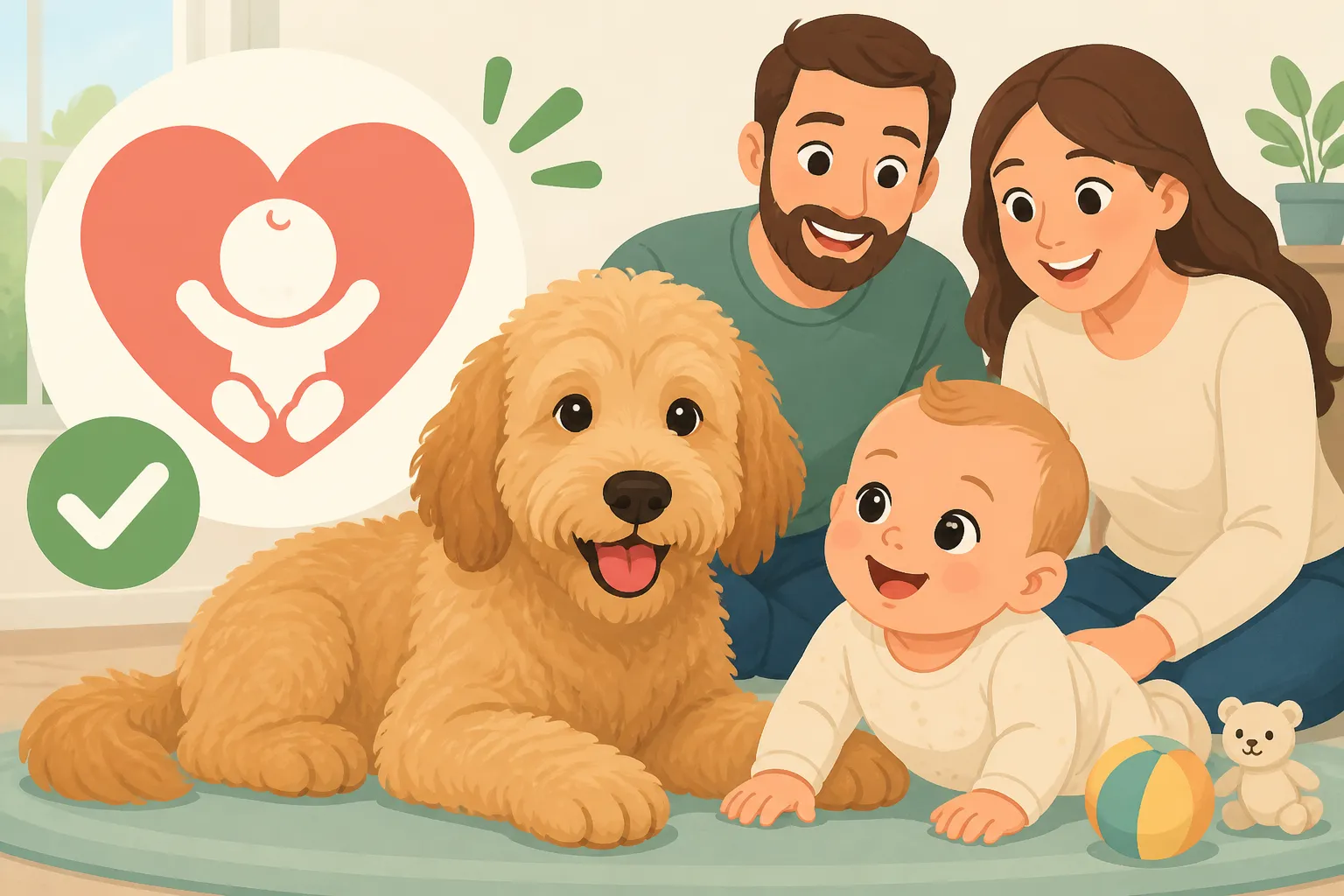
Whether a Labradoodle Suits a Family With Babies
A Labradoodle can live happily with a family that has a baby, but a friendly reputation is not a safety plan. Newborns bring crying, visitors, disrupted routines, and less time for walks or grooming; lively dogs may also bump into small children without meaning to. This guide explains what to consider, how to prepare your dog, and how to manage their first months together.
Is a Labradoodle a good fit for a family with a baby
Temperament matters more than the breed label
Labradoodles are often affectionate, sociable, and eager to be near their people. Those qualities can make them lovely family companions. But no breed label can guarantee that an individual dog will be calm, gentle, or comfortable around an infant. A dog’s temperament, past experiences, training, health, and day-to-day environment all matter.
Think about how your dog responds to ordinary household surprises. Do they startle at sudden noises, guard food or toys, jump up when excited, or become unsettled when people move around quickly? A baby adds new sounds and movements, and later a crawling child will reach, grab, and approach from unpredictable angles. A dog that has been relaxed with adults may still need careful support as those changes unfold.
If you are choosing a puppy, ask the breeder how the parents behave around people and what they do to introduce puppies to different sounds, handling, and environments. Temperament testing can offer clues, not guarantees. For more context about the range of traits in the cross, see The Temperament a Labradoodle Gets From Each Parent and Whether a Labradoodle Suits a First Time Owner.
Size and energy can affect everyday safety
A Labradoodle’s size can make a practical difference in a home with a baby. A large, excited dog can knock over an adult holding an infant, bump a bassinet, or send a stroller rolling if they pull on the leash. That is not necessarily aggression; it can be ordinary exuberance that has not yet been taught better manners. Smaller Labradoodles can still jump, mouth, or rush through a doorway, so size alone does not settle the question.
Pay attention to the dog’s behavior at busy moments. If your Labradoodle leaps up when someone comes through the door, pulls hard toward other dogs, or gets wound up when the family gathers in one room, practise calmer alternatives before the baby arrives. For example, teach the dog to go to a mat while you answer the door, then reward them for staying there as a visitor enters. Short, repeated practice is more useful than expecting a dog to suddenly behave differently once the household is tired and distracted.
It is also worth considering the dog’s daily needs. Labradoodles can be active and mentally engaged, and a newborn often makes routines less predictable. If you already have a dog, plan who will handle walks, feeding, play, and grooming during the early weeks. If you are considering bringing a puppy home at the same time as a baby arrives, weigh the demands honestly: puppy toilet training, night waking, and supervision can pile up quickly. The Household a Labradoodle Actually Suits and The Time a Labradoodle Takes Out of a Week can help you assess the lifestyle fit.
Preparing your Labradoodle before the baby arrives
Practise the new routines in advance
The easiest time to prepare is before the baby is home, when you can make changes gradually. If the dog will no longer be allowed in the nursery, start closing that room off well ahead of the birth. If you plan to use a gate, teach your Labradoodle that being on the other side is normal and rewarding. A baby gate can let the dog see and hear family activity while keeping a clear boundary.
Introduce baby-related sounds and objects in a low-pressure way. Play recordings of crying quietly at first, pair the sound with treats or a calm activity, and stop if your dog seems worried. Let your dog investigate a stroller while it is stationary, then practise walking beside it without a baby inside. Keep sessions brief; the goal is not to force closeness but to make unfamiliar things less surprising.
Work on specific skills that will matter in daily life: settling on a mat, walking on a loose leash, coming when called, leaving an object alone, and moving away from a space when asked. If your dog has a history of growling, snapping, guarding, or intense fear, speak with a qualified behavior professional before the baby comes home. Do not punish growling; it is useful information that the dog needs more space or support. Teaching a Labradoodle to Greet With Four Feet Down and Teaching a Labradoodle to Settle Under a Restaurant Table offer ideas for building calm behavior in different situations.
Set up the home for safe separation
Plan where your Labradoodle will rest, eat, and spend time when an adult cannot actively supervise. A comfortable bed or gated area gives the dog a predictable place to retreat. Keep the dog’s food, chews, and toys away from baby equipment and out of the baby’s future reach. Likewise, keep diapers, wipes, pacifiers, and small baby items secured; curious dogs may investigate them, and some may chew or swallow things they should not.
Use barriers as part of everyday life rather than only when something goes wrong. A gate can separate the dog from a changing area or let an adult manage feeding without juggling both baby and dog. If you need gates, storage containers, or enrichment toys, retailers such as Chewy may be one place to compare options, but choose products that suit your dog’s size and chewing habits. Check any item regularly for damage, and do not leave a dog alone with a toy that could break apart or become a choking hazard.
Make a simple household plan with everyone who will help. Decide who will walk the dog, who will manage greetings, and what happens when the baby is sleeping or crying. A tired parent should not have to improvise while holding an infant and trying to stop a dog from rushing into the room. Keep leashes, treats, and cleanup supplies in predictable places so another adult can step in without searching through the house.
Introducing a Labradoodle to a newborn
Keep the first meetings calm and controlled
Before the first introduction, give your dog a chance to go for a toilet break and have some quiet time. Avoid making the baby’s arrival a high-energy event with a crowd gathered around the dog. One adult should focus on the dog while another holds the baby. Keep the dog on a leash if that helps you maintain space, and let the dog notice the baby from a comfortable distance rather than bringing them nose-to-face.
Reward calm choices, such as looking at the baby and then turning away, lying down, or staying beside the adult. Do not insist that the dog sniff the baby or remain close. If the dog looks tense, repeatedly tries to leave, pants when it is not hot, freezes, or becomes fixated, calmly increase the distance and give them a break. Short, uneventful interactions are a better start than a long introduction that leaves everyone overwhelmed.
For the first days and weeks, keep meetings brief and supervised. A dog can be in the same room without being right beside the baby. Use a gate or leash when needed, and always make sure an adult is close enough to intervene. A sleeping infant is not a reason to leave the dog and baby together unattended, even if the dog has been gentle so far.
Supervision remains essential as the baby grows
Newborns soon become more active. A baby may kick, wave arms, squeal, crawl toward the dog, or grab fur. These changes can surprise even a patient dog. An adult needs to manage the space and the interaction rather than expecting the child to understand boundaries. Never leave a baby or young child alone with a dog, including a familiar family pet.
Watch the dog’s body language, not only their tail. Turning away, moving behind furniture, lip licking, yawning, freezing, or trying to leave can mean the dog wants more space. Make sure they have a retreat the child cannot reach, and do not let the baby crawl into the dog’s bed or approach them while they eat, sleep, or chew. As the child gets older, teach gentle, supervised behavior: no pulling ears or tail, climbing on the dog, chasing, or taking food and toys.
It is normal for the dog to need time to adjust, and it is also normal for parents to have less spare attention than before. If your Labradoodle seems anxious, increasingly reactive, or unable to settle around the baby, create more distance and ask your veterinarian or a qualified behavior professional for guidance. Do not wait for a close call to change the setup.
| Situation | Safer approach | What to avoid |
|---|---|---|
| Baby is sleeping | Use a gate or keep the dog in a separate area if you cannot supervise | Leaving the dog and baby together because the room is quiet |
| Dog approaches the baby | Allow calm observation at a distance and reward relaxed behavior | Forcing the dog to sniff or stay close |
| Dog is eating or chewing | Give them a protected, child-free space | Letting the baby reach toward the bowl or chew |
| Visitors arrive | Settle the dog behind a gate or on a mat before opening the door | Managing an excited greeting while holding the baby |
| Dog looks uncomfortable | Increase distance and give the dog a break | Scolding warning signals or insisting the dog tolerate contact |
Making daily life work for both dog and baby
Protect the dog’s routine without expecting perfection
A newborn can change the household rhythm overnight. Your Labradoodle may get fewer long walks, less play, or less predictable attention for a while. Try to preserve a few reliable anchors: regular meals, toilet breaks, a short sniff walk, or a calm activity at roughly familiar times. If you cannot manage the usual exercise, ask a trusted person to help rather than relying on the dog to simply adapt to a sudden drop in activity.
Mental enrichment can help on days when a longer outing is unrealistic. A food puzzle, a scatter of kibble in a safe area, or a short training session can give the dog something to do. Use only activities that are suitable for your dog and that can be supervised or safely managed around the baby. If you shop for dog supplies through Chewy or another retailer, check the size and construction of toys carefully, especially for a powerful chewer. Avoid leaving small parts where a baby could reach them.
Do not interpret every change in behavior as disobedience. A dog that paces, barks more, or follows a parent constantly may be responding to a disrupted routine, new sounds, or reduced rest. Try to identify the trigger and adjust the setup: a quiet room, a predictable break, or more distance from the nursery may help. If behavior changes are persistent or severe, a veterinarian can help rule out pain or other health issues, while a behavior professional can help you build a practical plan.
Keep grooming and household care manageable
Labradoodle coats need regular care, and a baby does not make mats disappear. If brushing is already a struggle, sort that out before the birth rather than leaving it until you are exhausted. Build a manageable routine with short sessions, use the tools that work for your dog’s coat, and keep the dog comfortable. A professional groomer may help with coat maintenance, but regular home checks still matter, especially around the ears, legs, and areas where a collar or harness rubs.
Set up a grooming spot away from the baby’s play area, and store scissors, clippers, brushes, shampoos, and other supplies securely. Hair and grooming products should not be left where a baby can touch or mouth them. When time is tight, ask the groomer for a practical trim that fits your capacity to maintain it rather than choosing a high-maintenance style because it looks appealing.
For more detailed coat and care guidance, read Brushing a Labradoodle to the Skin, Not the Surface and The Six to Eight Week Clock on a Labradoodle's Coat. If the dog swims or gets wet outdoors, drying and ear care also matter; Drying a Labradoodle After It Swims explains why damp coat care is worth planning for.
A Labradoodle can be a loving member of a family with a baby when the adults set the pace, protect the dog’s space, and supervise every interaction. The most realistic question is not whether Labradoodles are “good with babies” as a group. It is whether this particular dog, in this particular home, can be supported with safe boundaries, consistent care, and enough adult attention.
Disclaimer
This article is for general informational purposes only and does not constitute professional advice. Laws, prices and regulations vary by location and change over time. Consult a qualified professional for guidance on your specific situation.