The Fleece Coat and Why Breeders Aim For It
One of the biggest draws to the Labradoodle, let's be honest, is the promise of that glorious, low-shedding coat. Many prospective owners dream of running their fingers through soft, wavy fur without finding a handful of loose hair afterward. It's a truly appealing vision, but understanding the nuances of a Labradoodle's coat, especially the highly sought-after fleece type, is crucial to managing expectations and ensuring proper care. This guide will walk you through what makes the fleece coat so special and why it's the gold standard for many breeders and owners alike.
Understanding the Labradoodle's Coat Spectrum
When you embark on the Labradoodle journey, you'll quickly discover that not all coats are created equal. The breed actually has a spectrum of coat types, largely inherited from its Labrador Retriever and Poodle parentage. These different textures come with varying shedding levels and, consequently, different grooming demands. It’s not just about aesthetics; it’s about practicality for families and individuals, especially those with allergies.
The Hair Coat: More Like a Labrador
The hair coat is often the least desired coat type for those seeking a Labradoodle's low-shedding qualities. As the name suggests, it closely resembles the smooth, double coat of a Labrador Retriever. This means it sheds, and sometimes quite a bit, making it unsuitable for homes hoping to minimize allergens. The texture can vary from quite sleek to a slightly coarser, wavier look, but it lacks the characteristic soft curl or wave that most people associate with a Labradoodle.
Genetically, a hair coat often occurs when the puppy inherits two copies of the "improper coat" (IC) gene, meaning it doesn't express the furnishings that give the Labradoodle its signature look and low-shedding properties. This is often seen in early-generation Labradoodles, like an F1 (first cross) where the genetic dice can roll in many directions. Owners who get a hair-coated Labradoodle might be surprised by the shedding, as they often went for a Labradoodle specifically to avoid it. While easier to groom in some ways – less prone to matting – it doesn't offer the hypoallergenic benefits many seek. For more on this, you might find The Hair Coat Labradoodle That Sheds insightful.
The Wool Coat: The Poodle Influence
On the other end of the spectrum is the wool coat, which takes its cues directly from the Poodle side of the family. This coat is characterized by its dense, tight curls, often feeling much like a sheep's wool. It is truly non-shedding, which is a huge plus for allergy sufferers, as loose hair and dander are minimal. However, this low-shedding quality comes with a significant trade-off in grooming requirements.
The tight curls of a wool coat are incredibly prone to matting, and if not brushed meticulously and regularly, they can quickly form painful knots close to the skin. Daily brushing is often a necessity, along with professional grooming every 4-6 weeks to keep the coat short and manageable. Owners choosing a wool-coated Labradoodle must be prepared for a substantial time commitment to grooming, or be willing to pay for frequent professional services. While it fulfills the low-shed dream, it demands dedication to keep it healthy and mat-free. To dive deeper into managing this coat, consider reading The Wool Coat Labradoodle and Its Upkeep.
The Fleece Coat: The Labradoodle Ideal
The fleece coat is what most people picture when they think of a Labradoodle, and it’s truly the coat type that breeders strive to achieve. It represents a beautiful balance, offering the best of both worlds: the low-shedding qualities inherited from the Poodle, combined with a softer, more manageable texture that doesn't demand the extreme daily upkeep of a wool coat.
Defining the Fleece Coat's Characteristics
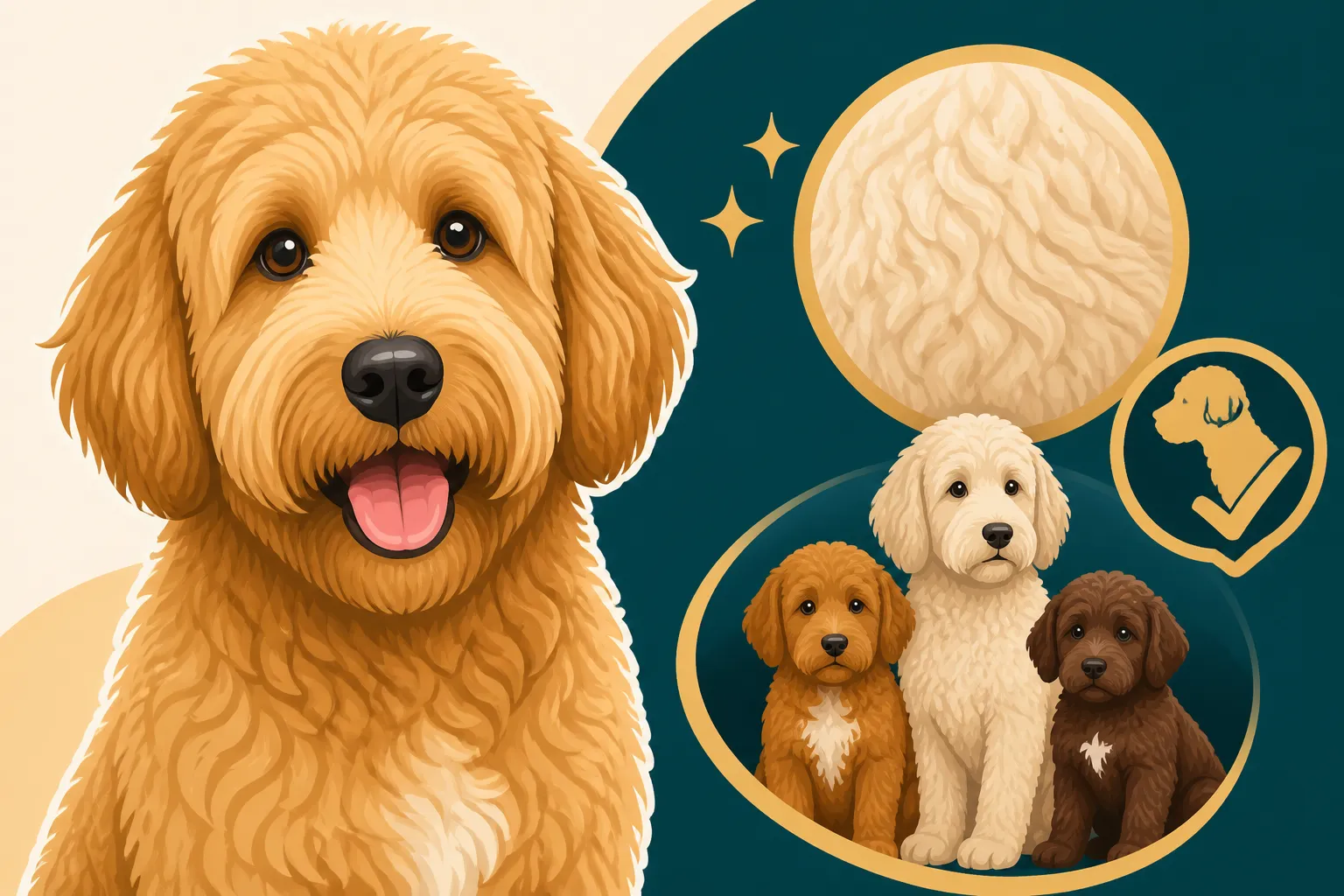
Imagine touching a cloud, or perhaps a luxurious angora sweater – that's often the comparison made for a well-maintained fleece coat. It's incredibly soft to the touch, often described as having a silky or cashmere-like feel. Visually, it can range from a soft, flowing wave to loose, spiraling curls, but it never has the tight, dense curl of a wool coat. This texture is appealing not just for its beauty but also for its practicality. The fleece coat is considered low to non-shedding, meaning it releases very little dander and hair into the environment, making it a fantastic option for families dealing with mild pet allergies.
The "furnishings" – the distinctive facial hair that creates the Labradoodle's bearded and Eyebrowed look – are always present and well-defined in a true fleece coat. These furnishings are a key indicator of the genes that contribute to its low-shedding nature. The overall look is one of playful elegance, a dog that looks perpetually cuddly and inviting, without the heavy shedding that can make purebred Labradors challenging for some households.
Why Breeders Strive for Fleece Coats
The fleece coat isn't just a happy accident; it's the result of careful, intentional breeding programs. Breeders put immense effort into producing puppies with this particular coat type because it aligns perfectly with the initial goal of the Labradoodle: a guide dog for allergy sufferers that retains the friendly, trainable temperament of a Labrador. The market demand for fleece coats is consistently high, driven by families seeking a companion that minimizes allergen exposure and offers a softer, more aesthetically pleasing look.
Achieving a consistent fleece coat across a litter involves understanding complex genetics and carefully selecting parent dogs. Ethical breeders often conduct extensive DNA testing to identify the specific coat genes in their breeding stock, aiming to maximize the chances of producing puppies with that desirable soft, wavy, low-shedding fleece. It's about combining the best attributes of both parent breeds to create a predictable and highly sought-after outcome. This selective breeding is a testament to the dedication involved in producing healthy, well-tempered Labradoodles with the ideal fleece coat.
Genetics Behind the Fleece Coat
Understanding the genetics behind a Labradoodle's coat is like peeking behind the curtain of nature's artistry. It's not just random chance; specific genes, inherited from the Poodle and Labrador parents, dictate whether a puppy will have a hair, fleece, or wool coat. For breeders aiming for that perfect fleece, deciphering these genetic markers is paramount.
The Role of the Furnishings Gene (F/IC)
One of the most critical genes determining a Labradoodle's coat type, and its shedding level, is the "furnishings" gene, often represented as F or IC (Improper Coat). Furnishings are those distinct facial hairs – the mustache, beard, and eyebrows – that give a Labradoodle its characteristic "doodle" look, differentiating it from a smooth-faced Labrador. More importantly, the presence of furnishings is strongly linked to a low-shedding or non-shedding coat.
A Labradoodle needs at least one copy of the dominant Furnishings (F) gene to have these facial features and, consequently, a low-shedding coat. If a puppy inherits two copies of the recessive "improper coat" (IC) gene (ic/ic), it will lack furnishings and typically have a hair coat that sheds. Breeders aiming for fleece coats will therefore ensure their breeding dogs carry at least one dominant F allele, and ideally two (F/F), to ensure all puppies inherit at least one F and avoid the "improper coat." This is why discussions around The Furnishings Gene Behind a Labradoodle's Beard are so vital for anyone serious about getting a truly low-shedding dog.
Understanding Curl Genes (Cu/cu)
Beyond furnishings, the degree of curl in a Labradoodle's coat is primarily influenced by the KRT71 gene, commonly referred to by its curl alleles, Cu (curly) and cu (straight). Different combinations of these alleles dictate whether the coat is straight, wavy, or tightly curled. For the fleece coat, breeders are looking for a specific balance.
A wavy fleece coat usually results from inheriting one dominant curly allele (Cu) and one recessive straight allele (cu) (Cu/cu genotype), or sometimes two copies of a less dominant curl allele. This gives the desired soft wave or loose spiral. A dog with two dominant curly alleles (Cu/Cu) will typically have a much tighter, denser wool coat. Conversely, a dog with two recessive straight alleles (cu/cu) will have a much straighter, often hair-like coat, even if they have furnishings. Therefore, breeders carefully select for parents who can pass on the right combination of curl genes to achieve that signature fleece wave, ensuring enough curl to contribute to low shedding without becoming overly dense and woolly. The degree of curl is a key predictor of both look and grooming needs, as detailed in discussions like Whether Curl Predicts How Much a Labradoodle Sheds.
Grooming and Maintenance of a Fleece Coat
While a fleece coat is often described as low-maintenance compared to its woolly counterpart, it's far from a "wash and wear" kind of coat. To keep that beautiful, soft texture mat-free and healthy, a consistent grooming routine is absolutely essential. Many new owners underestimate this commitment, only to find themselves battling painful mats down the line.
Essential Brushing Techniques for Fleece
The golden rule for grooming a fleece-coated Labradoodle is line brushing. This isn't just running a brush over the top layer of fur; it's a systematic approach to ensure you get all the way down to the skin. Mats often form at the base of the hair shaft, close to the skin, and if you're only brushing the surface, you'll miss these hidden tangles until they become a painful problem. To line brush, you essentially part the coat in small sections, hold the top hair out of the way, and brush from the skin outwards in small strokes. Work your way across the dog, section by section.
You'll need a good quality slicker brush and a sturdy metal comb. The slicker brush is your primary tool for detangling and removing loose hair, while the metal comb is crucial for checking your work and ensuring there are no hidden mats. Focus on areas prone to matting: behind the ears, armpits, flanks, tail, and anywhere a harness might rub. For most fleece coats, a thorough line brushing session 2-3 times a week, lasting 20-30 minutes each, is usually sufficient. However, during the infamous "coat change" (which we'll discuss next), daily brushing might be necessary. Neglecting this routine, even for a few days, can lead to serious matting, which can be uncomfortable for your dog and costly to fix. You'll find a lot of helpful guidance on The Line Brushing a Labradoodle Coat Needs.
Professional Grooming Schedule and Styles
Even with diligent home brushing, professional grooming is a non-negotiable part of owning a fleece-coated Labradoodle. These coats continue to grow and can become quite long and unwieldy without regular trimming. Most fleece-coated Labradoodles benefit from professional grooming every 6-8 weeks. This schedule allows the groomer to give a full bath, blow-dry (which helps straighten the hair for a more even cut), and a full body trim.
Popular styles for fleece coats include the "teddy bear clip," which leaves the coat a uniform length (often 1-2 inches) all over, maintaining that soft, fluffy look while keeping it manageable. Shorter "kennel clips" are also common, especially for active dogs or owners who prefer less daily maintenance. Beyond the full body trim, professional groomers also take care of essential details like trimming around the eyes to prevent hair from irritating them, tidying up the paw pads, and ensuring the sanitary areas are clean. When you bring your Labradoodle to the groomer, be clear about your preferences and the length you desire. A great discussion on this topic is What to Ask a Groomer For on a Labradoodle. You can find a vast array of grooming tools, from slicker brushes to detangling sprays, on sites like Chewy or Amazon to help with your home care routine between professional visits.
| Coat Type | Shedding Level | Texture | Grooming Needs (Home) | Professional Grooming Frequency |
|---|---|---|---|---|
| Hair | Moderate to High | Smooth, coarse, or slightly wavy | Occasional brushing (1-2x/week) | Every 8-12 weeks (for tidying) |
| Fleece | Low to None | Soft, wavy to loose spiraling curls | Regular line brushing (2-3x/week) | Every 6-8 weeks (for trims/bath) |
| Wool | None | Dense, tight curls, similar to sheep's wool | Daily, meticulous line brushing | Every 4-6 weeks (for trims/bath) |
Challenges and Considerations with Fleece Coats
While the fleece coat is highly desirable, it's important to approach ownership with realistic expectations. It comes with its own set of challenges, particularly during key developmental stages and in terms of managing owner perceptions regarding allergies. Being prepared for these aspects will make for a much happier experience for both you and your Labradoodle.
The Dreaded "Coat Change" Period
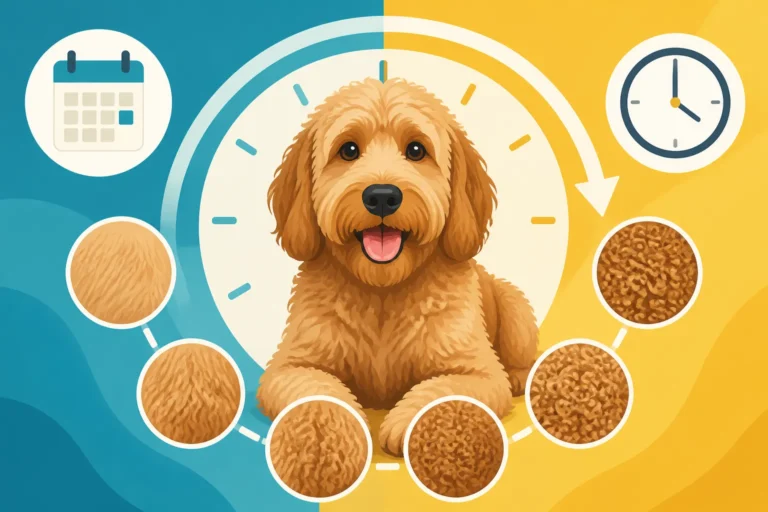
Perhaps the most significant grooming challenge for a fleece-coated Labradoodle owner is the "coat change," which typically occurs between 9 and 18 months of age, though it can start earlier or last longer. During this phase, your Labradoodle's soft, fine puppy coat begins to shed out, making way for the coarser, denser adult coat. The problem isn't the shedding itself (which is minimal), but rather that the shedding puppy hair gets trapped within the incoming adult coat. This creates a perfect storm for matting, often seemingly overnight.
Many owners, lulled into a false sense of security by the easy-to-manage puppy coat, are completely unprepared for the intensity of the coat change. What was once a quick brush can become an hour-long battle against tangles. If not meticulously brushed through daily during this period, mats can quickly become severe, requiring a full shave-down by a professional groomer. It’s a temporary but intense phase, and proactive, consistent line brushing is your best defense. Think of it as a rite of passage for Labradoodle owners. Understanding What Happens to a Labradoodle's Coat at Nine Months can help you prepare.
Allergy Management and the Fleece Coat
The primary reason many people seek a fleece-coated Labradoodle is the belief that they are "hypoallergenic." It's a common misconception, and while fleece coats are indeed low-shedding, no dog is truly 100% hypoallergenic. The term low-shedding refers to the minimal release of hair, which in turn reduces the amount of dander (dead skin cells) and dried saliva that can trigger allergic reactions. Since these coats don't shed much, fewer allergens are dispersed into the environment.
However, all dogs produce dander, saliva, and urine, and these are the primary culprits for allergies, not just the hair itself. A person with severe dog allergies might still react to a fleece-coated Labradoodle. It's crucial for prospective owners with allergies to spend extended time with a fleece-coated Labradoodle before bringing one home to gauge their reaction. Don't rely solely on the "hypoallergenic" label. While fleece coats are a fantastic option for many with mild to moderate allergies, they are not a guaranteed solution for everyone. Exploring Whether a Labradoodle Is Truly Hypoallergenic can provide more clarity on this important topic.
Finding a Breeder Who Delivers on the Fleece Coat
When you're looking for that perfect Labradoodle with the desirable fleece coat, choosing the right breeder is paramount. This isn't just about finding a puppy; it's about finding a reputable, knowledgeable breeder who prioritizes health, temperament, and coat predictability. A good breeder will be transparent, supportive, and an invaluable resource throughout your dog's life.
What to Look for in a Breeder
First and foremost, a reputable breeder will be open and honest about the genetic testing they perform on their breeding dogs. This includes not only health clearances for common Labradoodle issues but also specific DNA panels for coat traits, such as the Furnishings (F/IC) gene and curl genes (KRT71). They should be able to show you documentation proving that both parent dogs carry the genetics likely to produce fleece-coated offspring. Don't be afraid to ask for these results; they are a sign of a responsible breeder.
Beyond genetic testing, observe the parent dogs' coats when you visit the breeder. Do they themselves have well-maintained fleece coats? What about previous litters if possible? A good breeder will also be transparent about the potential for variation, even within the same litter, as genetics can sometimes surprise us. They should be willing to discuss the expected coat type of their puppies, and manage your expectations realistically. For a deeper dive into what to ask, consider The Health Tests a Labradoodle Breeder Should Show. Reputable breeders understand that finding a puppy is a big decision, and they will want to ensure their puppies are going to the right homes, just as you want to ensure you're getting the right puppy.
Understanding Coat Guarantees and Expectations
Some breeders might offer a "coat guarantee," which usually means they guarantee a puppy will have a non-shedding or low-shedding coat. While this sounds reassuring, it's important to understand what such a guarantee truly entails. It usually refers to the presence of furnishings (the F gene) which indicates a low-shedding tendency, rather than a guarantee of a specific texture (fleece versus wool). Even with the best genetic predictions, nature can sometimes throw a curveball, especially in early generations.
A responsible breeder will openly discuss the likelihood of a fleece coat based on the parentage and genetic testing, but will also emphasize that a Labradoodle's coat can continue to develop and change, particularly during the coat change period. They will educate you on the grooming commitment required for a fleece coat, reiterating that "low-shedding" does not mean "no-maintenance." It's essential to have a clear conversation with your breeder about what they can realistically guarantee and what your responsibilities will be in maintaining that beautiful coat. Even at 8 weeks, a puppy's coat is still developing, so discussions like Whether a Labradoodle Puppy's Coat Predicts the Adult One are very pertinent for new owners. Quality grooming tools, easily found on Amazon or Chewy, will be your best friend in keeping that fleece coat in tip-top condition.
Disclaimer
This article is for general informational purposes only and does not constitute professional advice. Laws, prices and regulations vary by location and change over time. Consult a qualified professional for guidance on your specific situation.