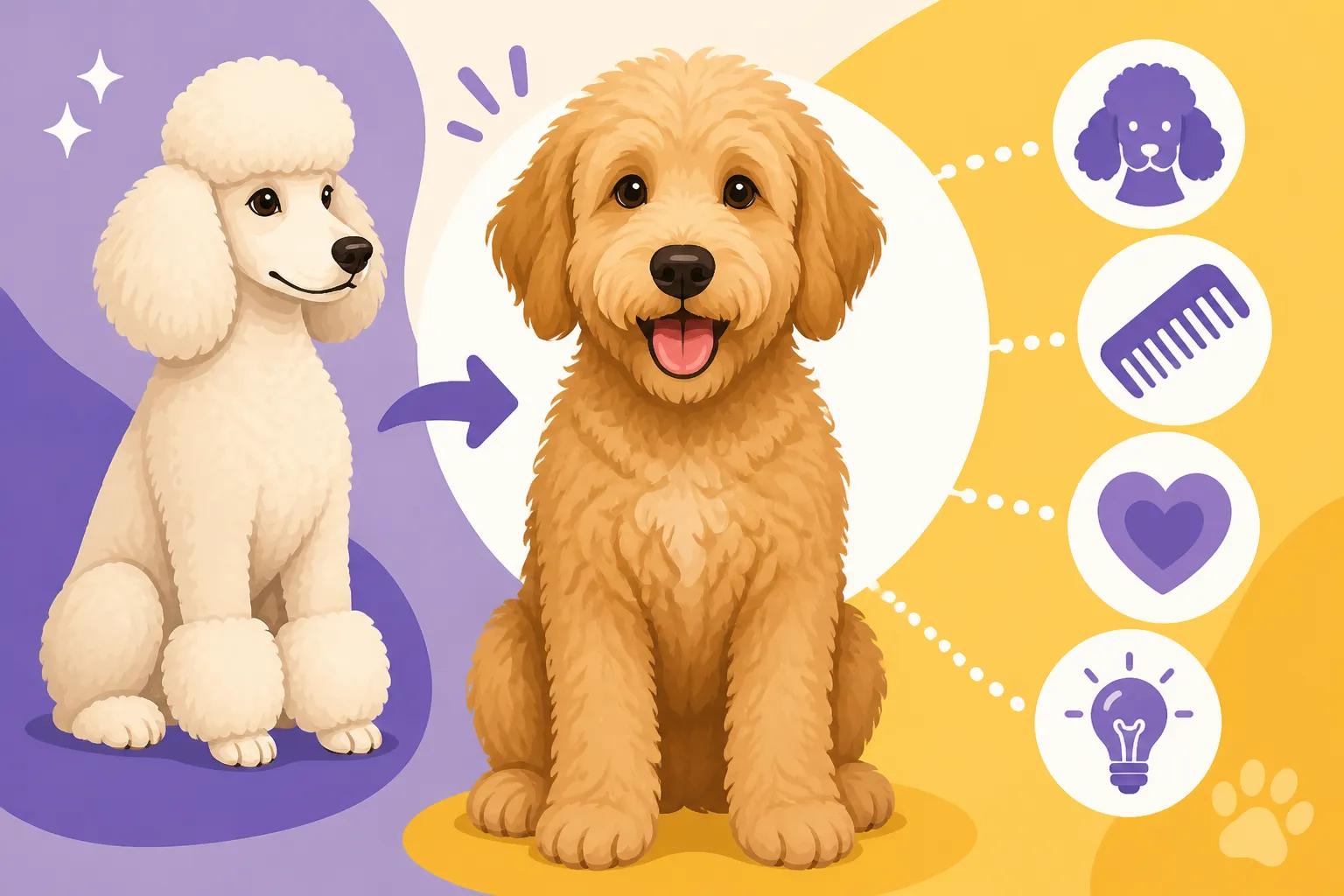
Which Labradoodle Traits Come From the Poodle
A Labradoodle may have a curly coat, a quick mind, and an uncanny knack for noticing every change in the room—but those traits do not come from the Poodle alone. Knowing what the Poodle may contribute can help you set realistic expectations for grooming, training, and daily life, while remembering that every Labradoodle inherits a unique mix.
The Poodle Traits You May Notice First
Coat texture, furnishings, and shedding
A Labradoodle’s curls or waves are among the most visible traits people associate with the Poodle. Some dogs have a loose wave, while others have tighter curls; some have a straighter, more Labrador-like coat. The Poodle’s coat genes can influence that texture, but the Labrador side matters too, and a puppy’s coat may change as it matures.
Poodles also commonly have furnishings: longer hair around the muzzle and eyebrows that gives a dog a bearded, expressive look. Labradoodles with furnishings may look especially “doodly,” but a beard or curly coat does not tell you exactly how much the dog will shed. For a closer look at how these features vary, see The Three Labradoodle Coats: Hair, Fleece and Wool and The Furnishings Gene Behind a Labradoodle's Beard.
Shedding is a particularly easy trait to misunderstand. Many people choose a Labradoodle expecting little or no loose hair, but a crossbreed’s coat is not a guarantee. Some Labradoodles shed noticeably, while others shed less and still need frequent brushing because loose hair can become trapped in the coat. Whether a Labradoodle Sheds at All explains why coat appearance alone is not a reliable promise.
| Poodle-influenced trait | What you might see in a Labradoodle | What not to assume |
|---|---|---|
| Curly or wavy coat | Curls, waves, or a softer fleece-like texture | That every puppy will keep the same texture as an adult |
| Furnishings | Longer hair around the muzzle and eyebrows | That furnishings guarantee low shedding |
| Coat growth | Hair that keeps growing and needs regular trimming | That the coat is easy-care |
| Lower shedding in some dogs | Less loose hair around the home | That the dog is hypoallergenic |
| Alertness and quick learning | Fast responses to cues and changes in routine | That training will happen automatically |
Grooming needs that come with a growing coat
Poodle-like coat growth can mean regular clipping as well as brushing. A Labradoodle may look tidy after a groom and then develop tangles in friction-prone spots such as behind the ears, beneath a collar or harness, and in the armpits. These mats can form close to the skin, where a quick brush over the top does not reach them.
A realistic grooming routine involves checking the coat down to the skin, rather than brushing only the visible surface. The right brush and comb depend on the dog’s coat, and many owners ask a groomer to demonstrate how to work through it safely. If you are putting together grooming supplies, you might compare tools at a local pet shop or through retailers such as Chewy, then ask your groomer which options suit your dog’s coat.
Regular professional grooming can make home care easier, but it does not replace it. If brushing has slipped for a few weeks, a dog may arrive at the salon with tight mats that are uncomfortable to work through. A shorter clip may be the kinder option in that situation. For a more detailed brushing routine, see Brushing a Labradoodle to the Skin, Not the Surface.
How Poodle Heritage Can Shape Behavior
Quick learning and an active mind
Poodles are often associated with intelligence and responsiveness, and those qualities may show up in a Labradoodle as quick learning, strong observation, or an ability to pick up household routines. A dog may learn that shoes mean a walk, that a particular cupboard holds treats, or that a certain time of day brings a family member home.
That quickness can be delightful, but it is not the same as automatic obedience. A clever dog can learn habits you did not mean to teach just as quickly as it learns “sit.” If jumping reliably earns attention, for instance, the dog may repeat it. Short, consistent training sessions and clear rewards help channel that fast learning toward behaviors you actually want.
A Labradoodle also needs practice in different settings. A cue learned in the quiet kitchen may not work immediately at a busy park, where there are squirrels, children, and other dogs to watch. Begin in a low-distraction place, reward the behavior you want, and gradually make the environment more challenging. The Poodle’s reputation for smarts does not remove the need for patient teaching.
Alertness, sensitivity, and company
Some Labradoodles are especially observant. They may notice a delivery van before you do, follow a change in the family’s routine, or look to their person for direction in a new place. That attentiveness can be useful in training, but it can also mean a dog is easily stimulated by noises, movement, or activity around the home.
Sensitivity varies between individual dogs. One Labradoodle may take new experiences in stride; another may need more time to feel comfortable with unfamiliar people, surfaces, or sounds. Calm introductions and rewarding relaxed behavior can help. Avoid forcing a worried dog into close contact with a stranger or a noisy situation: give the dog space and let confidence build gradually.
People often describe Labradoodles as affectionate and closely connected to their families. That tendency can reflect both parent breeds, not the Poodle alone. If a dog struggles when left by itself, companionship and affection are not enough to solve the problem; it may need gradual alone-time practice. The article The Temperament a Labradoodle Gets From Each Parent explores why traits can be difficult to assign to just one side of the cross.
Traits That Depend on More Than the Poodle
Energy, athleticism, and the need for activity
Poodles are active, capable dogs, and a Labradoodle may inherit an interest in movement, games, swimming, or learning tasks. But energy is not a simple Poodle-versus-Labrador equation. The Labrador parent can also contribute enthusiasm and athletic drive, and individual dogs vary widely. A laid-back adult and a busy young dog can come from similar-looking litters.
Activity needs should fit the dog in front of you. A walk may help, but many dogs also benefit from sniffing, retrieving, food puzzles, or short training games. A long, exciting outing is not always the answer to over-arousal; some dogs need help learning how to rest after activity, too. For ideas about balancing engagement and calm, see Whether a Labradoodle Needs a Job to Settle.
Age matters as well. Puppies need opportunities to explore and learn, but their exercise should be appropriate for their stage of growth. An adolescent Labradoodle may seem to have endless energy one day and struggle to focus the next. That does not mean the dog is being stubborn or “too smart.” It often means the routine needs structure, adequate rest, and manageable training goals.
Size and body shape
The Poodle can influence a Labradoodle’s size, particularly when a breeder uses a Miniature, Medium, or Standard Poodle. However, the size of a puppy is not determined by the Poodle parent in isolation. The Labrador’s size, the particular parents, and the breeding line all contribute. A puppy’s size estimate should be treated as an estimate, not a guarantee.
Body shape can vary, too. Some Labradoodles are lighter-framed, while others are broader or more substantial. A curly coat can make a dog appear larger than it is, especially when the coat has grown out. If size is important for your household—perhaps because you live in a smaller apartment or need to lift a dog into a car—ask about the adult sizes of both parents and close relatives.
It is also worth separating appearance from health and ability. A smaller Labradoodle is not automatically lower-energy, and a larger one is not necessarily more robust. Build, temperament, and exercise needs are individual. For a broader comparison of the breeds’ contributions, read Which Labradoodle Traits Come From the Poodle is not needed as a related link; instead, The Temperament a Labradoodle Gets From Each Parent offers useful context on why a cross cannot be neatly divided into two predictable halves.
How to Set Realistic Expectations for a Labradoodle
Think in probabilities, not guarantees
A Labradoodle inherits a combination of traits, rather than a fixed checklist where every Poodle feature appears in every puppy. Coat texture, shedding, size, energy, and sociability can vary—even between puppies from the same litter. A breeder may be able to discuss the parents and relatives, but no coat label or generation name can promise a particular adult dog.
This is especially important for people with allergies. A low-shedding coat may reduce visible loose hair, but it does not mean a dog cannot trigger symptoms. Allergens can be associated with dander and saliva as well as hair, and individual reactions differ. If allergies are a major concern, spend time around dogs with similar coats before committing, and discuss medical concerns with a qualified professional. See Whether a Labradoodle Is Truly Hypoallergenic and Which Labradoodle Generation Suits an Allergic Home for more detail.
Coat DNA information can sometimes help explain likely coat features, but it cannot tell you everything about the adult dog’s maintenance needs or how your household will respond to it. If you are evaluating a breeder’s claims, ask what the parents’ coats are like as adults, how much grooming they need, and whether the breeder can connect you with owners of older dogs from related lines. Whether a Labradoodle's Coat Type Can Be DNA Tested covers what such testing can and cannot clarify.
Choose for the dog you can care for
It is tempting to focus on the traits that look appealing in a puppy photo: a teddy-bear face, a curly coat, or an alert expression. A better decision considers the work attached to those traits. Can you keep up with brushing and grooming? Is there time for training and daily activity? Can you support a dog who may be more sensitive or more energetic than expected?
Before bringing a Labradoodle home, try writing down your ordinary weekday routine. Include the hours the dog would be alone, who will handle brushing, how exercise fits around work or school, and what you will do when the coat becomes tangled or the dog is distracted outdoors. This simple exercise often reveals practical questions that a cute puppy photo cannot answer.
You can also prepare supplies before the dog arrives. A comb, appropriate brush, nail-care tools, and basic cleaning products can make routine care less stressful. Retailers such as Chewy may be one place owners look for grooming essentials, but ask a groomer or veterinary professional when you are unsure what is suitable. Keep a simple care schedule on the fridge or in a phone calendar, and adjust it as you learn how your Labradoodle’s coat and behavior change.
Understanding the Poodle’s possible contribution is useful, but it should not be treated as a forecast for one specific dog. The most reliable approach is to learn about both parent breeds, ask thoughtful questions about the individual puppy and its relatives, and plan for the grooming, training, and companionship a Labradoodle may need. If you are comparing dogs, Whether a Labradoodle Is Calmer Than People Expect can also help you think beyond coat and appearance.
Disclaimer
This article is for general informational purposes only and does not constitute professional advice. Laws, prices and regulations vary by location and change over time. Consult a qualified professional for guidance on your specific situation.