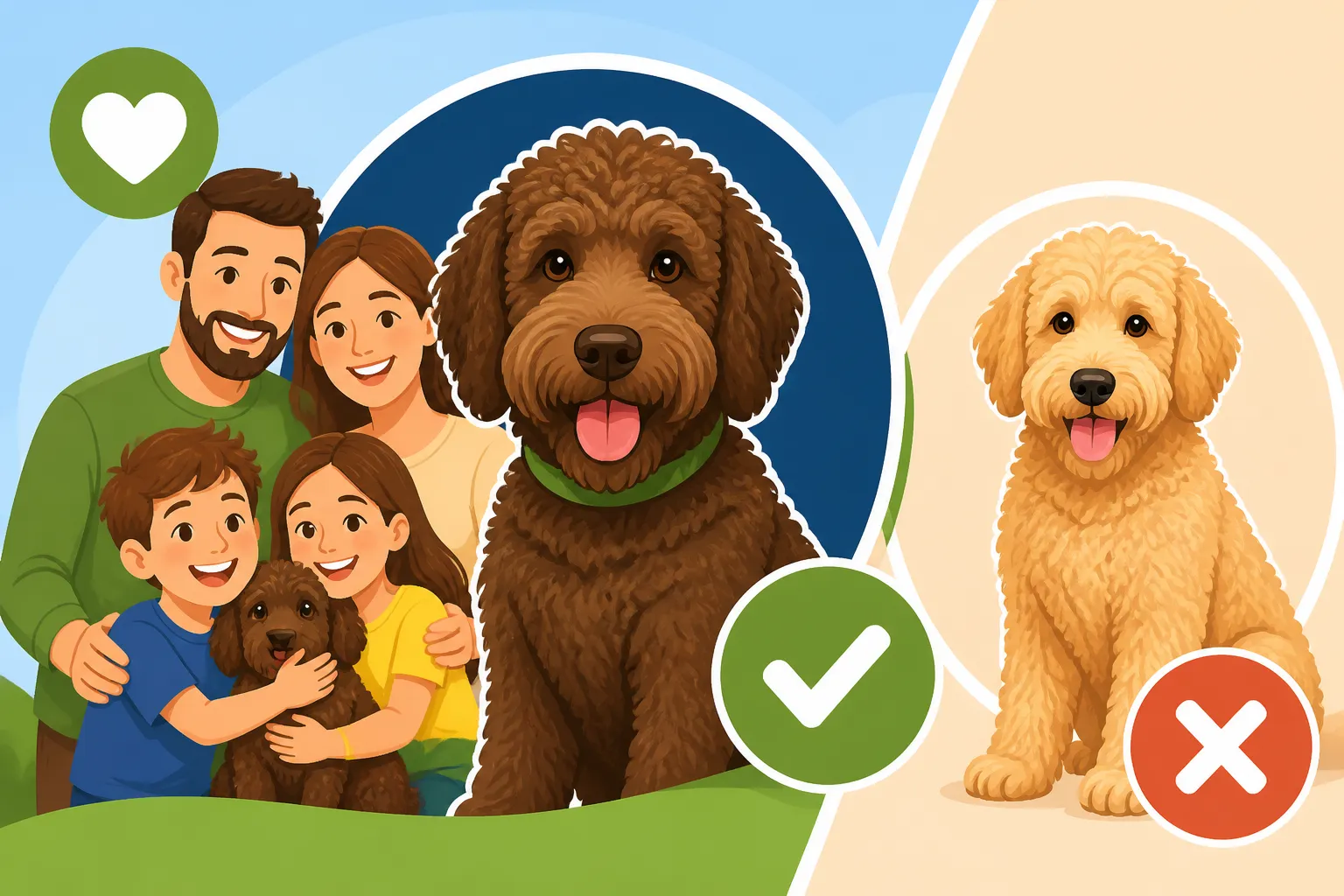
Labradoodle or Goldendoodle for a Family
Choosing between a Labradoodle and a Goldendoodle can feel like choosing between two versions of the same cheerful, curly-coated family dog. The harder truth is that neither name guarantees a particular temperament, size, shedding level, or energy needs. This guide compares what families should actually consider, from exercise and grooming to children, allergies, and choosing an individual puppy.
Labradoodle and Goldendoodle family traits
What the two crosses may have in common
A Labradoodle combines a Labrador Retriever with a Poodle; a Goldendoodle combines a Golden Retriever with a Poodle. Both crosses can inherit a mix of their parents’ looks and behavioral tendencies, and puppies in the same litter may not turn out exactly alike. Breed labels can offer clues, but they cannot promise that every dog will be sociable, easy to train, low-shedding, or calm indoors.
Both can be affectionate, people-oriented companions who enjoy being included in family life. They may also be energetic, enthusiastic dogs that need more than a quick trip into the yard. A family picturing a fluffy dog that quietly occupies a corner while the household is busy may be surprised by how much daily interaction and training a young doodle needs.
A Labrador’s retrieving instincts and enthusiasm may show up in some Labradoodles as a strong interest in toys, water, or carrying things around. Golden Retrievers are also often eager to engage with people and play, and those qualities may appear in a Goldendoodle. But the Poodle side, the individual parents, early experiences, and the puppy’s own personality all matter too. These are possibilities, not guarantees.
If you are comparing breed descriptions, remember that both mixes can be bright and responsive while still being excitable or distractible. A clever dog does not automatically know how to settle when guests arrive or ignore a sandwich left within reach. Training and management are part of family life with either cross. For a closer look at where inherited tendencies may come from, see The Temperament a Labradoodle Gets From Each Parent.
Which one is easier for a family
There is no dependable rule that Labradoodles are more energetic or that Goldendoodles are automatically gentler. Some families find that their particular Labradoodle is an energetic fetch enthusiast; another may have a Goldendoodle who is the household’s enthusiastic greeter. Meeting the puppy’s parents, asking about their behavior, and learning how the puppies respond to everyday handling can be more useful than choosing based on the crossbreed name alone.
Think about what “easy” means in your home. If it means a dog who enjoys walks, learns household routines, and likes spending time with people, either could be a fit with suitable care. If it means a dog that needs very little grooming, can be left alone for long stretches, and is naturally quiet around children, neither should be assumed to fit that picture. A family’s schedule, training habits, and tolerance for coat care can make a bigger difference than the name of the cross.
A good decision starts with honest conversations about the adults behind the litter. Ask what the parents are like when visitors arrive, how they behave around children and other dogs, and whether they can relax at home. Also ask how the breeder assesses puppy temperament and matches puppies to families. The broader household considerations in The Household a Labradoodle Actually Suits are useful for thinking through your own routines before you choose.
Children, routines, and the family home
Matching a dog to children and daily life
A friendly dog is not automatically a safe match for every child at every age. Young doodles can jump, mouth hands, grab clothing, and get overexcited during play. A large, bouncy puppy can knock over a toddler even without meaning to, while a child who hugs, chases, or takes toys from a dog may create a stressful situation for both. Adults need to supervise interactions and teach children to give the dog space, especially during meals, rest, and training.
Consider how much time the adults can give to exercise, enrichment, and training on an ordinary weekday—not just on a relaxed weekend. A Labradoodle or Goldendoodle may need walks, play, and opportunities to use its brain. Short training sessions and food puzzles can help, but they do not replace movement, companionship, or a plan for the hours when the family is at work or school.
It also helps to plan for life stages. A puppy needs frequent bathroom breaks and close supervision. An adolescent dog may appear to forget skills it previously learned, particularly around distractions. Families who expect a puppy to behave like a settled adult from the beginning can find the early months exhausting. A realistic view of that transition is covered in Raising a Labradoodle Through Its First Year.
What makes a family home work
A fenced yard can be convenient, but it does not train a dog or meet all its needs. A dog left outside alone may become bored, bark, dig, or look for ways to entertain itself. Apartment living can work for a suitable dog when the family provides regular outings, exercise, and training; a large home does not guarantee that a dog will get those things.
A family should also agree on a few basic rules before the puppy arrives. Decide where the dog sleeps, whether it is allowed on furniture, who handles walks, and how children should approach it. Consistency is helpful: if one person rewards jumping while another tries to discourage it, the dog receives mixed signals. Simple routines—such as asking for four paws on the floor before greeting people—give everyone a common approach.
If children are very young, consider the dog’s size and physical enthusiasm, not just its reputation for being friendly. A medium or standard-sized dog can be strong, and even a smaller dog can be overwhelmed by unpredictable handling. Give the dog a quiet retreat where children do not follow, and make sure adults are responsible for supervision rather than relying on the dog to tolerate everything. Families weighing a Labradoodle against other options may also find Labradoodle or Labrador for a First Dog helpful for clarifying what kind of day-to-day commitment suits them.
Coat care, shedding, and allergies
Grooming is part of the family commitment
Both crosses can have coats that require regular brushing and professional grooming, but coat type varies. A curlier or fleece-like coat may trap loose hair rather than shed it around the house, yet trapped hair can tangle and mat close to the skin. A straighter coat may be easier to brush in some cases but can shed more. The word “doodle” does not tell you exactly what your dog’s adult coat will be like.
Mats often form in places families do not notice at first: behind the ears, under a collar or harness, in the armpits, and around the legs. Brushing only the visible surface can leave tight tangles underneath. Ask a groomer to demonstrate how to part the coat and comb down to the skin, and build short, positive handling sessions into the puppy’s routine. Waiting until a young dog has a painful mat or needs a full groom can make the experience harder.
Before choosing either cross, ask what coat care the specific line tends to need and what grooming tasks the breeder begins with the puppies. Discuss practical details with a local groomer, including the kind of trim that suits your household and how to maintain it between appointments. For a deeper comparison of coat types and their upkeep, see The Three Labradoodle Coats: Hair, Fleece and Wool and The Coat Change That Hits a Labradoodle at Nine Months.
Allergies and shedding expectations
Neither a Labradoodle nor a Goldendoodle can be promised to be hypoallergenic. People with allergies may react to dander, saliva, or other allergens, not only to loose hair. A low-shedding coat may reduce the amount of hair around the home, but that does not mean a person with allergies will be symptom-free. Coat, individual dog, and individual person all make a difference.
If allergies are a concern, spend time with the particular adult dogs or puppies you are considering, ideally more than once and in a setting where you can observe your own reaction. A quick visit may not reflect what happens after living with a dog. Ask household members with allergies to speak with their healthcare professional about their symptoms and the implications of bringing a dog home. No breeder’s coat description can replace that step.
It is sensible to plan for the grooming commitment even if a dog sheds very little. Families may compare brushes, combs, shampoos, and grooming supplies through retailers such as Chewy, but the right routine depends on the dog’s coat and skin. Retail listings can help you review product descriptions; they cannot determine whether a particular tool or shampoo suits your dog. For related background, see Whether a Labradoodle Is Truly Hypoallergenic and Whether a Labradoodle Sheds Less Than a Goldendoodle.
Choosing between a Labradoodle and a Goldendoodle
Compare the individual dog, not just the label
A useful comparison focuses on the specific puppy, its parents, and the breeder’s practices. Ask to meet the mother when possible and learn about the father’s temperament, health, and daily behavior. Ask how the puppies respond to ordinary sounds, gentle handling, new people, and brief separation from their littermates. A responsible breeder should be willing to discuss both strengths and limitations rather than promising that every puppy will be perfect for every family.
| Family priority | What to ask or observe |
|---|---|
| A manageable energy level | Ask how the parents behave after exercise and how the breeder describes each puppy’s activity and recovery |
| Living with children | Ask about the parents’ behavior around children and discuss safe supervision and puppy handling |
| Less coat maintenance | Ask what coat types the parents have and what grooming the breeder expects, without assuming the puppy’s coat is guaranteed |
| Allergy concerns | Spend time with the actual dogs and discuss the family’s allergy concerns with a healthcare professional |
| A dog that can settle | Ask whether the parents relax indoors and what the breeder does to assess puppies’ ability to recover after excitement |
| Predictable adult size | Ask about both parents’ size and family history, while treating any puppy estimate as an estimate |
Health and temperament deserve as much attention as appearance. Ask what health screening has been completed on the parents and request the records rather than relying on verbal assurances. Ask how the breeder handles a puppy that is shy, highly active, or more independent than its littermates. A careful match may mean the breeder recommends a different puppy—or even suggests waiting for another litter.
A registry or crossbreed label cannot, by itself, tell you how a dog will behave in your home. The article The Labradoodle Against the Goldendoodle offers another way to compare the two, while What Nobody Tells a First Time Labradoodle Buyer can help set realistic expectations about ownership.
A practical way to make the decision
Start by writing down the non-negotiables for your household. Include how much exercise you can provide on workdays, how often you can brush the dog, whether anyone has allergies, and how much time the dog will spend alone. Then rank the priorities. If the family cannot manage frequent coat maintenance, a dog with a demanding coat may not be a sensible choice regardless of how appealing it looks in photos.
Next, compare actual breeders and individual puppies. Ask about parent temperament, health screening, early socialization, grooming preparation, and how puppy matching works. Be cautious of absolute claims such as “guaranteed non-shedding,” “perfect with every child,” or “calm without training.” A puppy’s future behavior cannot be reduced to a label or a single short visit.
Finally, picture an ordinary day six months after the novelty has worn off. Who gets up for a morning walk? Who brushes the coat? What happens when the dog is muddy, overexcited, or unable to settle while dinner is being made? If your family has realistic answers and is prepared to adjust routines, either cross may become a loving companion. If the main attraction is a particular look or a promise of effortless care, take more time before committing.
Chewy and similar retailers may be useful when comparing everyday supplies such as food storage, grooming tools, or enrichment toys, but buying equipment is only one small part of preparation. Check product instructions and ask your veterinarian or groomer when you are unsure what suits your dog. The best fit is not simply the dog whose coat or color you prefer; it is the individual dog whose needs your household can meet consistently.
Disclaimer
This article is for general informational purposes only and does not constitute professional advice. Laws, prices and regulations vary by location and change over time. Consult a qualified professional for guidance on your specific situation.