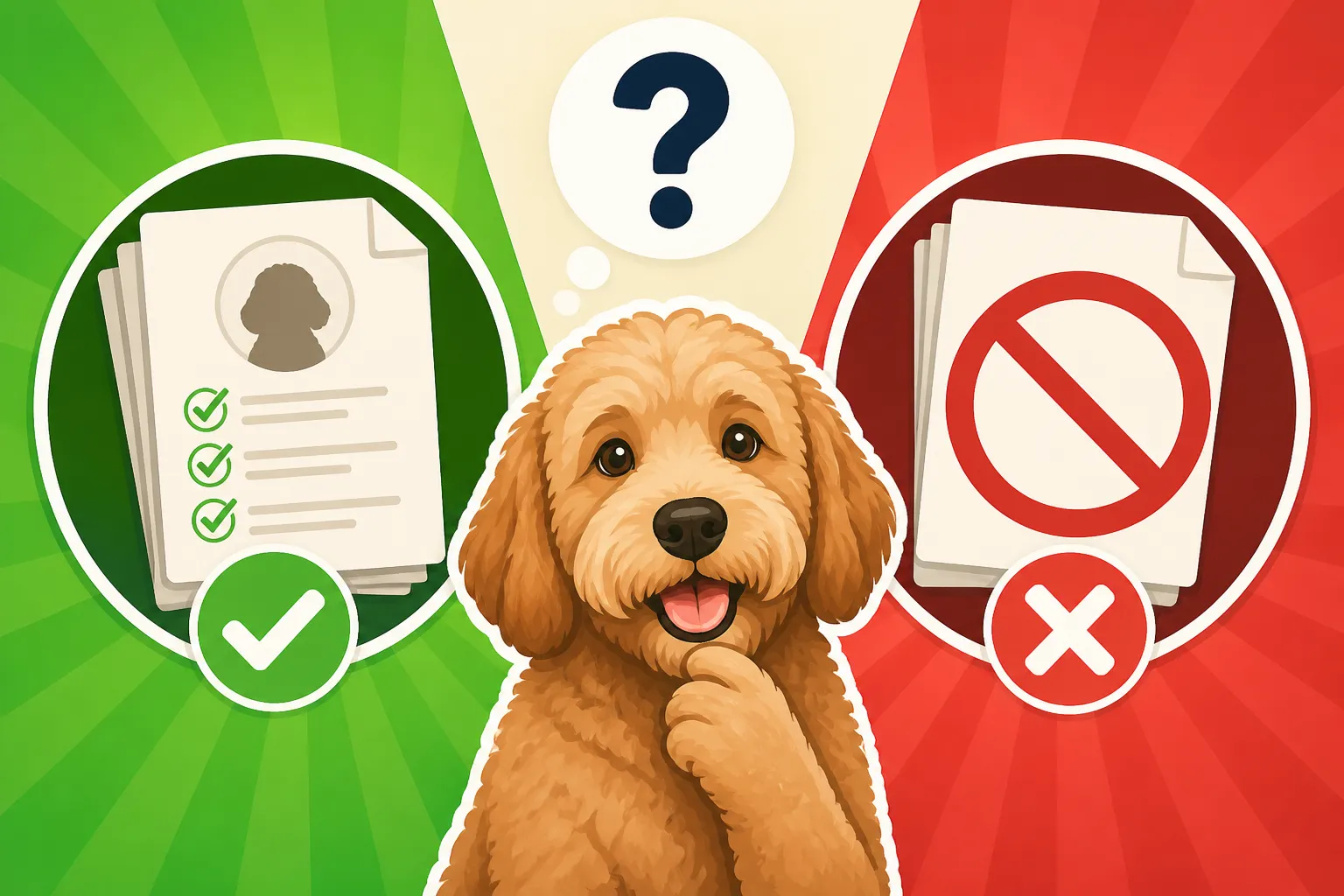
Whether Papers Matter When Buying a Labradoodle
A breeder’s “papers” can mean a pedigree, a registry record, health-test results, or simply a folder of puppy documents—and those things do not prove the same thing. If you’re trying to decide whether a Labradoodle puppy’s papers are worth paying attention to, this guide explains what to ask for, what documents can verify, and what they cannot.
What Labradoodle papers usually mean
Pedigree and registration are not the same as a health guarantee
A pedigree is a record of a dog’s ancestry. It may list parents, grandparents, and more distant relatives, helping you see how a breeder describes the puppy’s lineage. A registration record, meanwhile, is issued by a registry that records information about a dog or its ancestry under that organization’s rules.
Neither document automatically proves that a puppy is healthy, well bred, or a good match for your home. A pedigree can be useful background, but it is not a veterinary examination or a promise that inherited conditions will never occur. Likewise, registration is not the same as government approval or a universal quality certification. The details matter: who issued the record, what information it contains, and whether you can verify it.
If you want to understand what a lineage document can tell you, and where its limits are, read What a Labradoodle Pedigree Actually Shows. A paper trail can help you ask better questions, but it should be one part of your decision rather than the whole reason you trust a breeder.
“Papers” can refer to several different documents
When a breeder says a Labradoodle “comes with papers,” ask them to name each document. They may mean a pedigree or registry paperwork, a written sales agreement, vaccination and veterinary records, a microchip record, or test results for the puppy’s parents. These documents serve different purposes, so a vague answer is not enough to assess what you are receiving.
For example, vaccination records can help your veterinarian plan the puppy’s next care. A contract can spell out the breeder’s and buyer’s responsibilities. A parental health-test report may show that specific screening was performed. A registry document may provide ancestry or registration details. One document does not replace the others, and a stack of papers is not necessarily reassuring if it leaves the important questions unanswered.
| Document | What it may help establish | What it does not establish by itself |
|---|---|---|
| Pedigree | Reported ancestry and family relationships | That the puppy is healthy or has predictable traits |
| Registry record | Registration details under that registry’s rules | That a registry has independently approved the breeder’s practices |
| Parent health-test results | Whether particular screening was completed and the results recorded | That the puppy cannot develop any inherited or acquired condition |
| Veterinary and vaccination records | Care reported for the puppy to date | That future care or health outcomes are guaranteed |
| Purchase contract | Terms and responsibilities agreed to by the parties | That every term is fair, enforceable, or a substitute for careful research |
The most useful question is not “Does the puppy have papers?” but “Which papers, from whom, and can I see the underlying records?” If you are comparing registry claims, Whether ALAA Papers Prove Anything and What a WALA Pedigree Shows About a Labradoodle offer useful context. Membership or registration may provide information, but it should not be treated as a substitute for checking the breeder’s actual practices.
What papers cannot tell you about a Labradoodle
Registration does not make a Labradoodle a recognized purebred
Labradoodles are crosses between Labrador Retrievers and Poodles, and there is no single universally accepted breed registry or breed standard that makes every Labradoodle’s paperwork directly comparable. Different organizations may record dogs or pedigrees under different criteria. That means a registry name can be a starting point for questions, not a reason to assume that every organization records the same information or checks the same things.
Be cautious if a seller presents registration as proof that the puppy will have a particular adult size, coat, shedding level, temperament, or health status. A family tree may offer clues about a puppy’s background, but it cannot guarantee the exact dog you will get. In a crossbreed, individual puppies can vary, even when they share the same parents.
A breeder should be able to explain what a particular registration means in plain language and show you how to confirm it. If they say that a registry guarantees quality, ask what standards are involved and whether those standards are independently verified. You can also read Whether a Labradoodle Breeder Must Belong to a Club to understand why club membership and responsible breeding are related questions, but not identical ones.
Health testing needs evidence, not just reassuring language
A breeder may say the parents are “health tested,” but that phrase is too broad to evaluate on its own. Ask which tests were performed, which parent was tested, when the test was done, what the result was, and whether you can review the report. Screening should be relevant to the dogs’ size, ancestry, and breeding plan; a DNA panel alone does not necessarily cover every condition that could matter.
For a clearer picture of which records to request, see The Health Tests a Labradoodle Breeder Should Show. You can also review Whether a Labradoodle From Untested Parents Is a Risk before deciding how much weight to give a breeder’s verbal assurances. A careful breeder should be willing to discuss both test results and the limits of testing without promising a perfectly healthy puppy.
It is also worth distinguishing a test result from a general certificate or summary. Ask for the actual documentation where possible, and check that the dog named on the report matches the parent named by the breeder. If the breeder refuses to show results, offers only an undated statement, or says the puppy’s registration means testing is unnecessary, treat that as a reason to pause and ask more questions.
How to evaluate a breeder’s paperwork
Ask for documents before you commit
You do not need to be confrontational to ask for records. A straightforward message can be enough: “Could you show me the parents’ health-test results, explain what registry the puppies are recorded with, and share the contract and puppy veterinary records I would receive?” A responsible breeder should understand why a buyer wants to review those details before sending money or making a final decision.
Look for consistency across the documents. Do the names and identifying details match? Are the parents listed clearly? Does the breeder explain any gaps in the puppy’s records? Are you being shown the original results or a summary that can be checked? If the breeder has a waitlist or puppies are not yet old enough for certain records, they should explain what is available now and what will be provided later.
A breeder’s willingness to answer questions is meaningful, but it is not proof by itself. Compare what they tell you with the documentation, and avoid rushing because someone says another buyer is about to take the puppy. If you are considering an Australian Labradoodle, Whether an Australian Labradoodle Breeds True can help you think through how breeding programs and claims of predictability should be assessed.
Read the contract and keep your own records
Read the agreement carefully before signing. Check what it says about the purchase, health concerns, returns or rehoming, and any conditions the breeder places on the dog. Ask for clarification in writing if a clause is confusing. “The breeder explained it over the phone” is less useful later than a clear written answer that you can keep with the contract.
After bringing your puppy home, save the documents together. Keep the contract, registration information, parent test results, veterinary records, microchip details, and any written communications. A folder—digital or physical—makes it easier to answer questions at a vet visit or if you ever need to contact the breeder. Keep receipts and care notes separate from pedigree records: if you use Chewy for food or supplies, its order history may help you track what you purchased, but it does not verify a puppy’s ancestry or health screening.
That distinction is easy to lose when everything arrives in one puppy packet. Chewy receipts can be part of your household’s practical care records, while official test reports and veterinary documents belong in the health file. Neither a retailer’s records nor a breeder’s paperwork should be treated as a replacement for your veterinarian’s advice. For a closer look at what a contract can and cannot do, see Whether a Labradoodle Breeder’s Contract Is Enforceable.
Should you buy a Labradoodle without papers
Decide what is missing before judging the offer
“Without papers” can mean different things. A puppy might lack registry paperwork but still have veterinary records and documented parent health testing. Or the seller may have no reliable information about the parents, no test results, and no clear account of the puppy’s care. Those are very different situations, so ask exactly what is unavailable and why.
If lineage is important to you, missing pedigree information may be a deal-breaker. If your main concern is health and responsible breeding, the absence of registry paperwork may matter less than the absence of verifiable health records or transparent answers. Either way, do not assume a lower price makes the missing information unimportant. The cost of a puppy is only one part of the decision, and paperwork gaps may affect how confidently you can assess the breeder’s claims.
You may find Whether a Labradoodle Without Papers Is Cheaper for a Reason helpful when comparing offers. Price alone does not prove that a seller is dishonest, just as papers alone do not prove that a seller is responsible. Consider the full picture: the dogs’ living conditions, the breeder’s knowledge of the parents, health documentation, puppy care, and the clarity of the agreement.
Use a simple decision check
Before you commit, make sure you can answer these questions:
- What exactly does the breeder mean by “papers”?
- Which documents will be provided, and when?
- Can I review the parents’ health-test reports?
- Can the registry or record be checked with the issuing organization?
- Do the puppy’s veterinary records match the breeder’s explanation?
- Is the contract clear, and can I take time to read it?
- Are the breeder’s answers consistent and specific?
If several answers are vague, take a step back. You do not have to decide while standing in a kitchen with a puppy on your lap, however sweet the puppy is. It is reasonable to ask for time to review the records, talk with your veterinarian, and compare breeders.
Papers matter when they provide verifiable information that helps you make a careful choice. They matter much less when they are used as a shiny label to distract from missing health records, unclear breeding practices, or pressure to pay quickly. Focus on what each document actually says, confirm it where possible, and choose a breeder who is comfortable with thoughtful questions.
Disclaimer
This article is for general informational purposes only and does not constitute professional advice. Laws, prices and regulations vary by location and change over time. Consult a qualified professional for guidance on your specific situation.