What a Labradoodle Pedigree Actually Shows
A Labradoodle pedigree can look official while leaving the biggest questions unanswered: who the dog’s ancestors were, whether the listed parents are correct, and whether anyone checked those dogs’ health. This guide explains what pedigree paperwork can establish, what it cannot prove, and how to check the records before you rely on them.
What a Labradoodle pedigree records
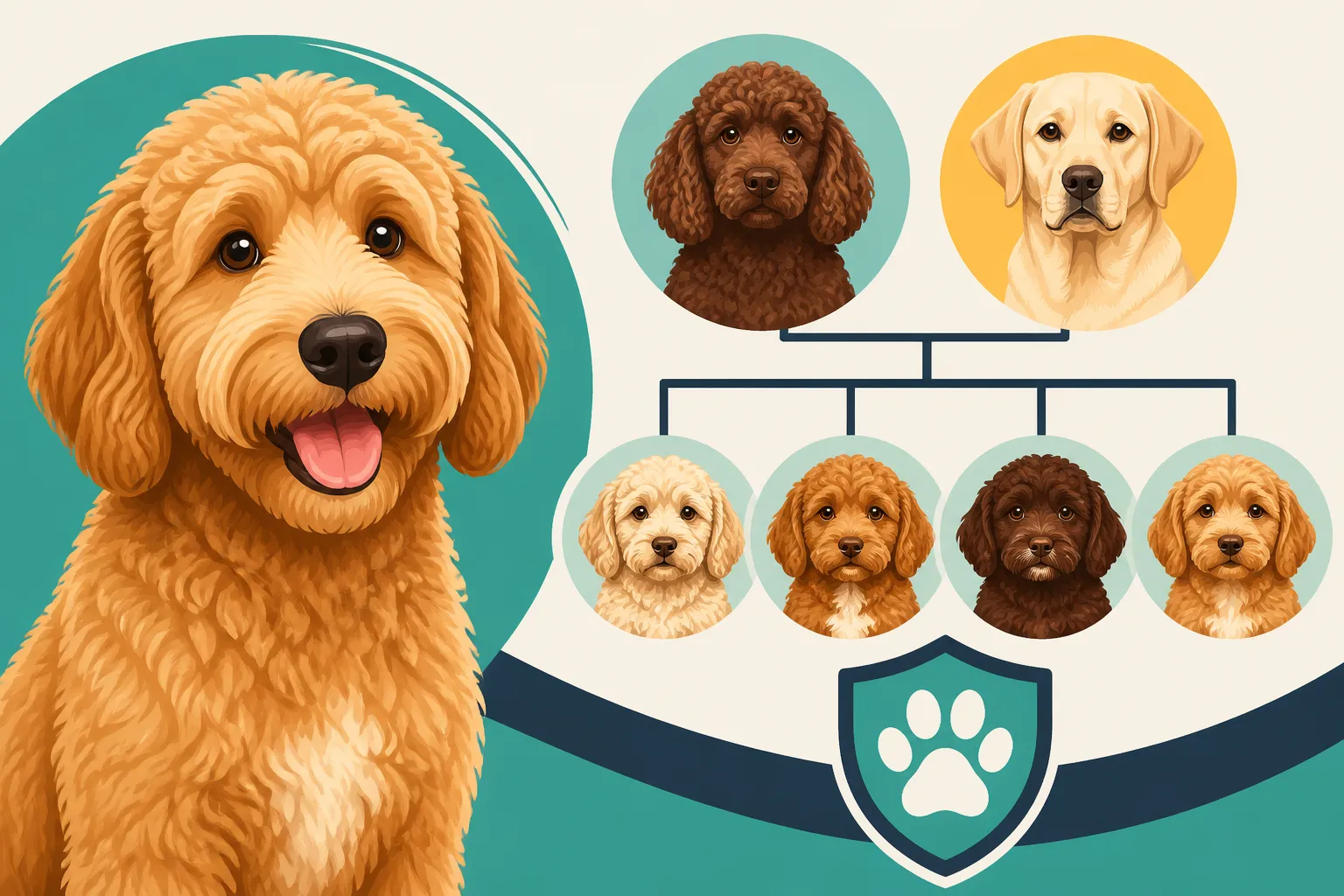
A pedigree is a written family tree. Depending on the registry and the depth of the record, it may list a dog’s registered name or number, its parents, and several generations of ancestors. Some records also include dates of birth, colors, breeder information, or titles and achievements attached to particular dogs.
The important point is that a pedigree records ancestry as reported and accepted by a registry or breeding program. It is not automatically a health certificate, a guarantee of temperament, or independent proof that every detail is correct.
The names and generations in the family tree
Start with the dog at the top or bottom of the document, depending on how the pedigree is laid out. Its registered name may differ from the name it uses at home. Then follow the lines to its sire and dam, and from them to grandparents and more distant ancestors. A useful pedigree lets you see how those generations connect rather than presenting an isolated list of impressive names.
Generation labels such as F1, F1b, F2, and multigenerational may appear in a breeder’s paperwork or description. They can give a general picture of how a dog was bred, but a label alone is not a complete family tree. If you are unsure what a generation term means, What F1 Means on a Labradoodle and What Multigen Means on a Labradoodle explain the terminology in more detail.
Ask the breeder to show how the label applies to this specific puppy. For example, “F1b” is useful only when you know which parent was crossed back to which breed and can see the parents’ identities. A verbal generation claim without names or supporting records tells you much less than a traceable pedigree.
Registration details and program information
A pedigree may come from a registry, breed organization, or structured breeding program. Labradoodles are crosses rather than a single universally standardized purebred breed, so paperwork can differ between organizations. A registration certificate and a pedigree are related but not identical: one may establish that a dog was recorded with an organization, while the pedigree lays out its listed ancestry.
Do not assume that a document bearing a logo means the same thing across every registry. Check which organization issued it, what information it records, and whether the registry makes records available for verification. Why No Kennel Club Registers the Labradoodle gives useful background on why Labradoodle paperwork can look different from paperwork for breeds with a long-established central registry.
For an Australian Labradoodle, records may reflect a multigenerational program and a broader ancestry than a simple Labrador-and-Poodle cross. The name “Australian” does not, by itself, tell you what is in a particular dog’s family tree. Ask for the actual lineage and the registry’s explanation of its terms. What a WALA Pedigree Shows About a Labradoodle and What ALAA Membership Requires of a Labradoodle Breeder can help you understand what particular organizations and programs may document.
Names are not the same as proof
A list of registered ancestors is useful only if you can connect those names to real records. A breeder may provide a pedigree, registration papers, or both, but those documents do not automatically show that the named dogs were independently identified or that the puppy is their biological offspring.
Look for consistent names and identifiers across documents. If a parent’s registration number appears on a pedigree, it should match the number on that parent’s registration record or other official documentation. If a breeder provides a litter record, compare the puppy’s details with the record and ask how the puppy is identified.
A polished certificate can be reassuring, but the details matter more than its appearance. If the pedigree contains unfamiliar abbreviations, missing parent information, or a sudden jump in generations, ask for an explanation before treating it as a complete account.
What a Labradoodle pedigree does not prove
It is easy to read more into a pedigree than it can support. A pedigree can help you understand ancestry and breeding choices, but it does not predict every outcome for an individual dog. It is one part of evaluating a puppy, not a substitute for veterinary records, health testing, or meeting the breeder.
It does not guarantee health
A pedigree may help you notice repeated ancestors or patterns in a line, but it does not prove that a dog has been screened for inherited conditions. Nor does a clean-looking family tree guarantee that a puppy will never develop a health problem. Some conditions are influenced by multiple factors, and health can be affected by both inherited and non-inherited causes.
Ask for actual test results for the puppy’s parents, not just a statement that the line is “healthy” or “genetically clear.” The relevant tests depend on the dogs’ ancestry and the breeding program. A general list of considerations is covered in The Health Tests a Labradoodle Breeder Should Show. For the difference between paperwork and membership claims, Whether ALAA Papers Prove Anything is also worth reading.
Check that each result belongs to the dog named in the pedigree. A breeder should be able to explain which dog was tested, what test or screening was performed, and where the result can be verified when a public database or testing organization provides that option. A pedigree without health records is still an ancestry document; it simply does not answer health-testing questions.
It does not promise coat type, size, or temperament
Ancestors can offer context, but they cannot guarantee that a puppy will have a particular coat, reach a precise adult size, or behave exactly like a relative. Labradoodles can vary, including within the same litter. A pedigree may show the breeds or lines behind a dog, yet the puppy’s eventual traits remain individual.
A breeder’s predictions are more meaningful when paired with information about the parents and close relatives. Ask what adult dogs in the line are like, how their coats developed, and how much variation the breeder has seen. Treat a confident promise as a claim to discuss, not a fact established by the pedigree.
Temperament is also shaped by early experiences, socialization, training, and the dog’s environment. A family tree may provide clues about a line, but it cannot replace observing the parents when possible or asking how the breeder evaluates and raises puppies.
It does not establish a universal breed status
Because Labradoodle recording systems and breeding programs are not all the same, a pedigree should not be treated as proof that every organization recognizes the dog as a standardized breed. Registration may show that a dog is recorded within a particular system. That is different from saying that every registry uses the same rules or accepts the same ancestry.
If a breeder describes a dog as a particular type of Labradoodle, ask what that wording means in the breeder’s program. Ask which registry issued the paperwork and what its records establish. Whether a Labradoodle Breeder Must Belong to a Club can help frame the question: membership or registration may be useful context, but neither should be treated as an automatic guarantee of breeding quality.
A consumer DNA ancestry report is not a substitute for a pedigree either. The report may estimate breed ancestry, depending on the test and its reference database, but it does not recreate a verified, named family tree. If you are considering a consumer DNA kit, review the test maker’s explanation and the current listing details wherever you shop, including retailers such as Chewy. The result should be considered separately from a breeder’s registry records.
How to read and verify the paperwork
A careful review does not require you to be an expert in every registry. It does mean slowing down, following the names, and asking questions until the records make sense. A responsible breeder should be able to explain the paperwork without making you feel foolish for asking.
Check the puppy, parents, and identifiers
Begin by matching the puppy’s name or identification details on each document. Then compare the sire and dam names with the names given in the pedigree, registration records, and health-testing results. Names can vary slightly between informal and registered use, so ask the breeder to explain any differences rather than assuming a mismatch is harmless or suspicious.
Where possible, look for identifying information such as registration numbers, microchip details, or test record identifiers. Not every document will contain every identifier, but consistent information makes it easier to establish that a result belongs to the dog being discussed. Keep copies of the paperwork and note which organization issued each record.
If the breeder offers a DNA ancestry test as evidence of parentage or breed mix, ask what the test is designed to establish. An ancestry estimate and a parentage verification test are not interchangeable. Consumer kits sold through a test company or retailers such as Chewy may be useful for particular questions, but a retail purchase confirmation does not validate a breeder’s pedigree or replace records from the registry.
Verify through the issuing organization
Find out who issued the pedigree and how a buyer can confirm its details. Some organizations provide searchable records or tell owners how to request verification; others may handle records differently. Contact the organization directly using its official contact details if you have questions about whether a certificate or registration number is genuine.
For Australian Labradoodles, ask the breeder which program or registry the dog is recorded with and whether the parents’ records can be checked. Whether Buyers Can Verify an Australian Labradoodle Pedigree focuses on that practical issue. If a breeder says verification is impossible, ask why and request other documentation that supports the ancestry claim.
The goal is not to turn a puppy purchase into an investigation for its own sake. It is to make sure you understand what the paperwork represents. A breeder who can calmly show how the records connect is giving you a much clearer basis for a decision than someone who relies only on a certificate image or verbal assurance.
Compare the pedigree with health records
A pedigree and health documents should tell a coherent story. If a breeder says the parents have completed specific screenings, ask to see the results and confirm the dogs’ identities. Do not rely only on a health summary printed on a sales page; detailed records make it possible to understand which screenings were done and what they mean.
Here is a practical way to sort the documents:
| Document or record | What it may help establish | What it does not establish by itself |
|---|---|---|
| Pedigree | Listed parents and ancestors within a recording system | That every ancestry detail has been independently verified |
| Registration record | That a dog is recorded with a particular organization | Universal breed recognition or health |
| Health test results | The outcome of specified tests for an identified dog | That the dog is free from every inherited or future condition |
| Consumer DNA ancestry report | An estimate of ancestry based on the test provider’s methods | A complete registered family tree or proof of all breeder claims |
| Parentage verification | Whether tested dogs are consistent with stated parentage | Overall health, temperament, or future traits |
A mismatch does not automatically mean fraud; paperwork can contain clerical errors. But a breeder should be willing to investigate and correct mistakes. If health results appear to belong to another dog, or the breeder will not explain a discrepancy, pause before proceeding.
Questions to ask before relying on a pedigree
You do not need to memorize registry rules to have a productive conversation. Clear, specific questions often reveal whether the breeder understands the records and is comfortable sharing them. Keep the discussion practical: what does the document show, who issued it, and how can you check it?
A simple question list for breeders
Ask for a copy of the puppy’s pedigree and the parents’ registration details. Then ask which registry or breeding program issued the documents and whether you can verify the records directly. If you see generation labels, ask the breeder to explain them using the actual parentage of this puppy rather than a general description.
Ask for the health-testing records for both parents and check that each result matches the dog named in the pedigree. If the breeder says the parents are “clear,” ask which conditions were tested and whether those results are available for review. The wording can sound reassuring, but the underlying records are what let you assess the claim.
You can also ask what the pedigree tells the breeder about the line and what it does not tell them. A thoughtful answer will usually include some limits. No responsible pedigree can promise a particular adult coat, a precise weight, or a lifetime free of health problems.
Warning signs and reasonable explanations
Be cautious if a breeder refuses to identify the registry, will not show parent information, or treats basic questions as an insult. Another concern is a pedigree with inconsistent names or numbers that the breeder cannot explain. Missing information is not always proof of wrongdoing, but it does mean you should avoid treating the document as stronger evidence than it is.
Some breeders may have a legitimate reason that a particular record is not publicly searchable. In that case, ask what alternative verification they can provide and whether the issuing organization can confirm the document. The response should be specific enough for you to understand what is being confirmed.
If you are comparing breeders, use the same questions with each one. One may provide a beautifully formatted pedigree but little health documentation; another may have simpler paperwork and clear, verifiable test results. The second set of records may answer more of the questions that matter for choosing a puppy.
Build a complete picture, not a paperwork score
A pedigree is most useful when considered alongside health testing, the breeder’s transparency, the puppy’s early care, and your own fit with the dog. It gives you a map of the ancestry that the registry records; it does not tell the whole story of the puppy you will bring home.
Keep copies of the pedigree, registration certificate, health reports, and any written explanations you receive. If you later need to discuss the dog’s background with a veterinarian or breeder, having the exact documents is more useful than trying to remember what was said during a busy visit.
Retailers such as Chewy may be one place buyers encounter consumer DNA products, but those products answer a different question from registry paperwork. Whether you see a kit at Chewy or buy directly from a testing company, read what the test claims to measure and keep its results separate from the pedigree. The most reliable understanding comes from matching each record to the question it can actually answer.
Disclaimer
This article is for general informational purposes only and does not constitute professional advice. Laws, prices and regulations vary by location and change over time. Consult a qualified professional for guidance on your specific situation.