Whether a Labradoodle Has a Breed Standard
A Labradoodle can look remarkably different from the next dog called a Labradoodle, which makes “Does this breed have a standard?” a fair question. The short answer is that there is no single, universally accepted standard for all Labradoodles. Some organizations publish standards for the dogs in their own breeding programs, but those do not apply to every Labradoodle.
What a breed standard actually means
A standard describes an agreed type
A breed standard is a written description of the ideal dog for a particular breed. It may cover appearance, size, proportions, coat, movement, and temperament. Conformation judges use standards to assess how closely an individual dog matches that stated ideal.
A standard does not promise that every dog in a breed will look identical. It gives breeders and judges a shared reference point. For established breeds, that reference can help encourage consistency over generations, although health and behavior still depend on many factors beyond appearance.
A standard is not the same as a breed description
You may find websites describing the Labradoodle’s typical coat, personality, or expected size. Those descriptions can be useful background, but they are not automatically official standards. A general overview of what owners might encounter is different from a document adopted by a specific organization and used to guide breeding or judging.
This distinction matters when you are comparing breeders. One breeder may use “standard” to describe their preferred look or breeding goals, while another may be referring to an organization’s written standard. Ask which document they mean and who issued it.
A standard does not guarantee a particular dog
Even when a breeder follows a written standard within a program, that does not guarantee that a puppy will reach a promised adult size, have a particular coat, or develop a specific temperament. Puppies inherit a mix of traits, and growth and behavior are shaped by health, environment, socialization, and care.
If you are choosing a puppy, it may help to separate three questions: Is there a written standard for this breeding program? What traits are the parents known to pass on? And what health and temperament information can the breeder show? The answers are related, but they are not interchangeable.
Why there is no universal Labradoodle standard
Labradoodles are not one uniform population
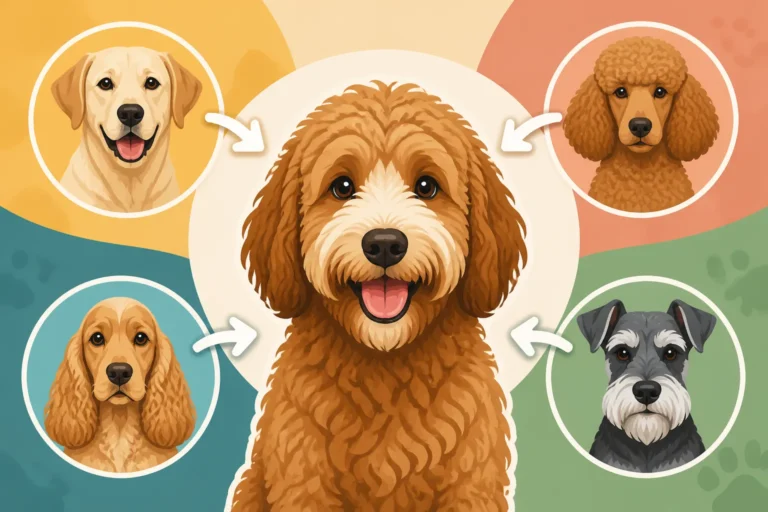
Labradoodles are crosses involving Labrador Retrievers and Poodles, and breeding practices vary. Some pair a Labrador with a Poodle, while others breed Labradoodle to Labradoodle across generations. The dogs can differ in size, coat texture, furnishings, and overall appearance.
That variation is part of why there is no single description that neatly fits every dog marketed as a Labradoodle. One may have a loose, wavy coat and a broad, Labrador-like build; another may have tighter curls and a more Poodle-like outline. A name alone does not tell you how predictable those traits will be.
For more on the naming and classification question, see Whether a Labradoodle Is a Breed or a Cross. The answer helps explain why standards, registries, and breeder terminology can be confusing.
Breed recognition and registration are separate issues
A registry may keep records of dogs, pedigrees, or breeding lines without recognizing the Labradoodle as a standardized breed. Likewise, an organization may create a standard for dogs in its own program without making that document universal across all Labradoodles.
The American Kennel Club does not recognize the Labradoodle as a purebred breed in its conformation system. That does not mean Labradoodles cannot be registered or participate in every type of organized dog activity. Different registries and organizations have different rules, and some allow mixed-breed dogs to take part in certain sports or programs.
For more context, read Why No Kennel Club Registers the Labradoodle and The Registries That Do Record Labradoodles. A registry entry can document information, but it should not be mistaken for proof that every Labradoodle follows one shared standard.
Australian Labradoodle programs may have their own standards
Some Australian Labradoodle organizations maintain written descriptions or requirements for dogs within their breeding programs. These may cover features such as size, coat, temperament, or breeding eligibility. They can be meaningful within that particular program, especially when paired with records and transparent breeding practices.
However, an organization’s standard applies within its own scope. It is not automatically a universal standard for all dogs called Labradoodles, and a label such as “Australian Labradoodle” does not by itself prove that a breeder follows a particular organization’s requirements. Ask which registry or program is involved and request the relevant documentation.
A retailer’s breed-care content can help a prospective owner think through ordinary needs such as grooming and exercise. For example, Chewy may be one place to read general care information, but it is not the authority that establishes a Labradoodle breed standard. The same distinction applies to any general-purpose pet website.
What a Labradoodle standard may cover
Size and proportions
A written program standard may set out size categories or describe preferred proportions. But Labradoodles vary widely because the parent dogs and breeding lines vary. Terms such as miniature, medium, and standard can be used differently by different breeders, so it is sensible to ask what measurements and adult ranges they mean.
A puppy’s expected size is not a certainty. Looking at the parents and close relatives can offer useful context, but even that does not guarantee the puppy will match a particular estimate. If size is important because of housing, travel, or handling needs, ask the breeder how they make estimates and what past litters have actually grown to.
Coat and appearance
Standards may describe coat texture, furnishings around the face, or the overall appearance expected in a particular program. Those descriptions should not be confused with a promise that a Labradoodle will be low-shedding or suitable for someone with allergies. Coat traits can vary, and individual reactions to dogs vary too.
A coat description is also not a complete measure of grooming demands. A curly or fleece-like coat may mat if it is not brushed and maintained, while a straighter coat may shed more. If you are comparing puppies, ask about both the likely coat and the practical routine it will require. The Three Labradoodle Coats: Hair, Fleece and Wool explains the differences owners may encounter.
Chewy’s general dog-care material may be helpful for building a grooming checklist, but it cannot tell you precisely what coat a particular puppy will develop. For that, a breeder should discuss the parents’ coats, the puppy’s developing coat, and the uncertainty that remains.
Temperament and function
A standard may describe a preferred temperament, such as sociability or a willingness to work with people. That wording describes an aim, not a guarantee. A dog’s behavior reflects inherited tendencies as well as early experiences, training, health, and daily life.
When evaluating a breeder, ask how they assess the adult dogs’ temperaments and how puppies are raised and socialized. Look for specific answers rather than broad promises that every puppy is “perfect for families” or “naturally calm.” A written ideal can guide selection, but it cannot replace honest discussion of the individual dog.
| Question | What a standard or registry may tell you | What it cannot guarantee |
|---|---|---|
| Is there a written type description? | The traits an organization prefers or records | That every Labradoodle follows that description |
| Is the dog registered? | That certain records or pedigree information may exist | That the dog is universally recognized as a breed |
| What size will the puppy reach? | The program’s size categories or expected range | The puppy’s exact adult height or weight |
| What coat will the puppy have? | Traits the program aims to produce | A precise adult coat or allergy outcome |
| What temperament is expected? | The behavior breeders hope to encourage | A guaranteed personality or suitability for every home |
How to assess a breeder’s use of the word standard
Ask which organization and document they mean
If a breeder says their dogs meet a standard, ask for the name of the organization and the written document they follow. Ask whether the standard applies to their own program or is intended to represent Labradoodles generally. A responsible breeder should be able to explain the distinction without treating a label as proof on its own.
You can also ask how the standard affects breeding decisions. Does it guide selection for structure and temperament? Is it paired with health screening and careful placement? A standard focused only on appearance will not answer whether the breeder is making thoughtful decisions about health and welfare.
If the breeder belongs to a club, membership may provide context, but it is still worth understanding what membership requires and whether the breeder can show relevant records. See Whether a Labradoodle Breeder Must Belong to a Club for more on that question.
Look beyond appearance and paperwork
A document describing the ideal Labradoodle is only one piece of the picture. Ask about the health testing recommended for the parent dogs, the results that are available, and the health history of related dogs. Ask how the breeder evaluates temperament and what support they offer if a puppy’s needs differ from what you expected.
A pedigree can help explain a dog’s recorded ancestry, but it does not independently prove health, temperament, or conformity. What a Labradoodle Pedigree Actually Shows offers useful context for reading those records. If you are comparing generation labels, What F1 Means on a Labradoodle can help clarify what a label does—and does not—tell you.
It is also reasonable to ask to meet the mother, where practical, and to see the puppies in the environment where they are being raised. Focus on the dogs’ condition and behavior, the breeder’s willingness to answer questions, and whether the information is consistent. A polished description is less informative than clear records and a candid conversation.
Decide what matters for your household
For many families, the most useful question is not whether a Labradoodle matches an ideal outline. It is whether the individual dog’s likely size, energy, coat care, and temperament fit the household. A standard may offer a reference point, but it cannot choose a dog for your schedule, budget, experience, or living arrangements.
If you need a predictable size or coat for practical reasons, discuss the limits of prediction before placing a deposit. If allergies are a concern, spend time around individual dogs and consult an appropriate health professional rather than relying on a breed label. If grooming is the worry, ask what home brushing and professional care the breeder expects owners to maintain.
Chewy and similar pet-care retailers can be useful for looking into everyday supplies or general care topics once you know what questions to ask. They are not substitutes for a breeder’s records, a registry’s rules, or veterinary guidance. For a broader look at what formal recognition can and cannot change, see Whether Recognition Would Help Labradoodle Health.
Disclaimer
This article is for general informational purposes only and does not constitute professional advice. Laws, prices and regulations vary by location and change over time. Consult a qualified professional for guidance on your specific situation.