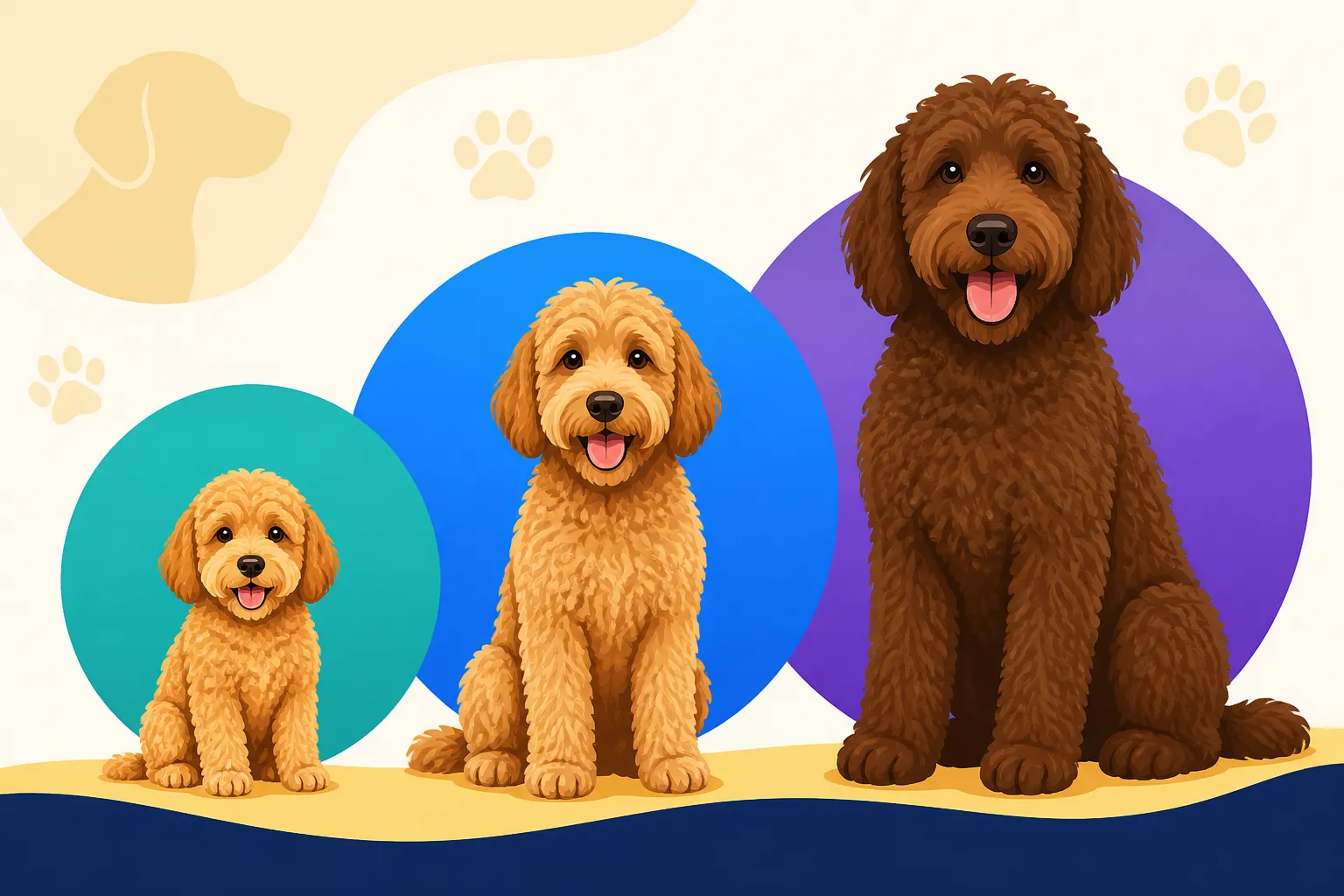
The Three Labradoodle Sizes and How They Are Set
One of the biggest questions I hear from aspiring Labradoodle owners is about size. You see all these adorable puppy pictures, but then you wonder, "Just how big will this furry friend get?" It's a valid concern, because a dog's size impacts everything from the car you drive to the size of their bed, and even how much food you buy from the pet store. This guide is here to untangle the nuances of Labradoodle sizes, from the mighty standard to the charming miniature, helping you understand what influences their growth and how to anticipate the wonderful, full-grown companion you'll have.
Understanding Labradoodle Sizing Categories
When you dive into the world of Labradoodles, you quickly realize that they aren't a one-size-fits-all breed. Unlike purebreds with strict breed standards defining their height and weight, Labradoodles, being a crossbreed (or evolving breed in the case of the Australian Labradoodle), come in a spectrum of sizes. This variation is a direct result of their parentage, primarily the Labrador Retriever and the Poodle, with Poodles themselves coming in Standard, Miniature, and Toy varieties. Reputable breeders typically classify their puppies into three main size categories to help prospective owners know what to expect.
The Standard Labradoodle: A Noble Presence
The Standard Labradoodle is often what people first picture when they hear the name: a substantial, athletic, and friendly companion. These dogs inherit their larger stature from both the Standard Poodle and the Labrador Retriever, both of which are medium to large-sized breeds on their own. The aim is usually for a dog that embodies the sturdy build of a Labrador with the elegant frame of a Poodle.
Typically, a Standard Labradoodle will stand between 21 and 24 inches tall at the shoulder, with some individuals pushing the upper limits depending on their specific lineage. Their weight can range significantly, usually falling between 50 to 65 pounds, but it's not uncommon to see some robust males reaching 70 pounds or even a little more. This size makes them fantastic partners for active families, offering enough presence to feel substantial without being overwhelmingly huge. They need space to stretch out and play, so they thrive in homes with yards or owners committed to regular outdoor adventures.
The sheer physical presence of a Standard Labradoodle makes them feel like a proper, full-sized dog, capable of keeping up on long hikes or jogs. They have a certain gravitas, often moving with an eager, confident stride. Their size also means they can be great candidates for certain types of work, like therapy or assistance roles, where their stature provides a reassuring presence. However, their larger size also means they take up more room on the couch, need a bigger dog bed, and of course, consume more food!
The Medium Labradoodle: The 'Just Right' Option
For many families, the Medium Labradoodle hits that sweet spot – not too big, not too small. This size category often appeals to those who appreciate the Labradoodle's wonderful temperament and low-shedding coat but might find a Standard a bit too large for their home or lifestyle. It offers a more manageable package while still retaining plenty of the classic Labradoodle charm and energy.
Medium Labradoodles typically stand about 18 to 20 inches tall at the shoulder. In terms of weight, you can expect them to fall anywhere from 30 to 45 pounds. This makes them a very versatile size, comfortable in a wider range of living situations, from spacious homes to larger apartments, provided they get sufficient exercise. They are substantial enough to be great playmates for older children but might be less prone to accidentally knocking over smaller tots than their larger counterparts.
Breeders achieve the medium size by carefully selecting parents, often pairing a Miniature Poodle with a Standard Labrador, or by breeding a Standard Labradoodle with a Miniature Poodle (an F1b cross). Sometimes, two medium-sized Labradoodles can produce a litter within this range. The goal is to consistently produce puppies that mature into this popular "middle ground" size. Their more moderate dimensions often mean they're a bit easier to transport, whether in the car for errands or for travel, and they can comfortably fit into more everyday situations.
The Miniature Labradoodle: Compact and Charming
The Miniature Labradoodle is the smallest of the three categories, designed for those who truly need a more compact companion. These delightful dogs bring all the intelligence, affection, and typically low-shedding qualities of the Labradoodle into a much smaller package, making them incredibly popular for city living, smaller homes, or simply for owners who prefer a pint-sized pooch.
A Miniature Labradoodle will generally stand between 14 and 17 inches tall at the shoulder and weigh between 15 to 25 pounds. Some breeders might even produce what they call "Toy" Labradoodles, which are even smaller, sometimes under 15 pounds, by incorporating Toy Poodle genetics. These tiny Doodles are absolutely adorable and can be incredibly convenient for travel, fitting under airline seats or comfortably in carriers.
The miniaturization primarily comes from the Poodle side of their heritage, specifically the Miniature or Toy Poodle. When a breeder aims for a Miniature Labradoodle, they will almost always use a Miniature or Toy Poodle as one of the parents, often crossing it with a smaller Labrador or even a smaller Labradoodle to maintain the desired size. While they are smaller, it's crucial to remember that Miniature Labradoodles still possess plenty of energy and intelligence. They aren't just lapdogs; they need regular exercise and mental stimulation just like their larger relatives, though the intensity and duration might be scaled down. Whether a Miniature Labradoodle Outlives a Standard is a common question, and generally, smaller dogs often do have a slightly longer average lifespan, but health testing remains paramount for all sizes.
The Genetic Blueprint: How Size is Inherited
Understanding how your Labradoodle will grow isn't just about looking at the cute puppy in front of you; it's about delving into the fascinating world of genetics. Your dog's eventual size is largely predetermined by the genes they inherit from their parents, a complex interplay between the Poodle and Labrador contributions, and how those genes are expressed across generations.
Poodle vs. Labrador Influence on Size
The two foundational breeds of the Labradoodle, the Labrador Retriever and the Poodle, bring very different sizing genetics to the table. The Labrador Retriever is quite consistent in its size, generally falling within the medium-to-large category. Males typically weigh 65-80 pounds and stand 22.5-24.5 inches, while females are 55-70 pounds and 21.5-23.5 inches. They contribute a generally sturdy, robust build.
The Poodle, however, offers a much wider range of sizes:
- Standard Poodle: These are large dogs, often similar in size or even larger than Labradors, standing over 15 inches (typically 22-27 inches) and weighing 45-70 pounds.
- Miniature Poodle: Smaller and more delicate, these Poodles are usually 10-15 inches tall and weigh 10-15 pounds.
- Toy Poodle: The smallest, standing under 10 inches and weighing 4-6 pounds.
When you cross these two breeds, you get a spectrum of possibilities. A Standard Labradoodle will typically have a Standard Poodle and a Labrador as parents, combining their larger genes. A Miniature Labradoodle will nearly always have a Miniature or Toy Poodle somewhere in its immediate ancestry to introduce those smaller size genes. This genetic diversity is precisely why Labradoodles aren't consistently sized like purebreds.
The Role of Parental Size and Generation
The most reliable indicator of a Labradoodle puppy's adult size is, naturally, the size of its parents. A reputable breeder will always provide information on the sire and dam's height and weight, as well as their Poodle or Labrador lineage. However, it's not quite as simple as "two medium parents always make medium puppies." Genetic influence can sometimes skip generations or express unexpectedly, especially in earlier crosses.
The "generation" of a Labradoodle also plays a significant role in size predictability:
- F1 Labradoodle: This is a first-generation cross between a purebred Labrador and a purebred Poodle. Size can be the most variable here, as you're mixing two distinct genetic pools directly. You could end up with a range of sizes even within the same litter, from pups leaning more towards the Poodle's size to those favoring the Labrador's.
- F1b Labradoodle: This is an F1 Labradoodle bred back to a Poodle (e.g., F1 Labradoodle x Standard Poodle for larger size, or F1 Labradoodle x Miniature Poodle for smaller size). This cross often aims to solidify certain traits, including size, by reintroducing more of the Poodle's predictable sizing.
- F2, F2b, and Multi-generational (Multigen) Labradoodles: These are crosses of two F1 Labradoodles, an F1 with an F1b, or multiple generations of Labradoodle-to-Labradoodle breeding, respectively. As breeders continue to breed Labradoodle to Labradoodle, they are attempting to create more consistency in traits like coat type and, crucially, size. With multi-generational breeding, especially in Australian Labradoodles, there's a greater likelihood of predictability because the gene pool for "Labradoodle traits" is becoming more established. This is why you often hear breeders speak of Whether an Australian Labradoodle Breeds True; the further along in the generations, the more consistent the outcomes.
Genetic Tests and Predictors for Size
While genetic testing has revolutionized understanding of certain health conditions and coat types in Labradoodles, precise adult size prediction through DNA tests is not yet a perfect science. There isn't a single "size gene" test that breeders can run to definitively tell you if your puppy will be 40 pounds or 60 pounds. What breeders rely on is a combination of factors.
Primarily, they use their extensive knowledge of their breeding lines. They observe the sizes of past puppies from particular pairings, track the growth curves, and understand the genetic contributions of each parent. For instance, if they consistently produce 20-inch dogs from a specific sire and dam, they can make a relatively confident estimate for future litters. They also look at the Poodle parent's specific size (Standard, Miniature, Toy) to gauge the potential for smaller or larger offspring.
While a genetic panel can confirm certain traits like the presence of the furnishings gene (which gives them their characteristic beard and eyebrows), or tests for various diseases, it doesn't give a precise number for future weight or height. Breeders are artists and scientists combined, using their experience, pedigrees, and an understanding of probability to guide their breeding decisions regarding size. They can give you an educated guess, but it's important to remember that nature always has a hand to play.
Factors Beyond Genetics That Influence Growth
While genetics lay the fundamental groundwork for your Labradoodle's potential size, it's not the only story. Environmental factors, particularly during the crucial puppy and adolescent phases, can significantly influence how your dog grows and develops. Think of genetics as the blueprint, and these factors as the construction materials and conditions.
Nutrition and Early Development
Just like children, puppies need proper nutrition to grow into strong, healthy adults. The quality and quantity of food your Labradoodle puppy receives during its rapid growth phases are paramount. For larger Labradoodles, especially, feeding a high-quality large breed puppy formula is often recommended. These formulas are specifically designed with appropriate calcium and phosphorus ratios to support slower, more controlled bone growth. Rapid growth from overfeeding or an imbalance of nutrients can lead to orthopedic problems like hip or elbow dysplasia later in life.
Imagine a Labradoodle puppy from Chewy's excellent selection of large breed puppy foods, getting all the right nutrients. This isn't just about weight gain; it's about the healthy development of bones, joints, and muscles. Underfeeding, on the other hand, can stunt growth and prevent a puppy from reaching its genetic potential. It's a delicate balance; you want steady, healthy growth, not a sprint to maximum size. Always follow the feeding guidelines for your puppy's age and anticipated adult size, and consult your vet if you have concerns about their weight or growth rate. Understanding How Much a Growing Labradoodle Should Eat is foundational to their healthy development.
Beyond the specific type of food, ensuring consistent access to fresh water is also vital for overall health and development. Just like us, a well-hydrated puppy is a healthier puppy. The right nutritional start sets the stage for a lifetime of well-being, directly impacting bone density, muscle mass, and even coat quality, regardless of whether your Labradoodle ends up being a petite miniature or a robust standard.
Exercise and Lifestyle During Growth
It's tempting to want to play endlessly with your energetic Labradoodle puppy, but excessive or inappropriate exercise during their growth phase can have detrimental effects on their developing joints. Puppies have open growth plates in their bones, which are cartilaginous areas that eventually fuse as they mature. High-impact activities like prolonged running on hard surfaces, jumping from heights, or intense, repetitive fetching can stress these soft growth plates, leading to injury or improper development.
For a young Labradoodle, particularly a Standard or Medium size, short, frequent play sessions on softer surfaces like grass are preferable to long, strenuous activities. Structured walks should be limited in duration and intensity, focusing on mental enrichment and gentle physical activity rather than pushing their limits. Your vet can provide guidance on appropriate exercise levels as your puppy grows. Remember, The Exercise Limit for a Growing Labradoodle is a real consideration; it’s about quality over quantity when they're still developing.
Lifestyle factors also include maintaining a healthy body condition score. An overweight puppy, even if it's still growing, puts undue stress on its joints, increasing the risk of orthopedic issues. Conversely, a puppy that doesn't get enough appropriate exercise might not develop the necessary muscle mass to support its skeletal structure effectively. It's about finding that happy medium to support healthy, functional growth.
Health and Hormonal Influences
A puppy's general health plays a significant, though sometimes overlooked, role in its growth trajectory. Persistent illnesses, chronic parasite infestations, or severe malnutrition can all hinder a puppy from reaching its genetic size potential. A healthy immune system and a body free from illness allow all resources to be directed towards growth and development. This is why regular vet check-ups and preventative care are so crucial during puppyhood.
Hormonal influences, particularly those related to spaying or neutering, can also affect a Labradoodle's final adult height. Studies suggest that early spaying or neutering (before growth plates have naturally closed) can delay the closure of these plates, leading to a dog with longer limbs and a slightly taller stature than they might have otherwise achieved. This is because sex hormones play a role in signaling the cessation of bone growth. For larger breeds, some veterinarians now recommend waiting until a dog is more physically mature, often 12-18 months of age, before spaying or neutering, to allow for full skeletal development. Whether Neutering Timing Changes a Labradoodle's Lifespan is a related consideration, with various studies exploring the broader health implications beyond just height.
Rarely, underlying hormonal conditions or congenital abnormalities can also impact growth, causing a dog to be significantly smaller or larger than expected. While these are uncommon, they underscore the importance of choosing a reputable breeder who prioritizes the health of their lines and can provide comprehensive health records for the parents and puppy.
Estimating Your Labradoodle's Adult Size
So, you've brought home that fluffy bundle of joy, and the question looms: how big will they truly get? While there's no crystal ball, you're not entirely without clues. Combining a breeder's experience with general growth patterns can give you a pretty good estimate, helping you plan for your future companion.
Breeder's Estimates and Puppy Characteristics
A good breeder is your first and best resource for estimating your Labradoodle puppy's adult size. They know their breeding lines intimately, understanding the sizes of the parent dogs, grandparents, and previous litters. They've seen how puppies from particular pairings tend to mature, allowing them to make educated guesses. They might tell you, "This litter typically produces dogs in the 35-45 pound range," or "Expect this pup to be on the larger side of a standard." They're not just guessing; they're basing it on observable history.
Beyond the pedigree, observing the puppy itself can offer some hints. Many people will talk about "big paws" as an indicator of a large adult dog. While not a scientific certainty, a puppy with noticeably oversized paws compared to its body might indeed have more growing to do. Breeders also look at bone structure and overall puppy chunkiness. A puppy that seems solid and has thick bones for its age is often on track to be a larger adult. The rate of growth in the first few weeks can also provide clues, with faster-growing pups often ending up larger. Whether a Labradoodle Breeder's Size Estimate Holds is often surprisingly accurate when based on extensive experience.
However, it's vital to remember that these are still estimates. Biology isn't always perfectly predictable. A reputable breeder will be transparent about this, giving you a realistic range rather than a precise number. They should be able to show you the parents and discuss their sizes, offering you as much information as possible to inform your decision.
Growth Charts and Prediction Formulas
For those who love numbers, there are general guidelines and simple formulas often used to estimate a puppy's adult weight. One common rule of thumb is to take a puppy's weight at 16 weeks (4 months) and double it to get an approximate adult weight. For very small breeds, sometimes doubling the 8-week weight is used. Another method involves taking the weight at 6 months and adding half of that weight again.
Here's a simplified example of how such formulas might look (keep in mind these are very general and can vary greatly by individual dog and breed mix):
| Age of Puppy | Multiplier (for estimated adult weight) |
|---|---|
| 8 weeks | Weight x 4 |
| 12 weeks | Weight x 3 |
| 16 weeks | Weight x 2 – 2.5 |
| 6 months | Weight + (Weight / 2) |
It's important to understand that these are broad generalizations and can be less accurate for crossbreeds like Labradoodles, where there's a wider genetic variation. A Labradoodle's growth curve isn't always linear, and some will have growth spurts later than others. Most Labradoodles will reach their full height by 9-12 months of age, but they often continue to fill out and gain muscle mass until they are 18-24 months old, particularly the larger Standard sizes. During this filling-out phase, they become more robust and less gangly.
When a Labradoodle Outgrows Its Breeder's Estimate
Despite all the careful planning, genetics, and formulas, sometimes a Labradoodle surprises everyone and doesn't quite fit the breeder's initial estimate. It's a reality that, while frustrating for owners who had a very specific size in mind, is part and parcel of owning a hybrid dog. Especially in earlier generations (F1 or F1b), where the genetic mix is still quite broad, there can be more variability. You might have been told you were getting a "medium," only for your pup to keep growing right into the lower end of the "standard" range.
This doesn't necessarily mean the breeder was intentionally misleading; it simply highlights the inherent unpredictability that can occur when combining diverse genetics. A Labrador's solid build and a Poodle's varying sizes can create outcomes that fall outside the typical bell curve. Sometimes, a puppy might have a growth spurt later than expected, or perhaps one parent's genetics exerted a stronger influence than anticipated.
The key is to manage your expectations and be prepared to adapt. A dog's size is just one aspect of their wonderful personality. If your Labradoodle ends up a bit larger or smaller than you planned, the most important thing is that they are healthy, well-adjusted, and a beloved member of your family. If you went into the process with a flexible mindset, these slight deviations from the estimate become charming quirks rather than major disappointments.
Practical Considerations for Different Labradoodle Sizes
Choosing a Labradoodle isn't just about picking a cute face; it's about considering how their adult size will fit into your daily life. Each size category — Standard, Medium, and Miniature — brings its own set of practical implications for your home, lifestyle, and even your wallet. Thinking through these aspects beforehand can prevent surprises down the line and ensure a harmonious life with your furry companion.
Living Spaces and Home Environment
The size of your Labradoodle directly impacts how comfortably they'll fit into your living space. A Standard Labradoodle, while not a giant breed, is a substantial dog. They need room to stretch out, play, and navigate without constantly bumping into furniture or feeling cramped. A house with a good-sized, securely fenced yard is often ideal for a Standard Labradoodle, providing them space to burn off energy. While they can adapt to apartment living, it demands an owner highly committed to daily, robust exercise sessions outside the home. Whether a Standard Labradoodle Fits an Apartment truly depends on the owner's dedication to meeting their energy needs.
Medium Labradoodles are much more adaptable. They can thrive in a variety of environments, from larger apartments to homes with smaller yards. Their "just right" size means they don't feel overwhelming in an average living room, but they still have enough presence to feel like a proper dog. They're easier to maneuver in smaller spaces and are generally less likely to accidentally knock things over with an enthusiastic tail wag.
Miniature Labradoodles are the champions of compact living. Their small size makes them excellent candidates for apartments, condos, or homes without large yards. They are much easier to transport, fitting comfortably in crates or carriers for travel. However, it's a common misconception that smaller dogs need less exercise. While they might not need as much space to exercise, they still need regular walks, playtime, and mental stimulation to prevent boredom and destructive behaviors. The main advantage here is that their exercise needs can often be met in smaller outdoor areas or even with vigorous indoor play.
Exercise Needs and Activity Levels
While genetics certainly influence a dog's inherent energy level and temperament, there's a general correlation between size and the sheer volume of exercise a Labradoodle needs to be content. A larger dog typically has longer legs and more muscle mass, meaning they can cover more ground and maintain higher energy levels for longer periods.
A Standard Labradoodle will likely require at least 60-90 minutes of vigorous exercise daily, which could include long walks, runs, hikes, or intense games of fetch. They thrive on having a "job" or a consistent outlet for their energy. Without sufficient exercise, a large Labradoodle can become bored, destructive, or even anxious. Their larger frames are built for activity, and they need that outlet to remain healthy and happy.
Medium Labradoodles, while still energetic, often have slightly more moderate exercise requirements, perhaps 45-60 minutes of solid activity each day. They can enjoy many of the same activities as Standards but might tire a bit quicker or be content with slightly less intense sessions. They are often happy with a good walk and some vigorous playtime in the yard or at a dog park.
Miniature Labradoodles still pack plenty of pep! Don't let their size fool you into thinking they're couch potatoes. They'll need at least 30-45 minutes of daily exercise, which can include brisk walks, indoor games, or short bursts of fetch. They may not run for miles, but they love to be active and engaged. Their exercise often involves more bursts of speed and agility rather than sustained endurance. Regardless of size, all Labradoodles benefit immensely from mental stimulation like puzzle toys or training sessions.
Cost and Upkeep Differences
It’s no secret that owning a dog comes with costs, and a Labradoodle's size can certainly influence the budget. Generally speaking, larger dogs tend to be more expensive to care for simply because they require more of almost everything.
Food is perhaps the most obvious difference. A Standard Labradoodle will consume significantly more food than a Miniature, leading to higher monthly grocery bills. You'll likely be buying larger bags of kibble, perhaps from Chewy, and going through them much faster. Treats, too, will be bigger and used in greater quantities.
Vet bills can also be impacted. Medication dosages are often based on weight, so a larger dog typically requires higher doses, which can translate to higher costs for treatments. Anesthesia for surgeries will be more expensive for a heavier dog, and even preventative medications like flea and tick treatments or heartworm pills are often priced by weight tiers.
Grooming costs, however, are a bit more nuanced. While a Standard Labradoodle certainly has more coat to manage, the primary driver of grooming cost isn't just size, but coat type. A dense, wool-coated Miniature Labradoodle might still cost a pretty penny to groom regularly, potentially as much as or more than a fleece-coated Standard. What a Full Groom Costs on a Wool Coated Labradoodle is a significant consideration, and for any Labradoodle, consistent professional grooming or dedicated home grooming is essential to prevent painful matting. Other costs, like larger crates, bigger beds, and more robust toys, also tend to increase with dog size.
The Importance of Reputable Breeding Practices
When it comes to Labradoodles, size is definitely a practical consideration, but it should never overshadow the importance of health and temperament. A reputable breeder understands this balance and prioritizes the overall well-being of their dogs, regardless of whether they are breeding Standards, Mediums, or Miniatures.
Health Testing for Parent Dogs, Regardless of Size
Perhaps the single most critical factor in ensuring a healthy Labradoodle, no matter its size, is rigorous health testing of the parent dogs. Both the Labrador Retriever and the Poodle are prone to certain inherited conditions, and a responsible breeder will screen their breeding stock for these issues to minimize the risk of passing them on to puppies. This due diligence goes far beyond a quick vet check and involves specific tests for common genetic and orthopedic problems.
For instance, hip and elbow dysplasia are significant concerns in larger breeds, and even Miniature Labradoodles can inherit these tendencies. Breeders should provide OFA (Orthopedic Foundation for Animals) or PennHIP clearances for hips and elbows. Hips and Elbows in a Sixty Pound Labradoodle is a critical concern, and good breeders take it seriously for all sizes. Eye conditions like Progressive Retinal Atrophy (PRA) are common in Poodles, and genetic tests are available to ensure parents are clear. Conditions such as von Willebrand's Disease (a bleeding disorder) and Addison's Disease are also relevant, especially given the Poodle's genetic contribution. Addison's Disease a Labradoodle Inherits From the Poodle can be a serious issue, so testing is vital.
A breeder who cannot or will not provide proof of health clearances for both parent dogs, including genetic testing results and orthopedic evaluations, should be a red flag. These tests are an investment, and they are a clear indicator of a breeder's commitment to producing healthy puppies. Without them, you are essentially buying a puppy with unknown genetic risks, which could lead to heartbreaking and expensive health problems down the line. The Health Tests a Labradoodle Breeder Should Show should always be a non-negotiable request.
Transparency and Communication from Breeders
A truly reputable Labradoodle breeder will be an open book. They won't just tell you the parents' sizes; they'll be happy to discuss their health clearances, show you their facility (or at least provide ample video/photo tours), and answer all your questions about their breeding program. They understand that you're making a significant, long-term commitment, and they want to ensure their puppies go to the right homes.
They should be able to clearly articulate the expected size range for a specific litter, based on the parents and their breeding history. They should also be honest about the potential for variation, especially in earlier generations. Beware of any breeder who guarantees an exact adult weight or height, or who makes promises that seem too good to be true, such as claiming "no shedding ever" or "hypoallergenic for everyone" without proper context. A good breeder will also ask you plenty of questions about your lifestyle, home, and experience with dogs to ensure a good match.
Open communication means discussing the puppy's temperament, its early socialization, and offering ongoing support even after you take your puppy home. A transparent breeder values the welfare of their puppies above all else and views you as a partner in that puppy's future.
Prioritizing Temperament and Health Over Exact Size
While it's perfectly natural to have a preferred size in mind for your Labradoodle, it's absolutely crucial to prioritize temperament and health above the precise number on the scale or tape measure. A dog that is exactly the size you wanted but has significant health issues or a challenging temperament will ultimately bring more heartache and expense than a dog that is a few inches or pounds off your ideal but is robust and well-adjusted.
The Labradoodle was originally bred to combine the intelligence and gentle nature of the Poodle with the eager-to-please, friendly disposition of the Labrador. The Temperament a Labradoodle Gets From Each Parent is a wonderful blend, but individual personalities vary. A good breeder will focus on breeding for sound temperament, ensuring that their puppies are confident, friendly, and trainable, regardless of whether they become a petite miniature or a stately standard.
Think about the bigger picture: you're bringing a family member into your home for potentially 10-15 years. That relationship will be built on companionship, love, and shared experiences, not on whether they precisely fit a certain size category. A healthy, well-socialized Labradoodle with a fantastic temperament will enrich your life profoundly, even if they surprise you by being a little bigger or smaller than you initially envisioned.
Disclaimer
This article is for general informational purposes only and does not constitute professional advice. Laws, prices and regulations vary by location and change over time. Consult a qualified professional for guidance on your specific situation.